
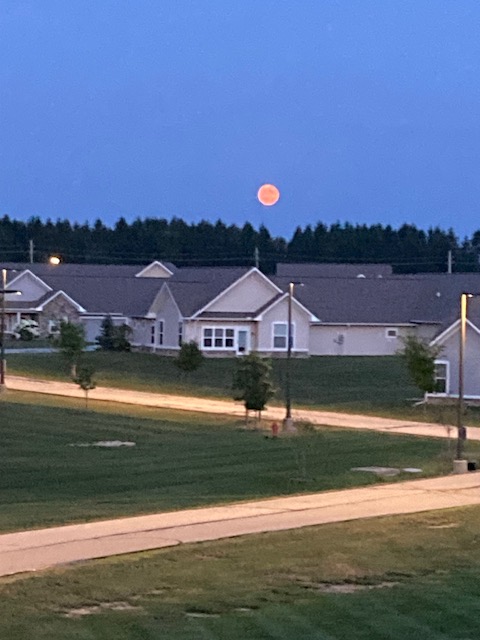
“The heavens declare the glory of God” (Psalm 19:1). They certainly do. Witnessing the red Sturgeon full moon hanging like a jewel in the sky two nights this week, prompts me to write about the phenomena above Earth.
The Moon
The moon has always fascinated people. Its appearance changes as it goes through phases from a delicate crescent sliver to a bright, full disk. And it disappears during a lunar eclipse. Each month’s full moon has a name. The closest celestial body to Earth, the moon causes tides and some say, affects our brains! We sing songs about it like “Moon River” and “Shine on Harvest Moon.”
We speak of the man in the moon, while Japanese see a rabbit formed by the dark areas. Can you see it here?

If you were fortunate, you watched the first lunar landing live. If you missed it, here is a fascinating video of it.
The Sun
The sun, which Earth circles every year, is our source of life as it travels across the sky 93 million miles away. Days when the sun shines perk up our spirits. Our solar system is zooming around the Milky Way Galaxy at about 450,000 miles an hour! Last year we were treated to see a solar eclipse, when the moon passed between the Earth and the sun.
Sunrises and sunsets are arguably the most beautiful sights on Earth.

The Planets
This past Sunday six planets aligned, forming an arc. Four of them could be seen with the naked eye right before dawn. (I forgot to look!) Venus, the planet closest to Earth, can be spotted as the Morning Star or Evening Star.
Gustav Holst composed The Planets. Each of its seven movements is named for a planet. Here is the one called “Jupiter” that expresses abundance of life and vitality. Its seven minutes long.
Stars
Riding across Texas land unlit by electrical lights, I saw a spectacular expanse of stars. What a gift in the night sky! Different cultures discern constellations and create stories to accompany them. There are 88 modern constellations. Arguably the most familiar are the Big and Little Dippers. I can usually spot Orion the hunter because of the three stars that form his belt and Cassiopeia the queen whose stars form a wide “W”.
Meteors
On Monday through Wednesday of this week the Perseid meteor shower peaks. “Falling stars” like these are a sight to behold. Actually they are small rocks or other matter glowing from being heated by speeding through Earth’s atmosphere.
In June a meteorite crashed into a Georgia home. Scientists say it was about 20 million years older than earth.
Aurora Borealis
These colorful northern lights occur when charged particles from the sun collide with gases in Earth’s upper atmosphere. This past year the aurora borealis was visible more south and some lucky people in Ohio saw it. There is a southern borealis too, but it is not as accessible.

Comets
Comets are bright bodies that orbit the sun. They are mainly composed of ice, dust, and frozen gases and may develop long tails. Of course, the most famous comet is Halley’s comet, which will be visible from Earth in 2061. It takes 76 years to circle the sun.

Rainbows
Who isn’t excited to see a rainbow shimmering in the sky? The dispersion of sunlight in water droplets creates a spectrum of color. Sometimes a second rainbow is formed. Several times while flying I’ve seen a pilot’s halo. That is a rainbow encircling the shadow of the plane on top of clouds. It flies along beside the plane.

Clouds
Clouds are masses of tiny drops, ice crystals, or other particles suspended in the atmosphere. There are ten basic kinds. Most of them created by the Supreme Artist add breathtaking beauty to the sky.

Even threatening dark clouds are attractive.

Lightning
Bolts of lightning streaking through a dark sky are awesome. Lightning is a giant spark of electricity caused by negatively and positively charged regions interacting within a cloud, between clouds, or from cloud to earth. Then its heat makes air molecules explode, resulting in a flash and thunder.
• What is the most glorious sky you have seen?








2 Responses
I have always thought that a full moon is one of the most beautiful spectacles in nature. There is just something so serene and solitude in it. The most fascinating sky I have seen was on a drive across the PA turnpike coming home from Reading PA. For just an instant there was a bright flash of light as a meteor struck across the sky. It was so close to the earth you could actually see the ball of fire at the tip with the tail trailing behind. Absolutely beautiful!
You were fortunate to see that meteor. Where I live there are too many lights to see meteor showers like the Perseid one this week. Sigh.