
Ubiquitous Carols
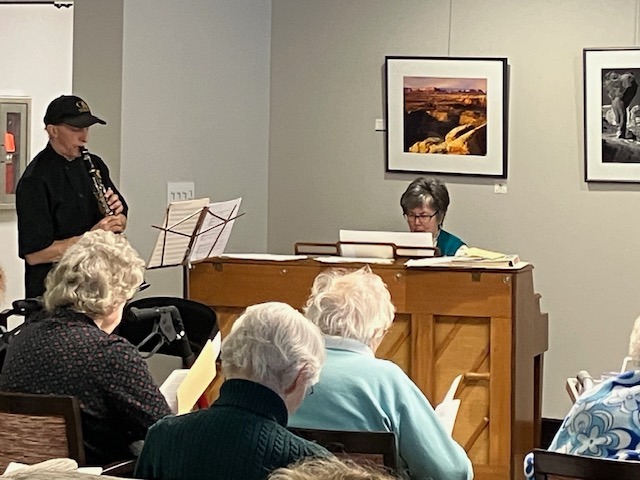
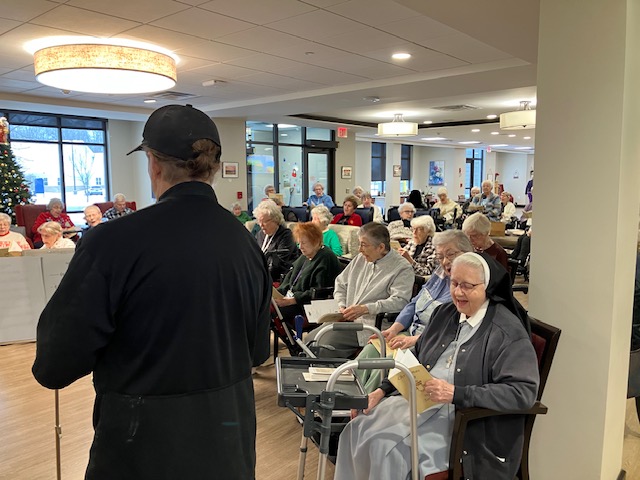
This past Saturday we held our sixth annual Christmas carol sing-along in Notre Dame Village. About sixty residents, both Sisters and lay, had fun. One man, whose son said he never sang, did sing the carols. As usual, the SND baker Richard Harcar played the clarinet, I played the piano, and Sister Lisette played the accordion. Newcomer Sister Olivia also played the piano.
More Carols
That night our convent choir met to practice carols for Christmas Masses. A favorite is the haunting “Mary’s Lullaby.” (I couldn’t find a clear version of it on youTube, so below you’ll find “Breath of Heaven” (Mary’s song) sung by Amy Grant instead, an equally lovely carol.
As a result of all these carols, I decided to research how they became entrenched in our Christmas traditions.
The History
Some pagan songs celebrated the winter solstice. In 129 A.D. the first Christmas carol arose: “Angels’ Hymn,” which celebrated Christ’s birth. For years pagan tunes were given Christian lyrics. St. Francis popularized the Nativity and boosted carols sung in the language of the people rather than in Latin.
It’s been proposed that a carol might have been a dancing song. Or perhaps a type of choral song. Carols were sung at celebrations and church services. The melodies were often folk tunes as early as the 16th century. First passed on orally, carols were written down and published in the 18th century. Carols became popular in the 19th century and more attached to Christmas. When Christmas cards appeared in the 1840s, they often had carols written inside. (Some still do.)
The first collection of carols was published in 1521. Later the Victorians saved them in anthologies.
Classical composers contributed some Christmas carols, notably Part 1 of Handel’s “Messiah.”
Catechisms
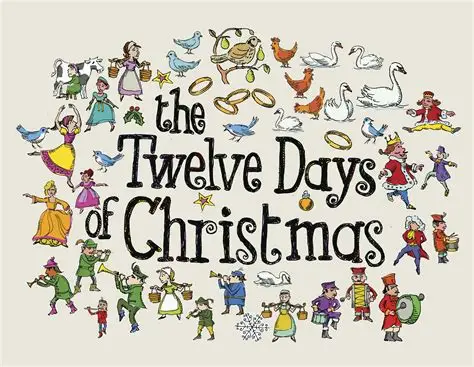
Carols were used to teach religion. There is a theory that “The Twelve Days of Christmas” taught these religious truths:
A partridge– Jesus; 2 turtle doves–Old and New Testaments; 3 French hens–faith, hope, and charity; 4 calling birds–the Gospels; 5 gold rings–the Pentateuch; 6 geese– days of Creation; 7 swans–gifts of the Holy Spirit; 8 maids–Beatitudes; 9 ladies: fruits of the Holy Spirit; 10 lords–Commandments; 11 pipers–faithful Apostles; 12 drummers–truths in the Apostles’ Creed.
(Because I had a hard time playing this one with all the repeats, Sr. Elizabeth Wood stood beside me and helped keep me on track!)
Caroling
Christmas caroling also originated with the Victorians. Groups sang carols outside homes to receive food or money for themselves of charities. This was done on December 21 and Christmas Eve. Charles Dickens had someone sing a carol at Scrooge’s door in A Christmas Carol.
Origin of Certain Carols
“Silent Night” Joseph Mohr, priest, wrote the lyrics in 1818, and his friend Franz Xaver Gruber supplied the melody. The hymn was first sung on Christmas Eve accompanied by a guitar. (This spawned the legend that the church organ was damaged by a flood or mice.)It was sung by both German and British soldiers during the Christmas Day Truce of 1914.
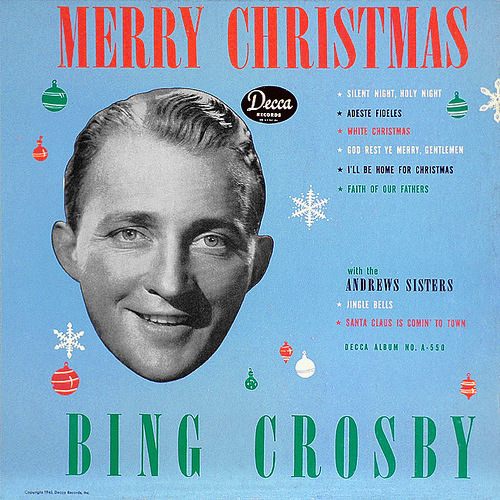
“White Christmas” This carol was first broadcast 18 days after Pearl Harbor on Christmas Day in 1941.
“I Wonder as I Wander” A girl in North Carolina sang an Appalachian folk song. John Jacob Niles paid her to sing it again and filled in the gaps.
“O Little Town of Bethlehem” Phillips Brooks, an American priest, wrote the text after attending Midnight Mass in Bethlehem in 1865. His church organist set it to music. Brooks intended it for his Sunday school.
“God Rest Ye Merry, Gentlemen” This dates back to at least the 16th century.
“Hark! The Herald Angels Sing” Charles Wesley first wrote a version in 1739. A century later Mendelssohn wrote the melody we know.
“Joy to the World” is based in Psalm 98.
“We Three Kings” This is the first popular carol from the United States. John Henry Hopkins, Jr., a clergyman, wrote both lyrics and melody in 1857 for a New York Christmas pageant.
“In the Bleak Midwinter” Gustav Holst and Harold Darke each wrote music for Christine Rossetti’s poem of 1872.
“Rise Up, Shepherd, and Follow” This rousing carol is an African American spiritual.
Have you ever gone Christmas caroling? Did carolers come to your home?
What is your favorite Christmas carol?




7 Responses
Kathleen, I found your refection interesting, inspiring, beautiful, and fun. Thank you for the video of “Mary’s Lullaby.” I love this song too! Merry Christmas! Melannie
Merry Christmas to you, too, Melannie. See you at choir practice!
Beautiful video and informative blog. An addition: I Heard the Bells on Christmas Day was written during the American Civil War by Henry Wadsworth Longfellow as a testament to faith and hope. Merry Christmas!
That is an interesting addition. I didn’t know that. Thank you and Merry Christmas.
Thanks for all your reflections, beautiful song. My favorites are Mary, Did you know and Little Drummer Boy.
Rita – those are 2 of my favorite Christmas songs too!!! 🙂
My pleasure, Rita! There are so many beautiful songs for Christmas. I have a CD of them playing right now.