
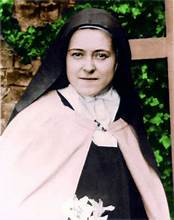
St. Therese of Lisieux captivated the hearts of many people because of her simple, practical spirituality of the “Little Way.” She accepted the fact that she wouldn’t gain heaven by stupendous feats. Not for her the path of the martyr, missionary, or priest. Instead, she soared to heaven by doing little ordinary acts with great love.
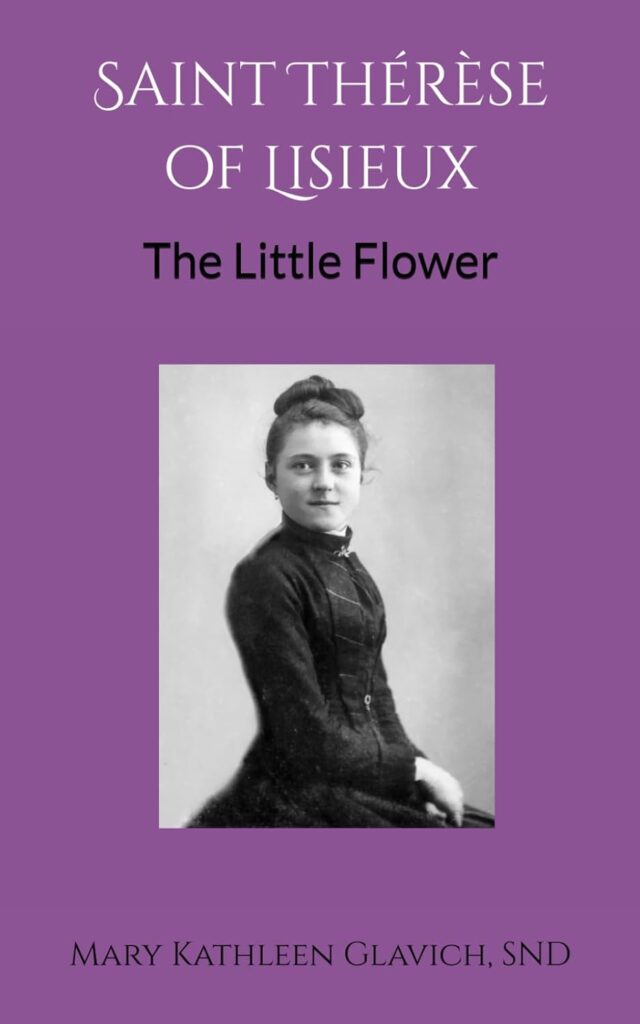
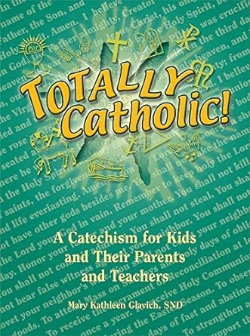
My book on the little saint, who died at age 24, is newly in print. It has quite a few photos of her. (Click on the blue words to see and/or order.) In the course of writing it and by making my annual retreat on her, I learned more about her. Here are some facts I gleaned . . .

Although her parents wished to be religious, that didn’t work out. They met on a bridge and Therese’s mother heard the inner words, “This is the one I have prepared for you.” The couple had nine children but only five girls survived.
Therese was the youngest and pampered. (At school she couldn’t comb her hair because her sisters had always done that for her! ) Her father called her “Little Queen.” As a child, she was super sensitive and cried often. (I could identify with that!)
A Miracle
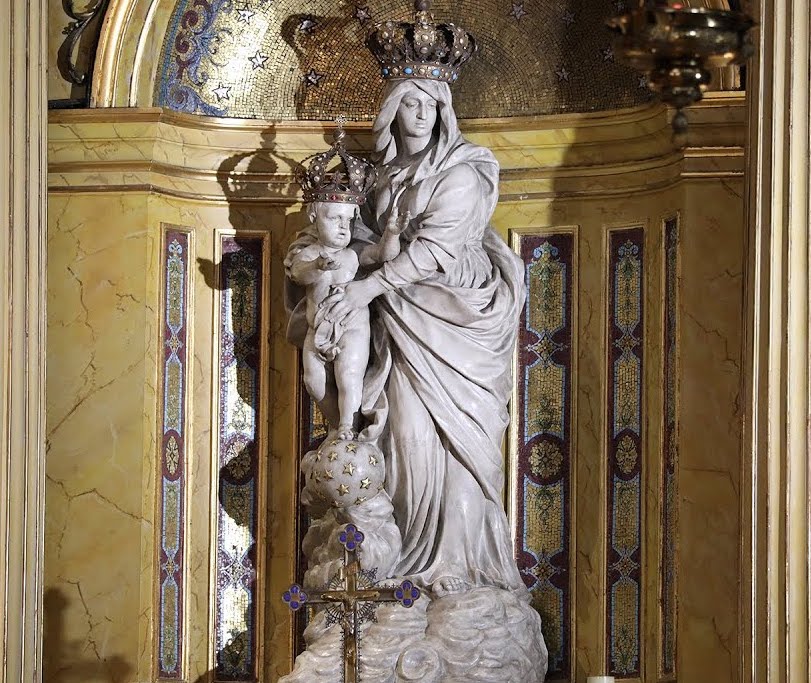
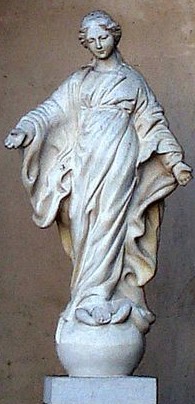
From birth, Therese was sickly. A neighbor nursed her for 12 months before returning her home. At age 10 Therese was extremely ill. Her mother moved her own statue, Our Lady of the Smile, into Therese’s room. Therese saw the statue change and look at her with a radiant face. From that moment, she was cured. Later, thinking that she lied about that statue, she was in turmoil. But then a few years later, praying before the statue of Our Lady of Victories, she realized it really had happened and she was at peace.
Later, at school, not being used to other children, she suffered. They taunted her, and she kept to herself.
One day when her father wasn’t home, she saw him walking in the garden with his face hidden by a cloth. This vision was a premonition of the time he would be in a mental institution and cover his face with a handkerchief because he was humiliated.
Therese’s goal was to rescue sinners. When a murderer was to be executed, she prayed for his conversion. Nevertheless, he didn’t repent. But then at the scaffold, he asked for the priest’s crucifix—a sign to Therese that her prayers for him were heard.
Therese’s Vocation

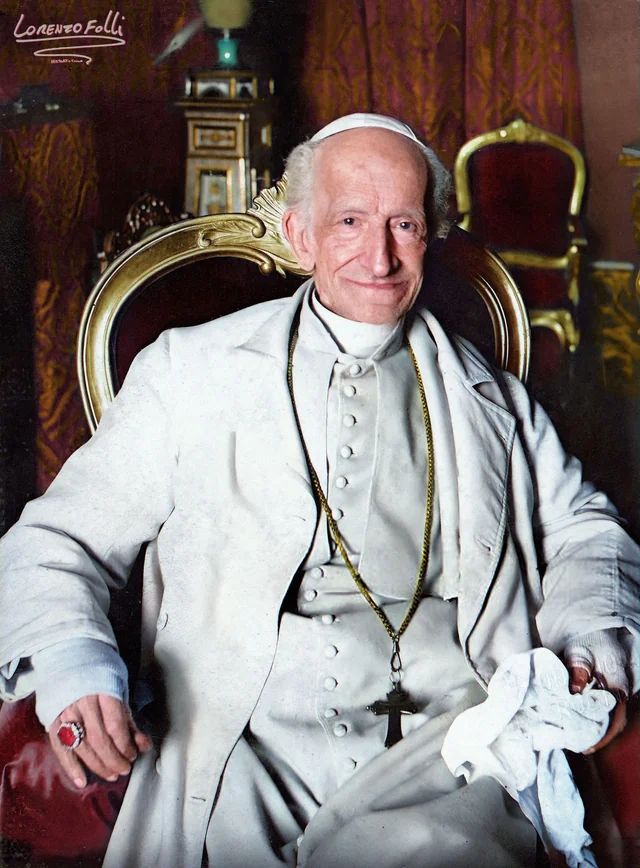
When Therese was four, she lost her mother and adopted her sister Pauline as her mother. After Pauline entered Carmel, Therese decided she wanted to be a Carmelite too. When she was fourteen, various people, such as the convent prioress and the bishop, refused her request to enter. So her father took her for an audience with Pope Leo XIII. To look older, she put up her hair.

Although the visitors were warned not to speak to the pope, just receive his blessing, Therese grasped his hands and asked for him to permit her to become a Carmelite. He said to do as the superior say. Finally she did enter when she was fifteen.
As a Carmelite

Therese prayed for and wrote to two missionary priests, which satisfied her longing to be a missionary.
Aiming to show God love in everything, she practiced self-control. When a sister splashed her with laundry water, she didn’t complain. Another example: when a sister praying in chapel kept clicking her teeth, Therese didn’t turn and stare at her. She also practiced being content with things that were not the best.
A woman of many talents, Therese wrote poetry and plays. In her play about St. Joan of Arc, she played Joan. Also, she created intricate liturgical vestments, a gift no doubt inherited from her mother, a lace maker.
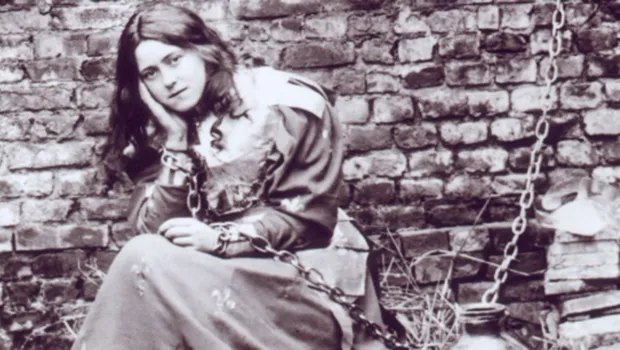
One day Therese realized “My vocation is love.” She wanted all her actions to show love for God.
At others’ request, she wrote the story of her life in three parts, which became the popular book called The Story of a Soul.
Three of her sisters were Carmelites with her. For a time, Pauline was her prioress. Another sister joined a Visitation community.
Last Days

Therese suffered from tuberculosis at a time when people didn’t known how to treat it. Unfortunately the doctor didn’t immediately recognize she had the disease, and in the end gave her mercury medicine that only increased her pain.
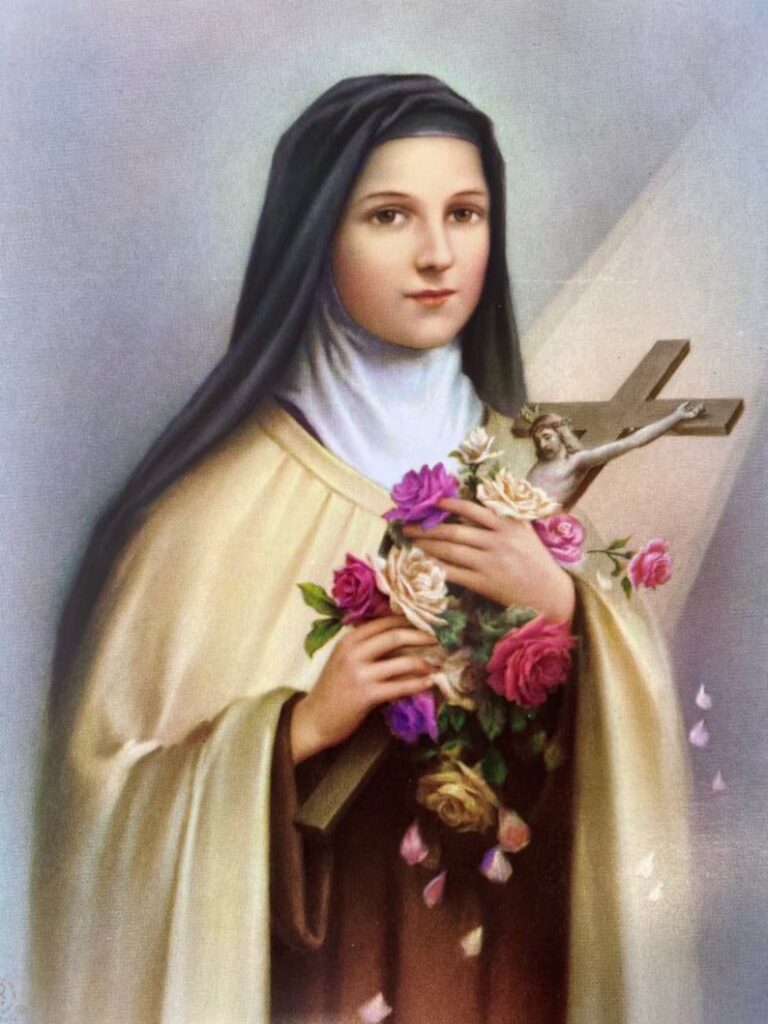
Before dying, she promised to let fall a shower of roses from heaven. Many people attest to her powerful intercession as they received answers to their requests. A short prayer to her is “Little Flower, in this hour, show your power.”
After being buried in a local cemetery, Therese’s body was exhumed and now is interred in the Carmelite chapel. A crowd of about 30,000 accompanied the body along the walk to the chapel. A wax figure modeled on how she looked in death lies atop the reliquary.
In 1997, the Holy Father declared Therese a Doctor of the Church when there were only two women Doctors: St. Catherine of Siena and St. Teresa of Avila. Now St. Hildegarde of Bingen joins the group.
This year, 2025, is the 100th anniversary of St. Therese’s canonization.
St. Teresa of Calcutta chose to be named for this “little flower,” not the big St. Teresa of Avila. Therese saw herself as a little flower. She wrote, “God willed to create great souls comparable to lilies and roses, but He has created smaller ones, and these must be content to be daisies or violets.” In addition she noted, “If every tiny flower wanted to be a rose, spring would lose its loveliness.”

Like St. Teresa of Calcutta, St. Therese experienced periods of dryness and a feeling of being abandoned by God. She compared herself to Jesus’s toy or ball that he sometimes leaves alone, and she accepted this.
This website has interesting information about the basilica of St. Therese in Lisieux.
• Have you ever prayed to St. Therese? Did you read her autobiography?
• What fact about her life was new to you?





2 Responses
Dear Kathleen,
Thank you for this beautiful reflection on St. Therese. I have loved her since I was a little girl. At my confirmation, I took the name Theresa in honor of her. I was happy when her feast day was changed from Oct. 3 to Oct. 1, because Oct. 1 is my baptismal date. One thing new for me: your story of that lovely statue “Ou Lady of the Smile.” Keep writing your inspirational blog! Melannie
I didn’t know you were a Theresa, Melannie. Unlike you, I was sad when St. Therese’s feast day was changed because my brother’s birthday is October 3! Thanks for your comment.