Just Who Are the Laborers?
 Jesus’ exhortation in Sunday’s Gospel “ask the Master of the harvest to send out laborers for his harvest” usually is interpreted to mean pray for more priests, deacons, and women and men religious. But look at the context of his words. Jesus is sending out seventy-two disciples. None of these followers are priests or consecrated religious and probably most of them won’t be. Every person who believes in Jesus is called to labor for his cause. By our baptism we all assume the responsibility to spread the good news of salvation and bring others to Christ.
For too long the duties of the laity were limited to praying, paying, and obeying. We’ve forgotten that all Christians are also to be relaying. We are to continue the work of Jesus and tell people about the kingdom of God. A friend who went to Catholic school with me became a Jehovah’s Witness after two of them appeared at her door and spoke with her. Personal contact makes all the difference in the world! (more…)
Pray Always and Pray All Ways
 At first glance St. Paul’s exhortation to pray always (1 Thessalonians 5:16–18) seems to be a mistranslation. Maybe what he really said was, “Pray a lot.” Praying ALWAYS is a mental impossibility. When I’m writing a book, for instance, my mind is 100% focused on the ideas I’m typing, not on God. The only way I can think of to pray always is to make all our daily activities a kind of prayer-in-action by consecrating our day to God by praying the Morning Offering.
We can, however, weave thoughts and words to God throughout the day in various ways. In addition to the customary morning, meal, and evening prayers, we can send “arrow prayers” to God at odd moments. We can pray while engaged in things that don’t require much thought like washing dishes, driving with cruise control, or weeding the garden. We can also adopt little tricks that trigger our mind to think of God. (more…)
Perseverance Pays Off!
 Lately I’ve been receiving lessons on perseverance. The most dramatic one was the incredible victory of the Cleveland Cavaliers with odds against them. After a 52-year drought, they clinched the NBA championship to the delight of their many diehard fans. Closer to home, I could not get the DVD player to work with the new television equipment that was installed recently. Last night I tried one more time and bingo. . . it worked! The other day I was telling someone how difficult it was to market my books. I prefer spending my time writing. He said, “Don’t give up. Keep trying.” I came across this quotation: “If you do nothing to market your book, do you know what you’ll get? Nothing.” (more…)
The Bible: You’ve Got Mail, Part 2
 Here is an excerpt from Chapter 2 of my latest book, Praying with Scripture.
Come to the Bible, not to study the history of God’s action, but to be its object; not to learn what it achieves throughout the centuries and still does, but to be the subject of its operation. ~ Jean-Pierre de Caussade, S.J.
There once was an elderly lady in Scotland who was very poor, even though her son had become a wealthy man in America. Neighbors, who charitably supported the woman, wondered why her son had apparently forgotten her. One day they questioned her about this. The mother stood up for her boy. She said, “Every week he writes me and sends a little picture. See,” she said, opening her Bible. “I keep them in here.” Stashed inside her Bible were hundreds of U.S. bank notes. Ironically the pages of the woman’s Bible held much wealth, but she was unaware of it.
Just as the woman’s Bible contained a hidden gift, so our Bibles hold hidden treasures for us. The Bible is one of the greatest gifts that God has bestowed on us. With it, we can not only survive but live an enriched and enriching life.
The Bible is defined as “the Word of God in the words of human beings.” God deigned to communicate with us through our means of communication, the written word. We believe that God moved certain Jewish and Christian people to reveal truths about him and our faith clothed in their own language and style of writing. Because God moved the minds and hearts of these people in this way, we acknowledge God as the author of the Bible. (You could call God the Holy Spirit the ghostwriter.) The words in Scripture are “inspired,” that is, God-breathed.
We can also say that God compiled the Bible. For centuries people debated which books were to be included in the canon, or official list of sacred books. In 1546, at the Council of Trent, the Holy Spirit guided the councilors to recognize definitively which books of Scripture were divinely inspired. We trust then that the Bible is God’s Word, and, if so, God is present in Scripture in some mysterious way. That is why St. Augustine could say that we should place ourselves before the Scripture of God as though we were before the face of God. In Scripture, God lives.
Therefore, reading the Bible and listening to it proclaimed bring us in touch with God. God broke into our lives and revealed himself in the form of Jesus, called the Word made flesh. With Scripture, God also chose to communicate to us through the words of a book.
The Bible is like a toll-free number for God that results in instant communication. It’s free. You’re not put on hold, and there’s no busy signal. Best of all, there’s no cold answering machine chanting, “Hello, this is God. I’m not in my office now, but . . . “
The Bible even has a 911, an emergency number. It is Luke 9:11, which reads, “When the crowds found out about it [that Jesus was in Bethsaida], they followed him; and he welcomed them, and spoke to them about the kingdom of God, and healed those who needed to be cured.” Like Jesus, the Bible welcomes us, speaks to us about the kingdom or God, and, yes, has power to cure those who need to be cured.
Scripture has other things in common with Jesus:
- Scripture is both human and divine.
- It can be misunderstood.
- Sometimes either its human nature or its divine nature is over-emphasized.
The Power of God’s Word
We see God’s Word at work at the very dawn of creation. According to Genesis, the first book of the Bible, God spoke and everything was created. Out of chaos came order and beauty. God merely said, “Let there be light,” and there was light.
Then at God’s subsequent commands the universe and an astonishing variety of creatures appeared. The millions of twinkling stars in the sky, our beautiful plant Earth, immense oceans, jagged snowcapped mountains, as well as the trees and flowers that grow in your own backyard—all are the result of God’s Word. Most awesome of all, God’s Word summoned us human beings into existence. It is not just a coincidence that in Hebrew the word for “speak” doubles as the word for “create.”
Actually the Word predates creation. From all eternity the Son of God in the Trinity is the Word of God. Theologians attempt to explain the unexplainable, the strict mystery of the Trinity. They say that the Son is begotten by and proceeds from the Father as an act of the divine mind. The Father’s reflections about himself are expressed as Word, similar to the way our thoughts are expressed in words. But because God is so great, infinite, his Word, unlike ours, is a Person equal to him in divinity.
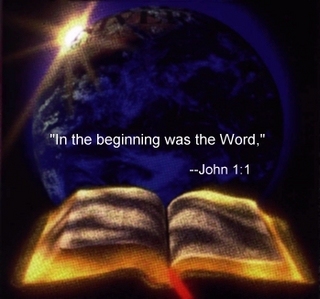
The opening verses of John’s Gospel clearly associate creation with this eternal Word: “In the beginning was the Word, and the Word was with God, and the Word was God. He was in the beginning with God. All things came into being through him, and without him not one thing came into being” (John 1:1–3).
Because Jesus, the Word made flesh, is God, his utterances are God’s words. What happened when Jesus spoke? At his word the blind could see, the deaf could hear, lepers were healed, sinners were forgiven, and the searching learned about God and the meaning of life. When Jesus spoke, roaring winds and towering waves died down, plain water transformed into excellent wine, and bread and fish multiplied to feed thousands. At Jesus’ word, even a man dead for four days walked out of his tomb.
A Roman centurion realized the potency of Jesus’ word. When his servant was sick, this man of faith pleaded with Jesus, “Only speak the word, and my servant will be healed” (Matthew 8:8). The servant was cured—and from a distance.
We come in contact with this same almighty Word whenever we read or hear the words of Scripture. They, too, have power to heal, change, guide, comfort, and give life. As one saint put it, Scripture tills the soil of your soul. Then God’s life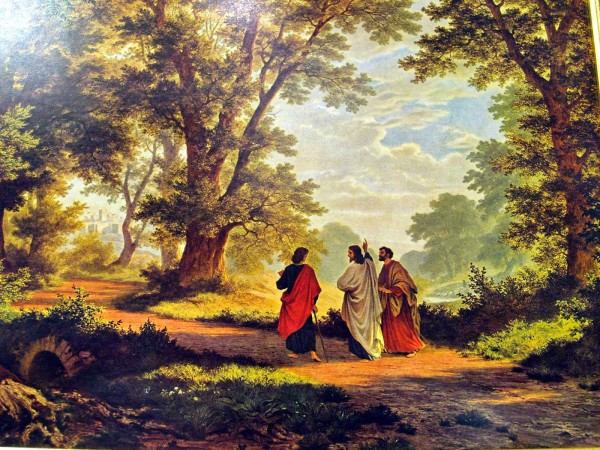 can grow in you and you can bear fruit.
In With Hearts Burning, a book on the Eucharist, Henri Nouwen explained how Scripture operates. He points out that, like a sacrament, the Word of God makes present what it indicates. Merely hearing God’s Word can change us. Nouwen refers to the two disciples who were on the way to Emmaus after the crucifixion. They had lost all hope, until a stranger (who was really the risen Lord) joined them. When he interpreted Scripture for them, the disciples’ hearts burned within them. They experienced the Lord’s presence. (Luke 24:13–23)
Likewise for us, the full power of the Word does not lie in how we apply it after we have heard it. The transforming power of the Word does its divine work as we listen. When we listen well, then our hearts too will burn within us, for we are in the presence of Jesus.
St. Ignatius of Loyola discovered the mighty power of words. When he was a soldier recuperating from battle wounds, he asked for some books to read. The castle library did not contain books like John Grisham’s or James Patterson’s novels. However, a life of Christ and the lives of the saints were available. Reading those books turned the soldier’s life around and inspired him to become St Ignatius, the founder of the Jesuits and the master of spirituality.
God describes the effectiveness of the divine word though the prophet Isaiah:
For as the rain and the snow come down from heaven,
and do not return there until
they have watered the earth,
making it bring forth and sprout,
giving seed to the sower and bread to the eater,
so shall my word be that goes out from my mouth;
it shall not return to me empty,
but it shall accomplish that which I purpose,
and succeed in the thing for which I sent it.
(Isaiah 55:10–11)
What concept presented here touched your heart in a new way?
Praying with Scripture: The Bible—You’ve Got Mail!
 It occurred to me that I am free to post excerpts from my books on this website. (This will give me additional time each week to write more books!) So here is the Introduction from my latest book: “Praying with Scripture: The Bible—You’ve Got Mail!” . . .
I would like so much for all Christians to be able to comprehend “the surpassing worth of knowing Jesus Christ” through the diligent reading of the Word of God, for the sacred text is the nourishment of the soul and the pure and perennial source of the spiritual life of all of us. ~ Pope Francis
Providentially I began the first version of this book on September 30, the feast of St. Jerome. This was very fitting because this priest and Doctor of the Church spent years in a cave in Bethlehem translating the Bible into Latin, which was then the language of the people. His Bible is known as the Vulgate. Through Jerome’s efforts back in the fourth century, God’s Word became accessible to all.