Praying about Memories

Last week my nephew Andy videotaped my sister and me recalling our experiences growing up in our house on Donald Avenue and the people who made up our family, immediate and extended. This trip down memory lane was a lovely experience. It unearthed events that I had long forgotten about. My sister and I remembered different things. By coincidence, in a homily last week, Pope Francis spoke of the value of treasuring memories. They can be a great source of prayer. So how do we let our memories inspire prayer? We replay them in our minds, aware of the presence of God as we do so. (more…)
Your Choice
As of today, I have written 217 posts for this blog. This week I am on vacation, and so I invite you to select any of my previous posts to mull over. I’ll be back next week, God willing!
Pondering the Year of Mercy Logo
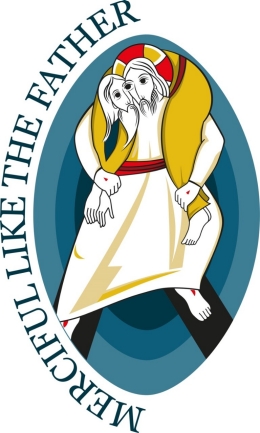
The logo in honor of the extraordinary jubilee year of mercy, designed by Father Marko Rupnik, S.J., is in the style of an icon. This means that all of its elements symbolize something. Learning about the significance of these various parts can deepen our understanding of this year established, “in hopes that a new flood of mercy will flow over the world.” In case you aren’t aware of the meaning of icon features—and if you haven’t been introduced to the mercy logo already,—here is some information. The two figures stand for Christ, who has the halo, and “Adam” or humanity…us. Christ carries the person over his shoulders the way a shepherd carries a sheep. This obviously refers to the Good Shepherd, Jesus who rescued the human race that had gone astray. The Divine Shepherd laid down his life for his sheep. The black slats Jesus stands on in the logo remind us of the cross. The wounds in his hands and feet are scars from his redeeming sacrifice. The redemption of the world is the greatest act of mercy God ever performed.
Some people interpret Jesus carrying the man to stand for the Good Samaritan. Just as the Samaritan went out of his way to care for the man robbed and beaten and left at the side of the road, Jesus took care of us after we were attacked by Satan.
A strange thing about the two persons is that they share one eye. This indicates that Christ communicates himself to us and so now we can see things as God sees them. This is the definition of wisdom: seeing things as God sees them. The man’s mouth is very close to Christ’s. It’s been said that as Christ expired on the cross, human beings inhaled his breath and obtained new life. This echoes creation, when God breathed into man and he became a living being.
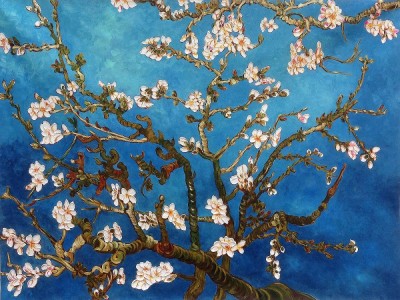
The mercy icon is almond shaped for several reasons. The almond shape is standard in iconography and used around Christ and later Mary and the saints. It is called a mandorla, which is from the Italian for “almond.” When two circles overlap, the part where they merge has the shape of an almond. This represents the divine nature and the human nature that are merged in Christ. An almond tree blooms early and is therefore a sign of life, of new beginnings. Thanks to God’s mercy, we have a second chance to live with him in bliss forever. The painter Van Gogh painted almond branches to honor the birth of his nephew and gave this masterpiece to his brother. In Hebrew the name for almond means “watching.” We, the redeemed who live in the last age, are watching for the next coming of Christ.
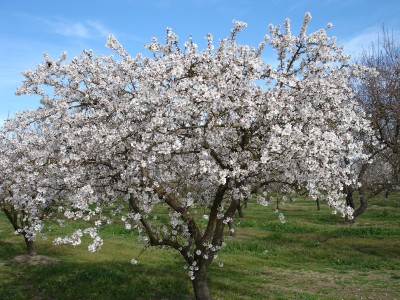
One of my favorite poems is by Nikos Kazantzakis:
I said to the almond tree,
“Sister, speak to me of God,”
and the almond tree blossomed.
The three blue concentric almond shapes range from light on the outside to dark. This can stand for the spiritual journey to God, in which we are led to the “dark night” where we experience God in unfathomable mystery. On the other hand, the blue shapes can be seen as going from dark on the inside to light, symbolic of Christ’s leading us out of the darkness of sin and death and into eternal light.
Speaking of the color blue, colors in icons have specific meanings. Blue stands for humanity; red for blood, life, and divinity; and white for the light of Christ. Gold, naturally, is a color for divinity. Notice in the mercy icon, the man wears a gold robe. Because of Christ, we are able to be like God.
The words on the icon, “Merciful like the Father,” are from Luke 6:36. (Luke’s Gospel is called the Gospel of Mercy.) Jesus tells us that we are to be merciful as the Father is merciful, which is the motto for this special jubilee year. But in the context of the icon, the words can mean that Jesus is merciful like the Father. He is the face of God’s mercy.
If this has whetted your appetite for studying more icons. I recommend the icon of Our Lady of Perpetual Help. It is a visual representation of Mary, the Mother of Mercies. We can run to her for help like Jesus does in the picture at the vision of his future execution: so fast that his sandal falls off. He grasps his mother’s hand for comfort and safety.
What work of mercy have you performed recently? What do you plan to do?
Below is a recording of the Year of Mercy hymn with English verses.
A Book, Books, and THE Book: The Power of Words
 I just finished reading The Little Paris Bookshop, an international bestseller. It’s a delightful novel about a man who sells books from his “The Literary Apothecary” located on a barge. He has a gift for “reading” people and presenting them with just the right book to meet their needs. The book is a love story on many levels as well as a travel book as the man makes his way through France. Any word-lover will savor the language in this book: “a man with a leathery skin like an iguana’s,” “the countryside beneath glittering stars and red summer moons,” “hair like coarse flax on a spindle,” cats’ “tails bristling like scrubbing brushes,” “weeping willows trailed their branches in the water like playful fingers,” “thinking felt like wading through treacle,” “wallowing in our happiness like roast beef in gravy.” The book conveys the lesson that books have the power to change lives. This lesson has been borne out in the lives of several notable people like Ignatius of Loyola. When he was a soldier recuperating from serious wounds, no romantic novels were available, so he read The Life of Christ and a book on the lives of the Saints. Those books set him on the path to being one of the greatest saints himself. A friend of mine became a Catholic after reading Thomas Merton’s Seven Storey Mountain. (more…)
Easter Eggs, Easter Candle, and Easter Joy
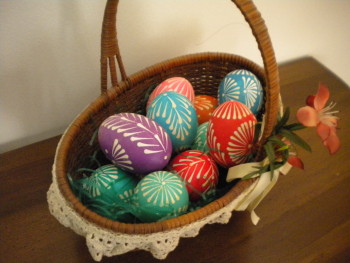 A few weeks before Easter, my mom melted beeswax in a coffee can lid. Then she dipped a straight pin inserted in a wooden matchstick into the wax and quickly made strokes on eggs the way her Polish mother taught her. The eggs sat in coffee cups overnight, soaking in vivid colors of Chick Chick dye. Then Mom scraped off the wax with a butter knife, revealing lovely white patterns.
Eggs are associated with Easter because they are a symbol of life. A chick pops out of a seemingly lifeless egg. And Jesus emerged from a tomb with a new and glorious life. His rising was more than resuscitation. Jesus came forth from the tomb no longer bound by space or time but with an entirely new mode of existence. More than 500 people saw him. Other Easter symbols stand for new life: the prolific rabbit, the rising sun, and spring flowers. (more…)