Do You Bring Gifts for the King?
 When my friend from Abu Dhabi first visited, she brought me frankincense from Yemen in a box carved in Arabia. You can see it in the picture. The slightest touch leaves the resin’s pungent fragrance on your finger. On Epiphany we celebrate “little Christmas,” the day Magi (wise men) from the East paid homage to the new king. They brought him the gift of frankincense, too, along with gold and myrrh. These are viewed as symbolic of the divinity, royalty, and mortality of the newborn baby respectively. (You’ve probably seen the cartoon pointing out that three women would have brought much more practical gifts, such as diapers.) Because there were three gifts, we infer that there were three Magi. Actually there might have been more. Tradition even names the trio: Caspar, Melchior, and Balthazar. To celebrate Christmas, we give each other gifts. It occurred to me that it would only be right and courteous to give the birthday boy a gift too. It’s not too late. Scripture scholars think that the Magi arrived much later after the birth of Jesus. Notice Matthew’s Gospel said they went into the “house” not the stable or cave.
Here are three gifts you might consider presenting to Jesus.
1. Lacking expensive gifts, the drummer boy in the Christmas carol gave Jesus his talent. He played the drum for him. Each day we can do something special and offer it to Jesus. Like what? Maybe you don’t feel like doing a certain task, but you take control of yourself and do it anyway. Maybe you have a sudden craving for the fudge leftover from Christmas, but you hold your craving in check and save the fudge for tomorrow. You might call or visit a person who would love to hear from you. Or maybe you exercise a talent you have and have ignored for awhile, such as painting a watercolor picture or crocheting an afghan. Then each night, along with considering the blessings of the day, you might reflect on the specific thing you did that day to honor Jesus.
2. Arguably the best present the Magi gave Jesus was their presence. We can imagine the difficulties they endured traveling from their country in the east to Bethlehem. They left their families and friends, did not know where they were going, and spent days riding camels across the desert and rocky terrain. We can make it a point to be present to Jesus each day. So what if we have a mountain of work facing us? So what if we are tired or depressed? Taking time to pray can be a valuable gift we offer. We might go to the trouble of celebrating an extra weekday Mass and offering praise and thanks for salvation
3. The star led the Magi to Jesus. Mary recently has been given the title “Star of Evangelization.” A gift Jesus would really appreciate is our bringing someone to him. We could invite someone to church with us, talk about our faith, read the Bible to someone, or volunteer to teach religion at our parish. In this year of mercy, you might forgive someone. Your love might be the catalyst that brings them closer to Jesus.
Twelve Magi trivia: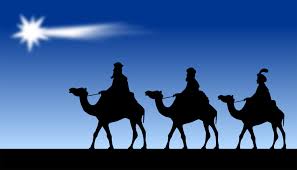
1. Some Eastern Church traditions hold that there were twelve Magi.
2. The Magi were probably followers of Zoroaster and as such delved into astrology, which was considered a science.
3. The Magi were “transformed” into kings based on Psalm 72:11 — “May all kings fall down before him.”
4. It is thought that our customs of kneeling and prostrating originated with the Magi bowing and doing the child homage.
5. Balthazar is often depicted as young and dark-skinned.
6. Our word “magic” is derived from “Magi.”
7. The Magi are considered saints and perhaps martyrs.
8. The carol “We Three Kings” was written by the Episcopalian deacon John Henry Hopkins, Jr., about 1857 as part of a pageant he wrote for his nieces and nephews.
9. Several theories have been proposed to explain the brilliant star. These range from “it was miraculous” to “it is a feature of Matthew’s pious fiction.”
10. The Magi were warned in a dream to go home by another route to evade Herod, just like St. Joseph was warned in a dream.
11. Chinese Christians believe that one Magi came from China.
12. The three traditional names have been traced back to a Greek manuscript from about the year 500.
What gift will you give the newborn king?
Turning over a New Leaf in 2016: Revelations and Resolutions
 I’m sure you’ve had the experience of suddenly realizing you have misunderstood something for a long time. For example, a friend of mine thought that in the Christmas song “Reindeer pause” was “Reindeer paws” until it dawned on her that reindeer have hooves not paws. Just as I began pondering this new blog, I had the revelation that turning over a new leaf does not refer to a leaf on a tree but rather the page in a book! Here at the brink of the new year we have the opportunity to write a new chapter in our life story. It is the traditional time to make resolutions. I prefer to think of it as a time to set ONE important goal that I will really concentrate on. (Too many goals tend to be forgotten. Plus it’s discouraging when you fail to reach them!) On a website I discovered five tips for setting a good or SMART goal: (more…)
Angels on High and on Earth
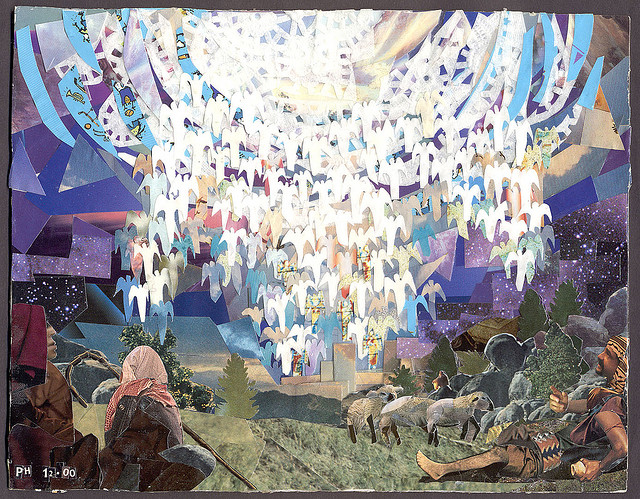 The Christmas story is replete with angels: The Angel Gabriel delivers the startling news to teenage Mary that she was chosen to be the Mother of God. An angel (probably Gabriel) breaks the life-changing news to Joseph, her espoused, in a dream. At the birth of Jesus, an angel sends shepherds to find a savior in a manger, and then a host of angels appear and praise God. An angel directs Joseph to flee to Egypt, and later an angel tells him it’s safe to return home.
Sometimes we speak of people turning into angels when they die. That isn’t true. Angels are a whole other form of being. They are pure spirits with no bodies. In heaven we will still have bodies but glorified ones. Moreover, angels are magnificent, awe-inspiring creatures, wiser, stronger, and more beautiful than we are. Ironically, because of the incarnation, angels now worship Jesus, who is human as well as divine. Although we can never really be angels, we can be angelic on earth by doing three things angels do.
First, angels are worshipers. That is number one in their job description. In heaven angels constantly proclaim, “Glory to God in the highest.” When we praise God alone or with a host of other people, when we sing the Gloria and the Holy, Holy at Mass, we are like angels—albeit without halos. Besides praising God in word and song, we can offer God our deeds as acts of praise. We praise God for who he is. We praise God for the wonderful things he has done for us. What can you praise God for today?
Second, angels are messengers. They tell people what God wants them to know. In particular, they proclaim the Good News. In fact, the word evangelist is based on the word angel. In this world where so many people are in need of hope, we can speak to them the consoling words that God loves them. Prisoners, the addicted, the afflicted, the needy and perhaps someone in our own family can be heartened by a  message of Good News from our lips. To whom can you share the Good News today?
Third, angels are vessels of God’s love and mercy. After Jesus was tempted in the desert, angels ministered to him. When he was enduring the agony in the garden, angels comforted him. In the Old Testament, when the prophet Elijah flees to the desert for his life and wants to die, an angel brings him food. In the Acts of the Apostles, when the apostle Peter is imprisoned, an angel comes at night, unshackles him, and leads him out. Certain angels called guardian angels are charged with protecting us. How can you be a ministering angel today?
One day I was delivered late to the sprawling Atlanta airport. After getting a ticket, I had no idea where to board the plane. The ticket agent said, “Follow that man. He’s going to the same terminal.” The young man, who had his little nephew in tow, led me to the train and to the right terminal. Then, because I was going to miss the plane, he took my carry-on and told me to run up the escalator to the gate. A few minutes later, as I stood in line for the plane, which luckily had been delayed, he caught up and handed me my suitcase. “You’re an angel!” I proclaimed.
Every day people act like angels. Who has been an angel in your life?
Would you like to know more about angels? You might read my book The Catholic Companion to Angels (ACTA Publications). It comes with three different covers because the publisher couldn’t decide which one to put on!
Christmas Cards: A Chore or a Chance

A friend of mine spends Christmas Day writing her cards. For one thing, this spares her from re-mailing cards to people who have moved. Another friend sends his cards in July. That way his card gets more attention and also reminds people of the Savior in the summer. Whether you purchase Christmas cards or create them yourself, Christmas cards can be a way to spread the Gospel, the Good News of Jesus, at Christmas time. Although a card with a cute reindeer or a lovely snow scene may be appealing, art and a Scripture verse related to the nativity event keep the focus on Christ. Likewise for stamps. Fortunately religious stamps are still available for Christmas. Do you decorate your envelopes with stickers? Why not use religious ones for this religious feast day? Since we pay almost a half a dollar to send each card, we can get our money’s worth by tucking something inside, such as a small flat gift, or a Christmas prayer or reflection. We might also give the gift of our time and write a note on the card or a duplicated letter with a personal note added. After all, Christmas might be the only time we are in touch with most people. Don’t you appreciate cards more when they include more than a signature? Writing others at Christmas gives more joy to those who receive our cards.
What about the many Christmas cards we receive? Display them for sure: Stand them on shelves or tape them around doorways. Each day your family might take one card and say a prayer for the person or family who sent it. Save photo cards in a special album. Recycle other cards by sending them to an organization that can use them. Here is one: St. Jude’s Ranch for Children Recycled Card Program, 100 St. Jude’s Street Boulder City, NV 89005. The children make new cards from all kinds of greeting cards and sell them to raise money for various programs. Send only fronts of cards that have blank backs. Cards from Hallmark, Disney, and American Greetings can’t be used.
You might recycle cards yourself by using them to make your own cards, gift tags, bookmarks, coasters, place mats, place cards, or jigsaw puzzles. Another option is to cut out pieces from them and use them to decorate gift boxes and scrapbooks.
A bit of history: Christmas cards originated in 1843 in Victorian England. In those days, people were obliged to answ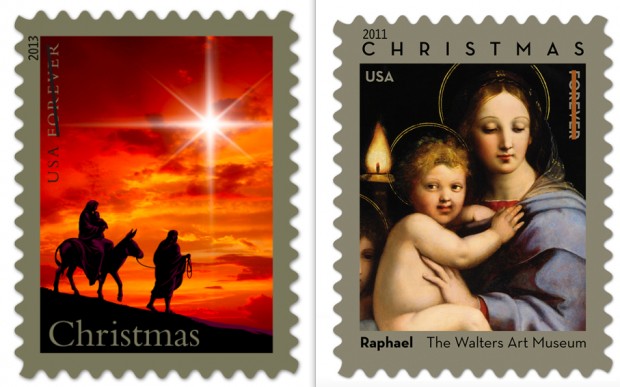 er letters. Sir Henry Cole received a daunting stack of letters at Christmas because he had many friends. In addition, postage was only a penny! To solve the problem of answering all of these letters, he hired J.C. Horsley, an artist, to paint a Christmas picture. Cole had this picture printed on stiff paper and sent out a postcards. In 1915, a company that would become Hallmark, realized people wanted more room to write, so the posted cards were replaced by book-like cards. By the way, notice that on both sides of Cole’s original card are scenes of people helping the needy.
What special Christmas card customs do you have?
St. Nicholas aka Santa Claus in the Year of Mercy
 On December 6 we celebrate the feast of St. Nicholas, when I hold my annual party for local convents in the tradition of my religious community. We inherited this celebration from the Sisters in Holland who helped form us German Sisters of Notre Dame. The feast entails gingerbread bishops, apple tarts, oranges, popcorn balls, bags of goodies, the singing of “St. Nicholas Day” and “Jolly Old St. Nicholas,” and a prayer to St. Nick.
I was introduced to this feast my first year in the convent, when we usually had silent meals. Suddenly at supper, a figure with a miter and crosier appeared at the door and a creature clothed in black slithered around the floor, hitting our legs with branches. These were St. Nick, who rewarded the good, and Ruprecht, who punished those who did wrong. (Neither of these come to my party!) Through the centuries, St. Nick, a generous bishop, evolved into the gift-giver we know as Santa (Saint) Claus (short for Nicholas). St. Nicholas makes a perfect patron saint for this year of mercy that Pope Francis declared.