Blessed Virgin Mary, an Advent Figure
 During Advent, Mary, John the Baptist, and Isaiah take center stage. Primarily we focus on Mary as we wait for Christmas, for she waited for nine months to welcome her son into the world that day. How well do you know your mother? Take this quiz and then check out the answers below.
1. Why is blue Mary’s color?
2. Did Mary read the Old or New Testament?
3. While Jesus walked hundreds of miles, Mary was a homebody. True or false?
4. What is Mary’s commandment?
5. What words of Gabriel to Mary became the motto of Ohio?
6. How long did Mary stay with Elizabeth?
7. What was the punishment for becoming pregnant before marriage?
8. Do Muslims honor Mary?
9. What name did Jacques Marquette, S.J., the explorer of the Mississippi River, give to it?
10. What did Pope Saint John Paul II do with the bullet the doctors removed from him after the assassin’s attack?
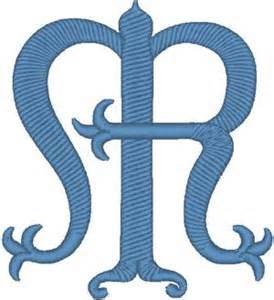
Can you see the letters M-A-R-I in the monogram for Mary?
Answers:
1. Mary’s clothes were earthen tones. Blue dye was expensive. Later when artists depicted Mary they made her clothing blue, which was the royal color of an empress. Blue also suits Mary because apparently it is God’s favorite color, used lavishly in the sky, oceans, and lakes.
2. Mary didn’t read Scripture at all because she was illiterate. Women in her day were not educated. Neither were they obliged to pray as men were.
3. Mary traveled a great deal. The journey from Nazareth to the village where Elizabeth lived was 92 miles. Then, when she was nine months pregnant, Mary went to Bethlehem, which was about 70 miles away. (Martin Luther commented that artists give Mary a donkey, the gospels don’t. In those days men rode while women walked, though I can’t imagine Joseph letting Mary walk.) From Bethlehem, Mary went to Egypt, a hundred mile trip, and if the Holy Family went to Alexandria, a Jewish settlement in Egypt, that was another two hundred miles. Then the family returned to Nazareth. Each year they went to Jerusalem for the Passover, which was about 63 miles. When Mary’s son was preaching she followed him to Capernaum and no doubt to other villages.
4. At the wedding feast of Cana, Mary says, “Do whatever he tells you.”
5. “Nothing will be impossible with God.”
6. Three months. Mary helped with meals, fetching water, and doing laundry. The two women talked together about their sons and sewed items for them.
7. Death by stoning.
8. The Koran contains more about Mary than the Bible. She is the only woman mentioned by name and is one of eight people who has a chapter named for her. Muslims regard Mary as a righteous woman and believe in the Virgin Birth and Mary’s sinlessness. Some mosques are named for her.
9. The River of the Immaculate Conception, which refers to Mary being preserved from sin when she was conceived.
10. The Pope was attacked on May 13, the day of Mary’s first apparition at Fatima. Incredibly the bullet zigzagged in him in such a way that it missed vital organs. The Pope credited Mary for his survival and send the bullet to be placed in her statue’s crown in Fatima.
These and other facts are in The Catholic Companion to Mary. SPECIAL DEAL: During Advent this $10.00 book can be purchased from me with free shipping. Just mail a check to Kathleen Glavich, SND,; 4237 Bluestone Rd.; South Euclid, OH 44121.
What is your favorite image of Mary? Why?
Christ the King, My King
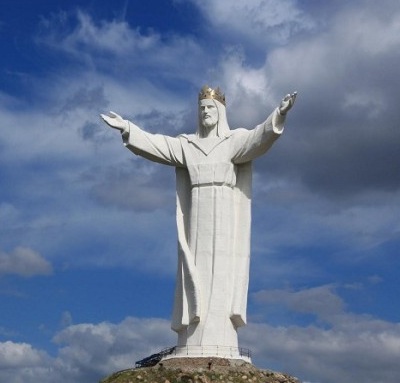 Kings have gone out of style. Mostly we use the term king for a man who excels at something, for example, King James (LaBron) is a great basketball player and a prom king is the most popular boy in high school. Scroll back a few centuries and kings were powerful rulers of countries who made laws, commanded armies, and levied taxes. The feast of Christ the King, which closes out the liturgical year, was established in 1925. It celebrates that Jesus is King of heaven and earth.
Jesus was crucified on the charges that he claimed to be King of the Jews. In reality, because Jesus is God, he not only is King of the Jews but king of the whole universe. When Pilate asked Jesus if he were king, he didn’t deny it. At the end of the world, Christ will come in glory and his kingdom will be fully established. The Book of Revelations offers a figurative image of him. He is called Faithful and True and rides a white horse. On his robe and thigh is the name “King of kings and Lord of lords.” (more…)
The Art of Listening . . . to Others and God
 Last week a workman was explaining a new carbon monoxide detector to me. When I said, “I don’t know where there’s another outlet,” he said, “You’re not listening. I said it doesn’t need one.” This made me wonder how many other times I wasn’t listening and what I was missing because of it. Usually when I’m listening with only one ear it’s because I’m planning the next thing I’m going to say. I don’t like it when people don’t listen when I’m speaking. Did you ever have the experience of having someone walk away while you were talking to them? Or looking around the room to see who else was there instead of giving you their undivided attention? Or did you ever make a comment that was ignored and then someone else says it and gets the credit? Not listening to someone sends the message that you don’t consider what they say important, and worse, you don’t consider that person important. Listening has to be one of the best ways to show love. (more…)
The Power of Memory
The November issue of Smithsonian carries an article about two scientists who added a false frightening memory to a rat’s brain. The rat then reacted with fear although it was in a safe box. Having located the source of our memories promises to yield discoveries that will help with Alzheimer’s and PTSD. Imagine if memories of horrible events could be obliterated! I don’t think I would risk tampering with my memories. They can be a blessing or a curse. Sure, some are painful, but they all contribute to making me who I am today. (more…)
Mindful of Our Deceased Loved Ones
 At our parish in November, the month of the poor souls, we write the names of deceased loved ones in a book. This year there is a new twist. Our pastor invited us to bring pictures of our departed relatives and place them on the window sills of the church. The pictures will surround us, reminding us that these people are with us celebrating the Eucharist. They are still present and loving us, although they are invisible. They exist in another dimension, one that we too will be slipping into one day. As holy as these people were on earth, there is no guarantee that they are in heaven (unless the Church has canonized them). Therefore, we don’t call them saints, but poor souls. My friend, a monsignor who was reader for my writing, preferred the term “holy” souls. He pointed out that the people in purgatory were not really poor because they were not in hell. They are just undergoing purification before living with God. They do not yet feel worthy to appear before their all-holy Creator who loves them. (more…)