Mindful of Our Deceased Loved Ones
 At our parish in November, the month of the poor souls, we write the names of deceased loved ones in a book. This year there is a new twist. Our pastor invited us to bring pictures of our departed relatives and place them on the window sills of the church. The pictures will surround us, reminding us that these people are with us celebrating the Eucharist. They are still present and loving us, although they are invisible. They exist in another dimension, one that we too will be slipping into one day. As holy as these people were on earth, there is no guarantee that they are in heaven (unless the Church has canonized them). Therefore, we don’t call them saints, but poor souls. My friend, a monsignor who was reader for my writing, preferred the term “holy” souls. He pointed out that the people in purgatory were not really poor because they were not in hell. They are just undergoing purification before living with God. They do not yet feel worthy to appear before their all-holy Creator who loves them. (more…)
The Power of Little Things Makes a Big Difference

Once when I was in charge of the songs for a retreat Mass, things went very wrong. I came too late to begin the opening song, I started one song too high, and so on. After that fiasco, I sat in the chapel feeling ashamed and miserable. As the other sisters filed out, one of them gave my shoulder a little squeeze. Suddenly things weren’t so bad . . . because of that little gesture.
(more…)To Be a Saint or Saintly Sinner
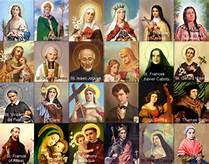 Since we are approaching the feast of the halloweds (the saints), I’ve been musing about sainthood. One of my favorite prayers as a teenager was, “O God Who art all powerful, make me a saint.” Some people exclaim, “I’m no saint,” yet we are all called to be saints. As French novelist Leon Bloy pointed out, “The only real failure in life is not to be a saint.” If we are not saints by the time we die, then we will have a miserable eternity. In view of our weakness, faults and temptations around us, being holy may appear farfetched, for some impossible! Keep in mind, though, that saints were sinners too—they had “tilted halos”— yet they loved God and others. The canonized saints are to serve as models for us, although the martyrs’ path to sanctity is not very appealing. The uncanonized saints, some of whom we rub shoulders with, may be easier to imitate. (more…)
The Rosary: Gospel on Beads
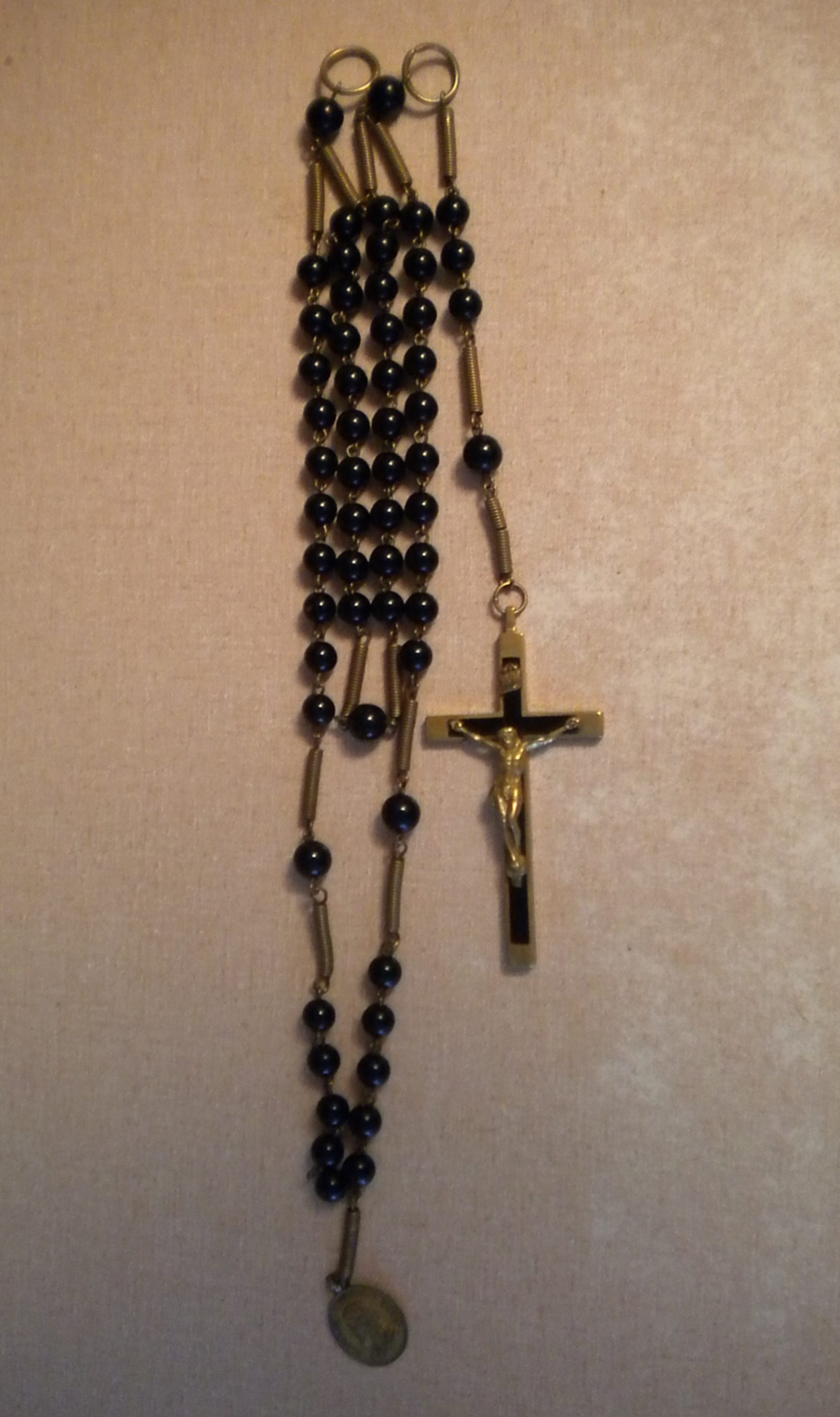 This week I saw the rough sketches for my next book, which is about funny stories from Sisters of Notre Dame classrooms. I suggested that the artist add a large rosary to the drawing of a Sister and e-mailed this photo of the one I used to wear. Although the rosary no longer hangs from our waist, warning students that we are approaching, we still pray it everyday. It is a powerful prayer, and one that Mary urged us to pray when she appeared at Fatima. She prayed it with Saint Bernadette at Lourdes (except for the Hail Marys!). In fact, after the catastrophe of September 11, Pope John Paul II asked us to pray the rosary for peace. October 7 is the feast of Our Lady of the Rosary, and the whole month is dedicated to this beloved prayer. It’s a good time to renew the practice of praying the rosary. It is not old-fashioned but ever new because while we say the formula prayers, we mediate on Gospel events.
I like to tell this story, which is quoted here from my book The Catholic Companion to Mary:
“A university student sitting on a train next to an old man praying the rosary remarked, “I don’t believe in such silly things. Take my advice. Throw the rosary out of this window and learn what science has to say.” “Science? I don’t understand,” replied the man. “Maybe you can explain it to me.” The student offered, “Give me your address and I’ll send you some literature.” Fumbling in his pocket, the old man drew out his business card. The boy looked at the card and burned with shame. It read, ‘Louis Pasteur, Director of the Institute of Scientific Research, Paris.’ ”
The rosary came about when illiterate people couldn’t pray the 150 psalms. They began to pray 150 Our Fathers. This evolved into 150 Hail Marys (Mary’s Psalter). Saint Louis de Montfort wrote a book called The Secret of the Rosary. In it he stated, “If you say the rosary faithfully until death, I do assure you that, in spite of the gravity of your sins, ‘you will receive a never-fading crown of glory.’ ”
Rosaries are not just for hanging on rear view mirrors, wearing around the neck, or holding in the hand when our body is in a coffin! They are meant to be prayed in honor of our Blessed Mother. People pray the rosary on beads they received for First Communion, on ten-bead bracelets and rings, or on their fingers, which conveniently number ten. Families pray the rosary together; some people pray it when they can’t fall asleep. Pope Francis prays the rosary when he takes a break—sometimes three rosaries a day. He finds it restful.
If you’ve forgotten how to pray the Rosary, you can pray along at the website www.comepraytherosary.org. To teach children about the rosary, there is the reproducible book The Rosary: The Gospel on Beads for Grades 2–6, which can be found in my Bookstore.
When has the rosary meant a lot to you? Do you have a special rosary?
The Challenge of Spontaneous Prayer
 A Catholic convert from an evangelical tradition asked me this week, “Why don’t Catholics pray spontaneously?” This is a good question. My friend proposed that it was because no one taught us to offer personal prayers out loud. I wonder, though, how it happened that our Christian brothers and sisters find it so easy to do, and we Catholics don’t. The closest thing we come to it is saying “God bless you” when someone sneezes. When asked to offer a prayer, we feel tongue-tied and self-conscious. Yet, imagine if instead of just promising someone, “I’ll pray for you,” we stopped and right then and there spoke to God about the person’s concerns. That person would be consoled and strengthened by hearing our prayer—and we wouldn’t risk forgetting to pray for him or her. (more…)