No Bed of Roses for Saints
 Writing a book on saints, I’ve come to realize how much they have suffered. You would think that a person who lived a good life and loved God would be blessed with a peaceful, easy life. So often this wasn’t the case. Instead of enjoying a charmed life, saints endured conflict, criticism, persecution, not to mention bad health. Sound familiar? If this is the story of your life at times, take heart. You must be doing something right! Recall when St. Teresa of Avila was riding a mule and ended up sitting in mud. She prayed, “If this is how you treat your friends, no wonder you have so few!” Jesus did warn us that in following him we could expect persecutions and a share of the cross. (more…)
Saints, Human Like Us
What is your concept of a saint? Do you think of someone pale and sickly, serious (if not downright grim), dressed in religious garb and living in caves or on clouds? Actually the saints had their feet on the ground. They were not all angels, although angels are included in the term “saints.” Saints were human like us. We are to imitate them, but how can we imitate someone we can’t identify with? In the course of time, stories about saints’ lives became exaggerated as the authors tried to emphasize the saints’ holiness. (This happens with other heroes too, like George Washington whose legend of chopping down the cherry tree serves to illustrate his truthfulness.) One example of this idealized biography, known as hagiography, is the story of St. Christina the Astonishing. Supposedly she died at age 22 and during her funeral, she left her coffin and flew to the church rafters. (more…)
What’s a Saint? Canonization?
In the comic strip “Wizard of Id” the king once asked a monk, “Any chance of ever being canonized, Padre?” The monk replied, “The closest I could hope for is to be shot out of a catapult.” The canonization of two contemporary popes has raised questions about sainthood. Why and how does the Church declare certain people in heaven? The practice began with the martyrs. Dying for the faith was a sure sign of sanctity. The early Christians honored the tombs of the martyrs in the catacombs. They celebrated the day of death (birth into heaven) as a feastday. After the persecutions stopped, Christians seeking to be holy took to the deserts to practice prayer and penance, sometimes called “white martyrdom.” In addition confessors proclaimed the faith and possibly suffered for it. The faithful bestowed the title of saints on some of these people. The first documented papal canonization didn’t occur until 973. In 1234, it became papacy’s task alone. (more…)
Visions of Jesus
A former prostitute turned her life around and became involved in church. She claimed to have visions of Jesus. Once during a woman’s retreat while Father Jim was speaking, she called out, “Father Jim, I see Jesus. He’s standing right next to you.” Calmly the priest replied, “Now we all know that Jesus is with us. Some of us can see him, and some of us can’t.” Then he went on with his talk.
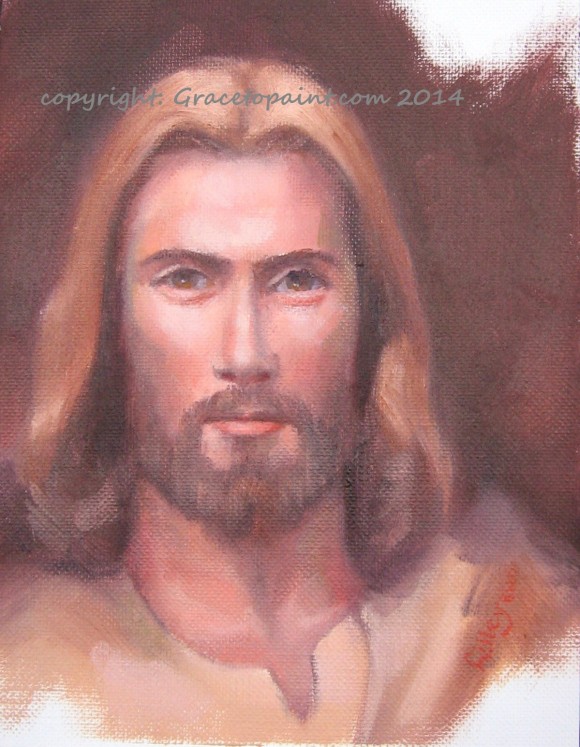
The Jewish people did not make images, which to them could easily become idols, so we do not know what Jesus looked like. There is the mysterious Shroud of Turin, which may or may not give us clues. But we really can only speculate about the God-Man’s appearance. Because Jesus was a first-century Jewish man, we can surmise that he was about 5’4”, tan, and had black or brown hair and brown eyes. (Scripture tells us, though, that his ancestor King David had auburn hair!) Jesus must have looked like his countrymen, or he wouldn’t have been able to melt into a crowd. And in the garden, Judas would not have had to kiss Jesus to identify him.
Some people think that because Jesus was the Son of God, he was strikingly handsome. Others refute that, quoting Isaiah 53:2 which states, “He had no form or majesty that we should look at him, nothing in his appearance that we should desire him.” As a construction worker, Jesus must have been strong and muscular. As an itinerant preacher who lived outdoors and walked for miles, he must have been tough. He also must have been gifted with a powerful voice. No doubt, Jesus greatly resembled his mother, Mary, who was the source of all of his DNA.
No matter what his physical appearance, Jesus had a charisma that drew people to him. The apostles, martyrs, and Christians throughout the last 2,000 years have devoted their lives to him.
We might wish that we could see Jesus as the apostles and others who walked with him did. Most saints in later centuries were not gifted with visions of Jesus. Like them, we will have to wait until we die to see Jesus face-to-face and enjoy the Beatific Vision. In the meantime, we count on his words, “Blessed are those who have not seen and yet have come to believe” (John 20:29).
Imagine that Jesus, the risen Lord, stands before you, gazing on you with love. What would you say to him?
Life as a Test
Star Trek fans might recall my favorite episode in which aliens test a woman to see if her race is worthy of saving on another planet. The woman is an empath, someone who can absorb the suffering of others. Her test is to take on the pain of Dr. McCoy when he is dying, and thereby give her life for his. She passes the test. This theme echoes the situation we are in. We are each given a certain number of days on earth to prove that we deserve to live in eternal bliss in another world. The fallen angels failed their test. Our first parents, representing the human race, also failed their test. Thanks to the mediation of Jesus, we have the chance to retake it.
Some people are fortunate to have short tests. Saint Therese of Lisieux, for example, only lived for twenty-three years. Others have tests that last for decades.
Teens cram for SAT tests. We prepare for our life tests by studying Jesus and the saints (who aced their tests), the Scriptures, and what the Church teaches. Jesus has provided us with a cheat sheet. In a parable he explains that to be rewarded with entry into the kingdom we are to feed the hungry, give drink to the thirsty, welcome the stranger, clothe the naked, and visit the imprisoned. God has even given us each a personal mentor, a guardian angel to suggest the right answers.
Catholic school children were known to pray during tests, “Holy Spirit, Lord of Light, help me choose the one that’s right.” This Person of the Trinity is in charge of our sanctification. We can call upon the Holy Spirit for supernatural assistance as we go through life’s tests.
The tests are often difficult multiple choice tests: which course of action will you take? Some tests are identification: what is truth? Some tests in life are like stress tests: how do you endure suffering? Other tests are like driving tests: how good are you at following the rules? Pop quizzes are the norm: how will you act on the spur of the moment? Each test in some way measures love, love of God and love of others. St. John of the Cross stated that at the end of our lives we will be judged on love. Jesus, the Teacher, will look over the story of our lives (our essay test) and evaluate it. Ultimately, there are no grades for our lives, no B+’s or D’s. We either pass or fail.
Some people (like St. Ignatius) have found a daily examination of conscience, a self-evaluation, helpful in deepening their spiritual life. If you have too, how do you carry it out?