Presenting the Face of Jesus
No doubt you’ve heard of the 80-year-old woman in Spain who recently turned a valuable fresco of Jesus into an unrecognizable blur. The thought occurred to me that this is a metaphor for what we sometimes do. We attempt to be Jesus for the world–other Christs. Our intentions are good. But then we make a mess of things. The Gospels give us a true picture of Jesus. He was patient, kind, forgiving, wise, loving, and good. Is that what people see when they look at me? Not always! A work of art is the result of a combination of talent and plain hard work. To be a Christian, a genuine likeness of Christ, we who are baptized have the potential. The sanctifying power of the Holy Spirit with all his gifts is at work in our hearts. However, the task still requires effort on our part.
A Sunny Morning Outlook
 My mother used to wake up my sister and me by singing, “Oh, I hate to get up in the morning (3x)..it’s so nicer to stay in bed.” Then she would open the venetian blinds. Lately I’ve been echoing these words as day after day Superstorm Sandy brought dreary weather to Cleveland. I once heard we should spring out of bed as though it were on fire. These dark mornings the bed has been more like quicksand, sucking me in. So I’m generating some thoughts to motivate me. First of all, I’m still alive after a night of sleep, called the “little death.” Good! A new day stretches before me. What nice surprises will it hold? (I believe in self-fulfilling prophecy. Thinking positively results in positive events.) Blessed Charles de Foucauld had a wonderful attitude worth imitating. He used to pray, “Lord, one more day to love you!” (more…)
Saints Walk Among Us
Sometimes it’s pointed out that “we stand on the shoulders of giants.” We also rub shoulders with giants and may not even realize it. On the Feast of All Saints we celebrate all people who have made it into heaven, whether they’ve been officially canonized or not. It’s pretty obvious that Mother Teresa and Padre Pio are holy persons. But there are plenty other human beings who are unrecognized saints. They weren’t awarded Nobel prizes for taking in the dying, and they didn’t suffer the stigmata, the bloody wounds of Jesus. In fact, today we live with saints. They may be family members, neighbors, or co-workers who quietly live with love and integrity as Jesus taught. (more…)
How to Be a Gentleman or Gentlewoman
In his book The Idea of a University Blessed John Henry Cardinal Newman defined a gentleman as “one who never inflicts pain.” (Of course, this also holds true for a gentlewoman.) I was going to write about what this means, but in checking to see if I remembered his words correctly, I discovered that this holy man already had unpacked the definition. To paraphrase some of his thoughts: A gentle person prevents others from being embarrassed. He or she avoids upsetting people by clashing with their ideas or causing them to feel restrained, suspected, sad, or resentful. The gentle person tries to put everyone at ease and feel at home. This means approaching others in a way attuned to their personality: being tender to the shy, gentle to the distant, and merciful to the foolish. (more…)
Mary, a Helpful Mother
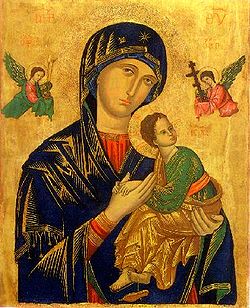
(Teachers: See patron saint questions at end of this post. Click on “Read more.”) In our church a painting of Our Lady of Perpetual Help is in a front niche usually where her statue stands. It is an icon, symbolic art regarded as a door to the sacred. Icons are an acquired taste. Appreciation for them can develop much as an appreciation for spinach. (more…)