Mary Calls Us to Lent
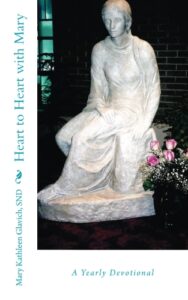 These days I am busy preparing to give a three-day parish mission on our Blessed Mother entitled “Mary Calls Us to Lent.” My aim is twofold: 1) to convince the parishioners to pray to Mary as their God-given loving mother and powerful intercessor and 2) to inspire them to imitate her as the first and best Christian. Because my mind is focused on the Mother of God today, this post includes an excerpt from my new book Heart to Heart with Mary: A Yearly Devotional. It is the reading for Wednesday, January 31. The realistic statue of Mary on the cover is in our chapel at the provincial center. I love how she looks—not like a distant goddess but like a simple, approachable woman, someone you can converse with and pour out your heart. (more…)
Mountains, Real and Metaphorical, in Spirituality
 On the way to Germany, when we flew over the Alps, a Sister with me had tears running down her face as she gazed at the beauty spread out below us. Mountains are awe-inspiring. No wonder people imagined their gods living on a mountain. For example, the Greeks and Romans believed their gods dwelt on Mount Olympus. Mountains play a role frequently in the Bible. Noah’s ark settles on Mount Ararat, God orders Abraham to take Isaac up a mountain and sacrifice him as a test of faith, Moses receives the Commandments on Mount Sinai and dies on Mount Nebo, God speaks to the prophet Elijah on a mountain, and the Temple is built on a mount. Today that Temple Mount is holy to Christians, Jews, and Muslims. The psalmist, because of a mountain’s solid endurance, calls God a mountain. God says in Isaiah, “Though the mountains may fall, my steadfast love will never leave you” (Isaiah 54:10). Hikers are drawn to climb mountains like Mt. Everest. Scaling a mountain is a daunting challenge. My sister and I accepted the challenge when we undertook the strenuous walk up Diamond Head mountain in Hawaii. Part way up was a rest stop where several hikers gave up and turned back. But Nancy and I doggedly continued on until, shaky and out of breath, we reached the summit. There the stunning view made the grueling trip worthwhile. In life we are confronted with invisible mountains that test our stamina and faith:
A worker is given a project that looks overwhelming, even impossible. A man unexpectedly finds himself the caretaker of a mentally disabled man. A woman must undergo eight chemotherapy treatments. A businesswoman must work with a colleague who grates on her nerves. The list of “mountains” is endless. You are probably facing at least one right now, maybe a whole range! How do you climb a mountain? One step at a time. Old Testament people met God at the top of their mountains. We are blessed because Jesus is “God with us” and accompanies us every step of the way up the steepest inclines. I suspect that more than once he has to resort to pulling us up and rescuing us when we stumble and slide down.
Speaking of Jesus, mountains often figured in his life. Satan took Jesus to a very high mountain and offered him all the kingdoms of the world. Before choosing the apostles, Jesus went to a mountain and spent the night in prayer. He gave us his outline for a 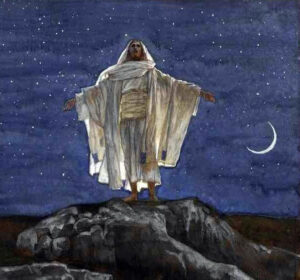 good life during a sermon on the mount. He took three apostles up a mountain (traditionally Mount Tabor) and revealed his glory to them there. Jesus died on Mount Calvary and ascended into heaven from Mount Olivet. He spoke of having faith strong enough to move a mountain. Like us, Jesus also encountered intangible “mountains.” He had to deal with hardhearted and critical religious leaders and thickheaded disciples. He kept up a strenuous regime that involved walking for miles, speaking to crowds, and healing throngs of sick people.
Are you climbing a mountain right now? Don’t be afraid. Have courage because you are not alone. Remember, the view from the top is magnificent.
What is your experience with mountains? Have you climbed a physical one? Have you successfully conquered an invisible one? What did it feel like? What did you “see”? What were the benefits?
Speaking Up to Do God’s Will
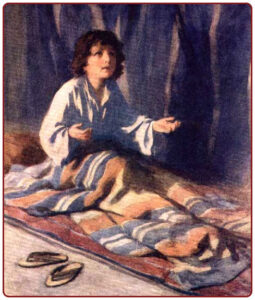 This week when the first reading at Mass was the story of the boy Samuel being called by God during the night, Fr. John Christman did not give the expected homily. Usually this story is a springboard for a vocation talk. Instead Father focused on the sequel to the reading. After Samuel replies to God, “Speak, Lord, your servant is listening,” God gives him a daunting task. He is to tell the priest Eli, Samuel’s beloved mentor, that his family would be punished because his two sons were blaspheming and Eli did nothing to stop them. The message of this reading on two levels is “Speak up!” Imagine how Samuel dreaded bearing the bad news to Eli. It would have been much easier to keep quiet. But Samuel did what God expected of him. He spoke to Eli. On the other hand, there is Eli’s silence when he should have spoken up. That had dire consequences: his two sons were killed in battle and he fell over backwards, broke his neck, and died. Today some brave people are carrying out this message to speak up; others choose to remain silent. (more…)
To Brighten and Inspire You
 Here is something for the cold, gloomy days we are experiencing: As I cleaned out things accumulated over decades in preparation for moving, I came across the following clever piece. Whenever I see excellence—such as a stunning ballet, a breathtaking piece of art, or a well-written poem or story—I’m spurred on to do the best I can in my projects. The account here is silly but incredibly well-done. I hope it makes you smile and prompts you to do your utmost in whatever task you undertake today. It might remind you of the movie Ghostbusters and make you chuckle . . .
It is with the saddest heart that I must pass on the following news.
Please join me in remembering a great icon of the entertainment community. The Pillsbury Doughboy died yesterday of a yeast infection and complications from repeated pokes in the belly. He was 71.
Doughboy was buried in a lightly greased coffin. Dozens of celebrities turned out to pay their respects, including Mrs. Butterworth, Hungry Jack, the California Raisins, Betty Crocker, the Hostess Twinkies, Little Debbie, and Captain Crunch.
The gravesite was piled high with flours.
Aunt Jemima delivered the eulogy and lovingly described Doughboy as a man who never knew how much he was kneaded. Doughboy rose quickly in show business, but his later life was filled with turnovers. He was not considered a very “smart” cookie, wasting much of his dough on half-baked schemes. Despite being a little flaky at times, he still, as a crusty old man, was considered a roll model for millions.
Doughboy is survived by his young wife, Play Dough; two children, John Dough and Jane Dough; plus they had one in the oven. He is also survived by his elderly father, Pop Tart.
The funeral was held at 3:50 for about 20 minutes.
*******
Did you ever notice that in old photos, people rarely smiled? Also, we seldom think of Jesus laughing. The Gospels don’t state that he laughed, but do record that he cried twice. 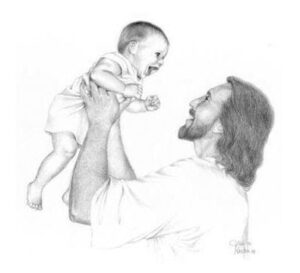 For sure, Jesus laughed. After all, he was human! Imagine his face when he sends Peter the fisherman to catch a fish to pay the tax. Or when the children are climbing up onto his lap and tugging at his arm. Some of his stories are downright funny, although not being products of his culture, we sometimes miss the humor. We can, however, imagine the ridiculous sight of a camel (especially a two-humped one) squeezing through a needle, or of the Pharisees swallowing a camel but spitting out gnats, or of someone setting a lighted candle under a bed. Only someone with a sense of humor would make up nicknames for people. Jesus called James and John “Sons of Thunder” and Simon “Peter” (rock).
When do you think Jesus laughed? Do you think he laughs with you? Or at you sometimes?
A Polish Saint, Maximilian Kolbe
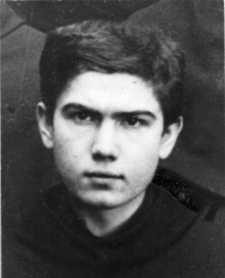 I’m working on a project for an amateur radio operator who discovered that his hobby had a patron saint. In the process, I realized that this saint would also make a good patron saint for me: St. Maximilian Kolbe. For one thing he is Polish, and so was my mother. Second, he had a profound love for our Blessed Mother, and I am a Sister of Notre Dame. Third, he was devoted to publishing material to promote the Gospel, and so am I. If you are not familiar with this extraordinary saint, let me introduce you to him. He was canonized in 1982, surprisingly as a “martyr of charity.” He died, not in defense of the faith, but by volunteering to die in place of another prisoner at Auschwitz. His entire life, though, was one of heroic virtue.
St. Maximilian Kolbe was born in occupied Poland in 1894 and named Raymond. He was a normal, mischievous boy until after one escapade his mother sighed and said, “What will become of you?” Raymond, who was raised to have a strong devotion to the Mother of God, went to church and prayed before her statue. His mother’s distress and words had a profound impact on him. Years later she disclosed that while praying that day, Raymond had a vision of the Virgin Mary holding a white crown for purity and a red one for martyrdom. Mary asked the boy to choose, and he chose both. Although he desired to fight to free Poland, eventually he became a Franciscan priest and became a knight not for Poland but for the Blessed Mother. He was a genius who excelled in math and science and obtained two doctorates in Rome. One professor remarked that he could have won a Nobel prize if he hadn’t chosen to become a priest.
In Rome, Max was afflicted with tuberculosis, a disease he battled for the rest of his life. But ill health did not prevent him from promoting the Gospel. While still studying, he began an organization whose members were devoted to Mary. It was called Militia Immaculatae (Knights of the Immaculate) and grew to thousands of members. Back in Poland, with the help of divine providence he overcame many obstacles (like the resistance of his community) and successfully printed a newspaper referred to as The Knight. He succeeded in setting up a printing house where dozens of friars were employed publishing this paper and other religious material. It blossomed into the complex of many buildings and became a large monastery with a seminary and a virtual city named Niepokalano (City of Mary). Father Kolbe’s zeal drove him to establish a similar undertaking in Japan called Garden of Mary. The friars constructed the buildings under adverse conditions, and Father Kolbe led them in enduring the hard labor and miserable weather, despite his illness. Always progressive, Father Kolbe set up a radio station and planned to make films too.
After Germany invaded Poland, all priests became targets, in particular, Father Kolbe, who was the publisher of material that was sometimes critical of the Nazi philosophy. Father Kolbe and his friars were arrested and taken to an internment camp hundreds of miles away. After three months they were released. As Poland was attacked, the Franciscans at the City of Mary took in hundreds of refugees, feeding them and treating them in their infirmary. They also built an orphanage that in the end housed a thousand children.
One day in 1941, the Gestapo came for Fr. Kolbe and four other priests who were involved in the publications and taken to Piawak prison. There Fr. Kolbe ministered to the other prisoners and contracted pneumonia. Later, he was herded into cattle cars with hundred of other prisoners and transported to Auschwitz. I will spare you the descriptions of the atrocious conditions and the inhuman treatment Fr. Kolbe was subjected to at the prison and the concentration camp.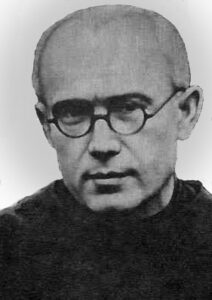
In the end, one prisoner from Fr. Kolbe’s bunker had escaped. The punishment was that ten prisoners would be sent to the starvation bunker to die. The Commandant cruelly chose ten victims. One man selected cried out that he had a wife and children. Fr. Kolbe stepped forward and said he would take the man’s place. In the starvation bunker, Fr. Kolbe kept up the spirits of the other prisoners, leading them in prayers and hymns. When only four men were still alive, it was decided to inject them with carbolic acid. Fr. Kolbe, the only one fully conscious, held out his arm for the lethal injection.
At Fr. Kolbe’s canonization, the man whose life he had saved was present.
This is only a sketchy biography. I encourage you to read more about this unusual man.
Do you have a special patron saint? If so, who is it and why do you have a special devotion to him or her?
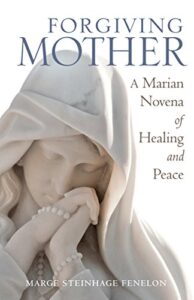 BOOK REVIEW: Forgiving Mother: A Marian Novena of Healing and Peace
Marge Steinhage Fenelon
Recently non-native speakers were asked in a poll to name the most beautiful English word. Most of them responded, “mother.” However, not everyone enjoys a good relationship with his or her mother. Some mothers are uncaring and even abusive, sometimes because of bad experiences with their own parents. Being deprived of a mother’s love leads to a host of problems, such as suffering, guilt, anger, and a lack of self-worth. Realizing that a number of people are estranged from their mothers, Fenelon wrote this book to offer help. She speaks from personal experience, frankly recounting times her mentally ill and abusive mother treated her cruelly. This makes for uncomfortable reading. However, Fenelon explains that she reveals these “family secrets” to show her readers that she knows what they are going through.
The paramount advice the author offers is to look to our Blessed Mother and take comfort in her tender love and help. (My own book Heart to Heart with Mary cultivates this practice and would make a good resource for those in need of a mother’s love.) Fenelon traces the development of her relationship with Mary, dwelling on her involvement with the Schoenstatt Movement, its founder, and consecration to Mary. She presents St. Germaine as an example of grace at work. In the course of the book, she offers practical advice and shares her wisdom. The reader finds answers to questions such as how do you deal with painful memories? How do you forgive?
Before Fenelon’s mother dies, they are reconciled and Fenelon is healed. The book concludes with a novena based on the wisdom offered in each of its nine chapters. Each day of the novena begins with an introduction followed by a Gospel passage for meditation. Commentary on the passage and how it is linked with subject of the book is next. Then several questions for pondering are suggested. These questions may be the basis for prayer with Jesus or answered in writing in a journal. The day concludes with a prayer to Jesus or Mary and a rosary prayed for a particular grace or intention.
In its gentle, personal way, this book can be a boon to anyone who bears painful wounds from an unhealthy relationship with a mother or stepmother.