
I was happy when Charles de Foucauld was canonized in 2022. Several times he has crossed my life. Most memorable is discovering his morning prayer, “Lord, one more day to love you.” As a young sister, I was moved by these words. What a great way to start the day: thinking of God, thanking him for the gift of life, and preparing to carry out the day’s tasks for love of God. As a craft, I created a banner with these words and saved it all these decades! You can see it here.

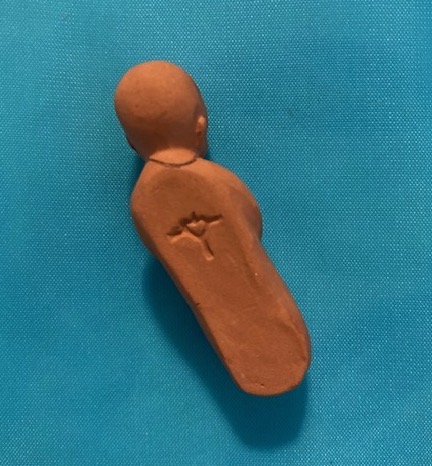
Much later a fellow teacher gave me a terra cotta baby Jesus made by the Little Sisters of Jesus, a community based on the spirituality of St. Charles. The figure has the symbol of St. Charles on the back: the heart and a cross.

Then when I was on a pilgrimage in the Holy Land, in Nazareth we stopped at the Poor Clare convent where St. Charles worked as a porter and servant, and we prayed in its chapel.
Another saying of St. Charles that I like is “Jesus is Lord of the impossible.”
Who Is Charles de Foucauld?
Dorothy Day claimed that he was among the greats. Born in 1858 to French nobility, he was orphaned when he was six. His grandfather raised him. For twelve years he was an agnostic. He lead a dissipated life and was expelled from school. A large inheritance supported his extravagant lifestyle. He attended Saint-Cyr Military Academy and the French cavalry school, but, restless, he quit the military at age 23. Then he traveled and studied the geography and culture of Algeria and Morocco, receiving a gold medal for his exploration and research.
Conversion
In Morocco he encountered Muslims of strong faith and began praying, “My God, if you exist, let me come to know you.” He returned to the Catholic faith at age 28. During a pilgrimage to the Holy Land, he realized that his vocation was to follow Jesus in his simple life at Nazareth.
St. Charles became a Trappist and took the name Charles of Jesus. However, he considered the villagers more poverty-stricken than they. So, after seven years, he left the order, moved to Palestine where he lived in one small room, prayed, and worked for the Poor Clares. He was ordained a priest when he was 43.
He went to the Sahara in French Algeria and lived as a hermit near Morocco. His goal was to live among the furthest removed and the most abandoned. He built a hermitage where hospitality was offered to all regardless of their religion, and he dreamed of founding a community of “little brothers of Jesus.” He said, “Our entire person must breathe Jesus, all our actions.”
Life among the Tuaregs
After moving to southern Algeria, he lived with the Tuareg people, becoming their friends. Over ten years, he studied them, learned their language, translated their poetry, and worked on a dictionary and grammar. He wanted to live in such as way that people would ask, “If such is the servant, what must the Master be like?”
In 1916, bandits intended to kidnap him, but two French calvary members stopped them. A 15-year-od bandit shot St. Charles, and the two soldiers were also killed. The Tuareg people buried St. Charles the next morning. In 1944, the young bandit was executed.
The Legacy of St. Charles
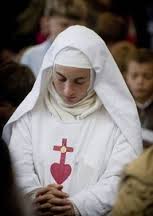
Although the dream of founding a religious congregation never materialized, the spirit of St. Charles lives on in Little Brothers of Jesus, Little Sisters of Jesus, and 18 other religious organizations. His vision is one of radical simplicity, humility, solidarity with the marginalized, and deep-rooted love. We celebrate his feast day on December 1.
St. Charles’s Prayer of Abandonment
Father,
I abandon myself into your hands;
do with me what you will.
Whatever you may do, I thank you:
I am ready for all, I accept all.
Let only your will be done in me,
and in all your creatures –
I wish no more than this, O Lord.
Into your hands I commend my soul:
I offer it to you with all the love of my heart,
for I love you, Lord, and so need to give myself,
to surrender myself into your hands without reserve,
and with boundless confidence,
for you are my Father.
• Is there a saint who often comes across your path?
• Do you have a connection with the Little Brothers or Little Sisters of Jesus?
This hymn that is new to me summarizes St. Charles’s spirituality: