
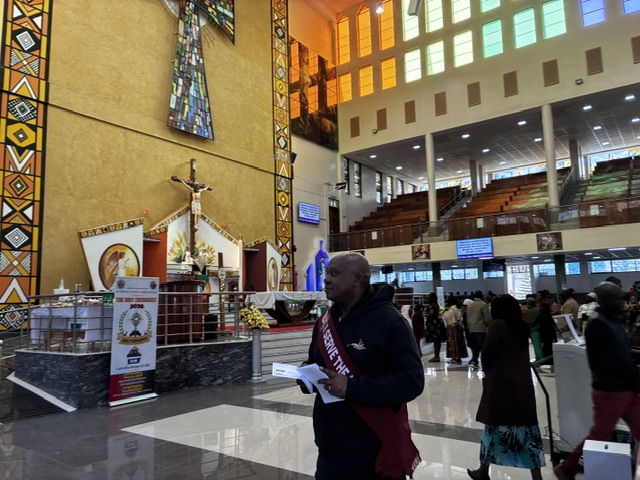
Africans celebrate the Eucharist with enthusiasm. Music is accompanied by instruments, clapping, whistles, and whoops. Although our convent Masses in Africa were normal length, our Sunday Mass at humongous St. Veronica Church lasted two hours because of the many hymns the choir sang and the processions. (At the offertory, people brought up things for the needy, even mops. And ushers did not collect money; instead people walked down the aisles and deposited it in a box at the end of each aisle.) Once after our convent Mass, a priest told me he would be celebrating a three-hour Mass that day!
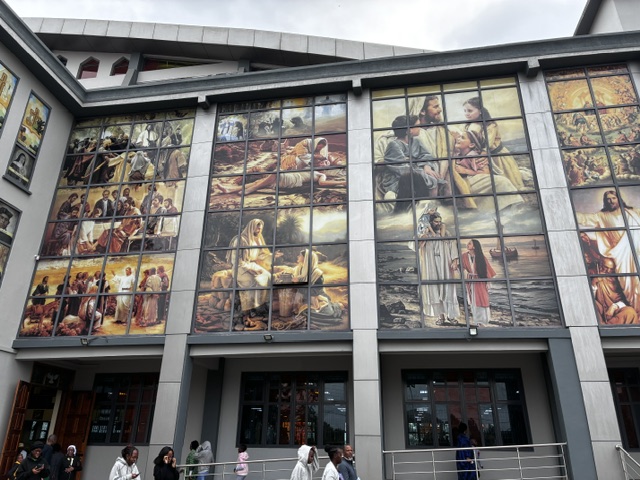
St. Veronica’s Church is shaped like Noah’s ark. Its facade is covered with religious images.
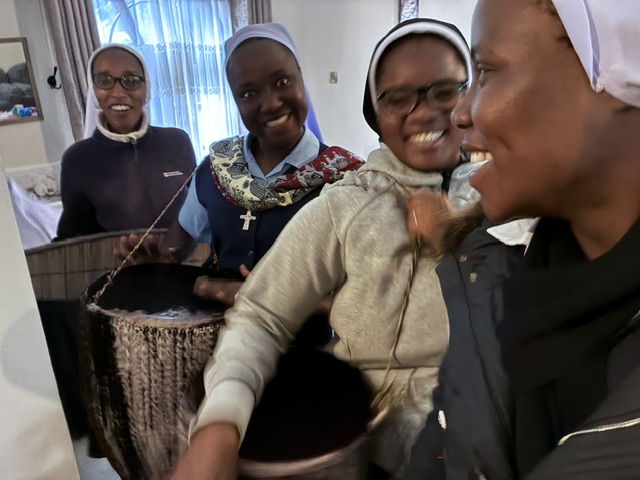
At the Karen House, the house for students where I gave the retreat, the Sisters often sang in three-part harmony with echoes, accompanied by different drums, a tambourine, and a shaker (a flat, rectangular instrument filled with seeds). I told them that if the Sister responsible for our liturgy in Chardon heard them, she would think she died and went to heaven!
The hymnal contained songs in English and in Swahili. To my pleasant surprise, the song I wrote for St. Julie’s canonization, “Mother Julie lived for the Lord” was among them.
During the hymns, we and the priests clapped (in different rhythms), sometimes dropping our arms at the side. Or we waved our hands from side to side.
The Sister who read usually sang the entire Responsorial Psalm.
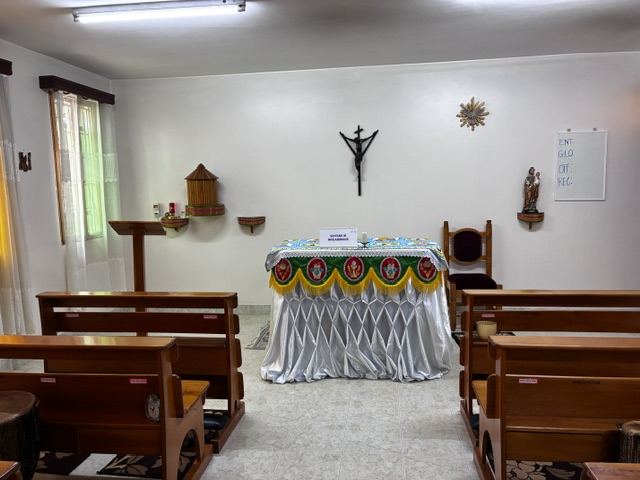
The white altar cloth in the chapel in the Delegation House has designs made by pinning. The designs are changed occasionally.
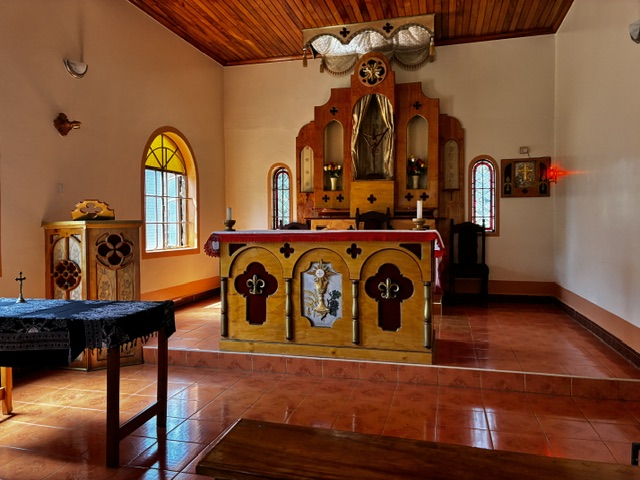
Communion
We sometimes received Communion by intinction. Either the priest placed the sacred hosts and wine at the top of the altar and we dipped the host in the cup ourselves, or the priest dipped the host and we received on the tongue. Otherwise we received the host in our hand or on the tongue.
At St. Veronica Church, our Sister Christine was a Eucharistic minister. Laypeople were not needed to fulfill this role. Those who served in special ways wore a large sash with the title of their role on it.
On the last day of retreat, after Communion a Sister went to the ambo and gave a speech thanking me for leading the retreat.
Adoration
Each day the Sisters had Exposition of the Blessed Sacrament for an hour. They sang, prayed out loud and silently, and concluded with the Divine Office. They have the new version of this Church prayerbook.
In front of the sacred host, many Sisters knelt on the floor, bent over, and touched their forehead to the floor. If I had done this, it would have taken two Sisters to help me up!
At the Delegation House, the Sisters did not wear shoes in the chapel. Imagine if at our Province Center we removed our shoes before entering!
Celebrants
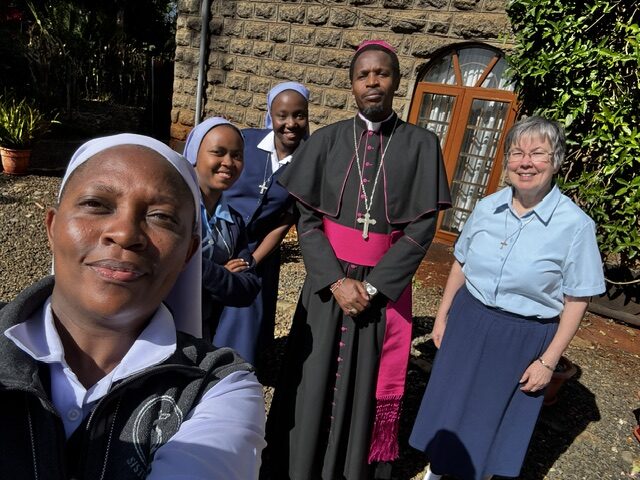
At the beginning of the Mass, the priest explained its intentions. After Communion he gave a little talk about who he was and his ministry. One day Bishop Obed was the presider. He had only been consecrated three months earlier. The Sisters called him a baby bishop.
Next week I’ll report on the food I ate in Africa.



2 Responses
Fabulous!
At the Catholic school, where I taught, one of the sisters was in charge of the music, and she was always very joy filled! We clapped often, and did sacred dance, and it was wonderful!!! Then, a new principal came in and said that clapping was not appropriate in church!
Kathleen, What a wonderful description of your time with our Sisters in Africa! You have a real knack for noticing small details that add so much interest to your beautiful narrative! You would make a fine news correspondent for our Sisters all over the world. You not only write so well, you take great pictures! I really enjoyed this. Thank you so much! Melannie, SND