The Rosary, a Lifeline

October is known as the month of the Rosary, no doubt because October 7 is the feast of the Holy Rosary. The feast originated with the Battle of Lepanto when, against all odds, Christians overcame the Muslim forces attacking Europe—accredited to Christians praying the rosary. (Hmm. What would happen if all Catholics prayed the Rosary to vanquish terrorist groups?)
The rosary is associated with Catholics as much as the Mass is. It hangs in our cars, and our hands hold it in the coffin. Martin Luther, a former Catholic, did away with many Catholic things, but not the rosary. He prayed it every day until he died. The composer Hadyn prayed it whenever he got composer’s block. It was Pope St. John Paul II’s favorite prayer. After 9/11, he encouraged praying it for peace.
When the Blessed Virgin Mary appeared in Fatima, Portugal, she, too, advised us to pray the rosary for peace. To those who think that after the reforms of Vatican II, the rosary is something to be thrown out the window, think again!
The Rosary is a highly scriptural prayer. We pray two ways during the rosary: We say the traditional formula prayers, which are rooted in the Bible (Our Father, Hail Mary, Glory Be), but at the same time we ponder the mysteries of Jesus, one mystery per decade (set of ten beads). I tell children that this takes practice, like mastering patting your head and rubbing your stomach at the same time. The repetitions of the Hail Marys is like soothing background music to our thoughts. (So soothing that the rosary can function as a remedy for sleepless nights, more effective than counting sheep, the Calm app, or lavender oil).
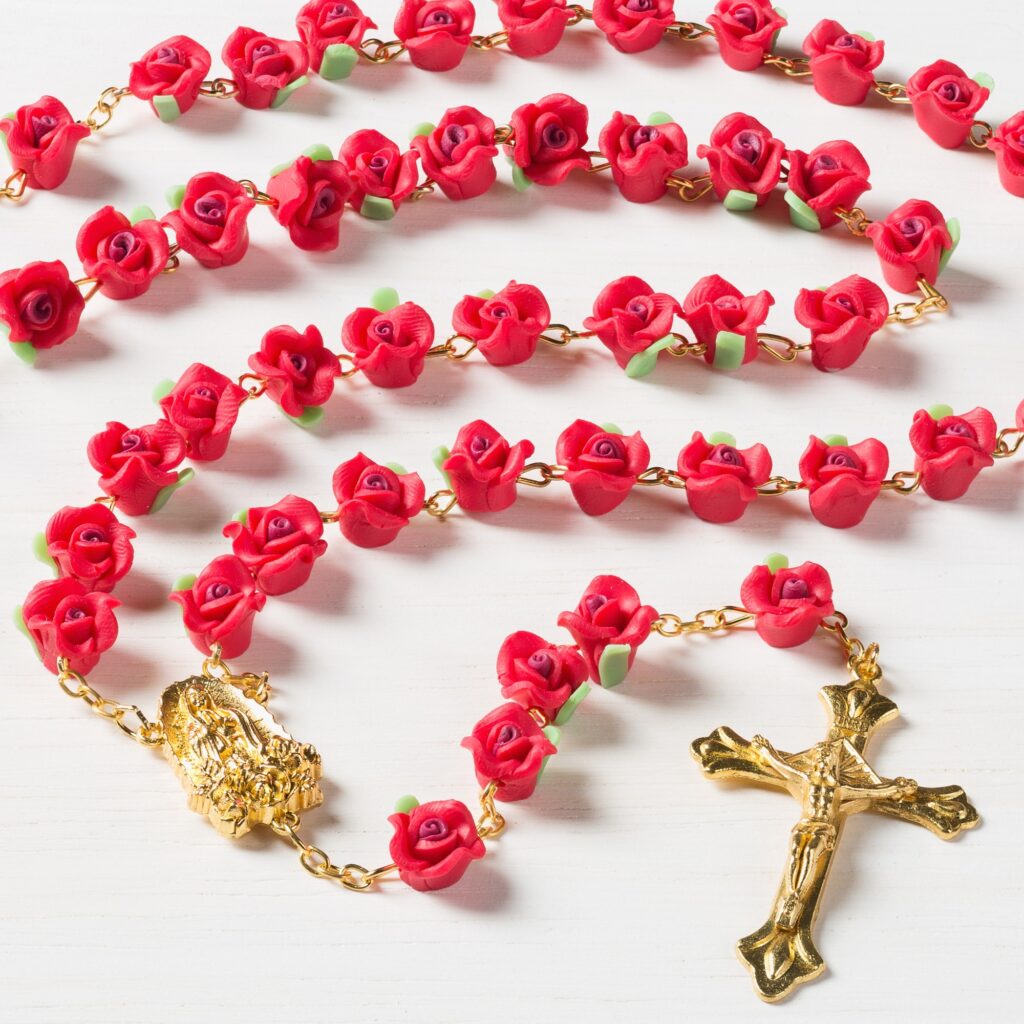
The Rosary is known as a Marian prayer because we primarily honor our Blessed Mother by praying fifty-three Hail Marys. The Rosary has been compared to a garland of roses we present to her.
I also ask the children how they feel when someone says something nice about their mother. Then I comment that likewise Jesus is pleased when we praise his mother. We Sisters of Notre Dame (Our Lady) pray the Rosary every day.
Rosaries can be beautiful crystal ones or homemade ones. There are also single decade rosaries. I have one of these made from crushed rose petals. Some people pray on ten-beaded bracelets or rings. Lacking any of these, we can always pray on our hands, which conveniently have ten fingers!
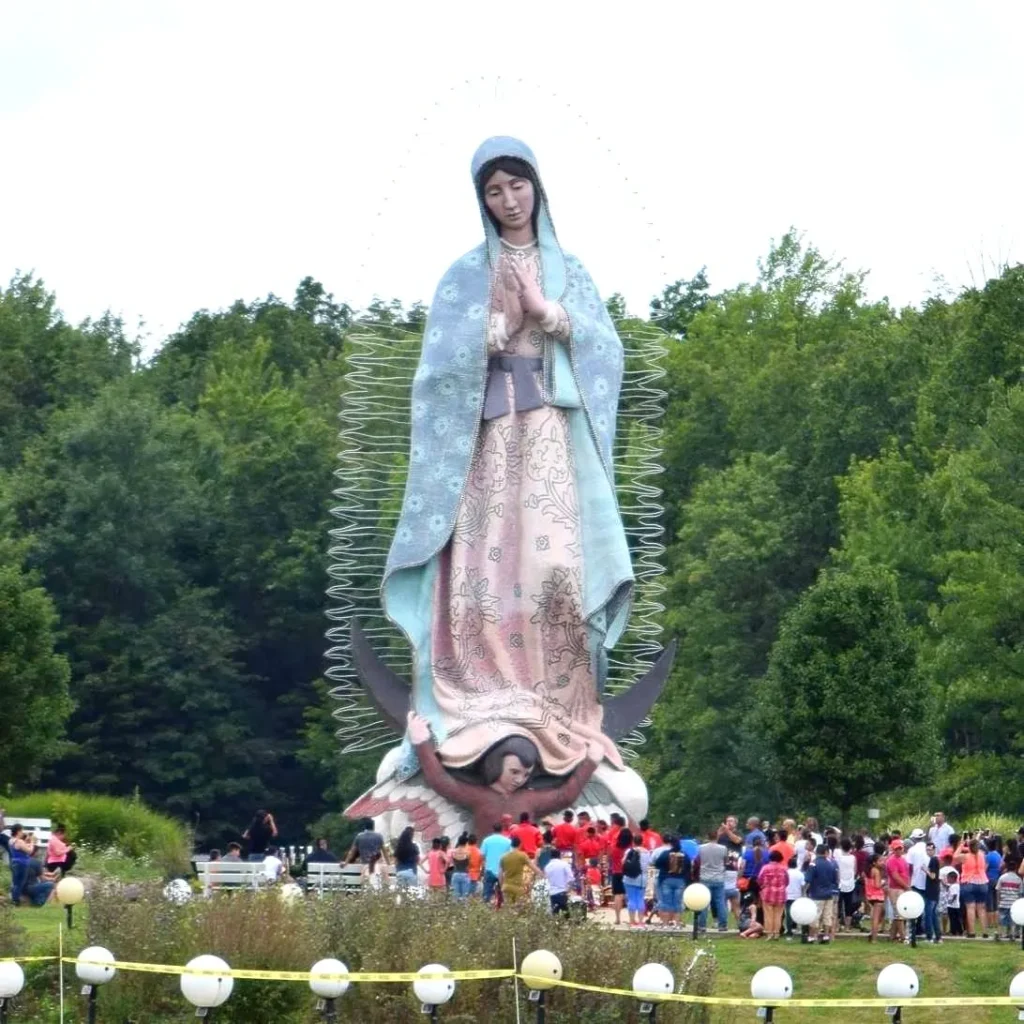
The largest rosary is at a shrine in Windsor, Ohio. It is made of foot-high lamps near the tallest statue of Our Lady of Guadalupe, which is 50-feet high.
Variations: You can make up your own mysteries, such as the miracle mysteries or the parable mysteries. You can also stay mindful of the mystery by inserting in the Hail Marys words that refer to it. For example, for the Annunciation you might pray, “Hail Mary, full of grace, to whom the Angel Gabriel came, the Lord . . .”
You can also meditate on mysteries from your own life!
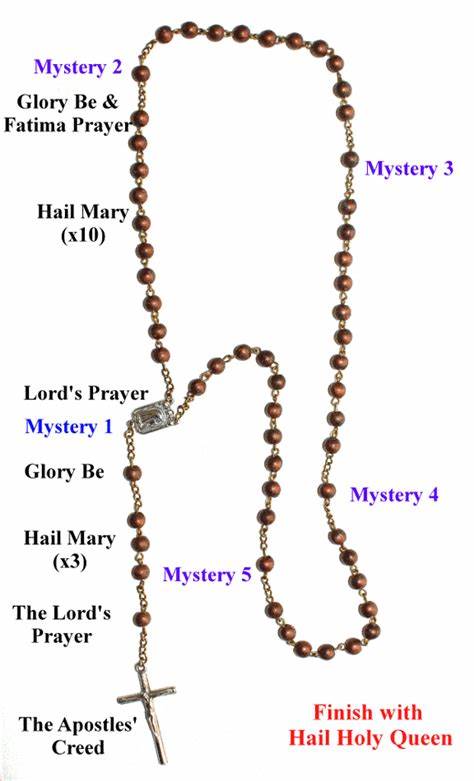
In case you need a refresher on how to pray the Rosary, here is a simple diagram.
By the way, the rosary developed over the years. The legend that Mary personally handed one to St. Dominic began because the Dominicans were chief promoters of the rosary.
Here is one of the sites where you can pray the rosary along with others: https://www.comepraytherosary.org/
• What rosary has special meaning for you?
• When has praying the rosary been a comfort or joy for you?
My Story: Humor Helping Pain

God’s Funny Bone
Did you ever laugh so heartily that tears trickled down your cheeks and you were gasping for breath? What a gift! Animals spend their lives eating, pooping, mating, and sleeping, a rather boring existence. Humans do those things too, but a sense of humor adds spice to their life. Now, because we are made in God’s image, according to Logic 101, the almighty One must have one too. And indeed he does.
Picture God at the dawn of time, sitting at the drawing board gleefully designing a giraffe, a hippopotamus, a platypus, a kangaroo, and a two-year-old human. This is the One, too, who invented sex to propagate species.
The Bible reveals God’s flair for comedy. Didn’t he make Abraham’s old wife Sarah pregnant when her womb had retired? Eavesdropping the day this was predicted, Sarah cackled at the ridiculousness. Her son is named Isaac, which means laughter.
Then there was the time the Philistines captured the Ark of the Covenant from the Israelites and placed it across from their god Dagon, a statue. The next morning, Dagon had keeled over and lay face down. Take that, false god! Unwilling to admit defeat, the Philistines propped him up. But the next day not only was Dagon prostrate again, but his arms were lopped off!

Let’s not forget the day a boy named David clad simply in shepherd’s garb and armed only with a staff and slingshot faced a heavily armored, javelin-carrying giant. No Israelite soldier had the courage to accept Goliath’s challenge to fight him. The lad, however, dispatched the intimidating enemy with a single well-aimed stone. How droll! But the Philistines weren’t laughing.
Jesus as Comedian
When God came to Earth, he didn’t leave his sense of humor behind. The gospel writers didn’t record times when Jesus laughed, grinned, or even smiled, but it doesn’t take a psychologist to realize he must have, especially on certain occasions.
Surely at the wedding in Cana, Jesus had to struggle not to burst out laughing at the servants’ open-mouthed faces when they discovered wine in the water jars. And how could he help but smile when his fishermen friends took his advice and hauled in enough fish to almost sink their boats?
Like any captivating speaker, Jesus infused his preaching with humor. Visualize a camel trying to squeeze through the eye of a needle—especially a two-humped camel. Picture (or feel) a log in your eye.
Imagine Pharisees straining out a gnat from water but gulping down a camel. In Aramaic camel is gamal and gnat is galma. So Jesus stooped to making a pun, the lowest form of humor!
Note that first-century lamps were oil lamps with flames shooting out, and beds were low. When Jesus referred to a lamp put under a bed, aware that the lamp would ignite the bed, the audience must have laughed. These rural people also must have roared at the silly farmer who strewed precious seed on paths, rocks, and thorn bushes. And the idea that seeds would produce a hundredfold was outrageous.
Jesus was not above playing a prank either. He sent Peter the apostle, a fisherman, to fish in order to catch the payment for both their temple taxes.
My Sore Toe

God sometimes orchestrates events in our life that are downright funny. In my case, humor came into play when I was in pain from a toe, the fourth one on my left foot. A friend called it my “ring toe.”
Ever since learning “This Little Piggy Went to Market” as a toddler, I didn’t pay much attention to my toes. That is, unless a callous, corn, or blister appeared. Mostly, I took these ten strange digits for granted—until with every step, a searing pain shot through my foot. When I visited California, a walking tour was like an ordeal by fire.
Back home, I turned myself in to a podiatrist. Dr. W. said that X-rays revealed extra bones all through my foot. (Ah, that’s why I weigh more than I should, I mused.) The good doctor surmised that a bone in that sore toe had shifted. He proposed removing that bone.
That afternoon, our head nurse said I needed a second opinion, so I drove 45 miles to see another doctor. After examining the X-rays, this doctor, while holding my foot as one would hold someone’s hand, said, “This is a funky foot. Can I keep your X-rays?” Then he said that I might as well have the surgery.
Coincidentally, the day those two men were caring for my poor foot happened to be Holy Thursday, when we commemorate Jesus washing the apostles’ dirty feet! I had missed my community’s special Last Supper prayer service with different kinds of bread. But now I could hope to walk without wincing.
The Operation
Lying on my back in the surgery room without my clothes, I felt uncomfortable, like I was trapped in a strange dream. The nurses were chatting away as they prepared the doctors’ instruments. One of them glanced over at me and said, “Sister, we don’t often have a patient who can talk. Would you tell us a story?” How bizarre, I thought.

Because I had been writing a preschool program, the story of Harlequin sat on the top of my mind. So, I told the nurses this sweet Italian tale about a little boy whose family was too poor to provide a costume to wear to the town’s carnival. Each of his friends brought the boy’s mother a scrap from making their costumes. She sewed them together, creating a stunning multi-hued costume with a diamond motif. The little boy was thrilled, not only because his costume was the best at the festival but because he was clothed in the love of his friends.
Doctor W. and his partner entered the room, and the surgery began. As the doctors worked, I asked, “Are you finding anything?” My doctor quipped, “We just took out a beer bottle cap.”
Occasionally, I felt a gentle pressure on my lower leg, which was very soothing. When I mentioned this, my doctor said, “That’s Dr. B’s stomach whenever he leans over.”
Afterward Sister Mary Roman, the nurse at the college where I lived, was there to take me home. She said first I should eat breakfast in my hospital bed—after all, we had paid for it. Sister had recently fallen and broken her arm, so she wore a cast. I had been fitted for a wooden shoe. When we arrived at our parking lot, it was raining. Under a large, black umbrella we held onto each other, two wounded women. Quite a sight! Laughing, I hobbled along as fast as I could, happy the operation was behind me.
Thanks to God, a little humor had turned a frightening event into a pleasant experience. And, yes, the surgery was a success.
• What comical things have happened to you?
• When have you been able to spot the humor in a difficult situation?
A Visit to Me and Notre Dame

This is an unusual blog this week. An associate from Florida who paid me a visit in August created a blog that presents me, my books, and the Sisters of Notre Dame. So, if you are interested in learning more about us, click on this link:

This Sunday is our annual Chicken Barbecue at NDCL, the high school on our Chardon property. You are welcome to come between noon and 5:00 p.m. I will be at the Book Nook taking preorders for my new book Cherished by Jesus: A Daily Devotional for Women.

Memories for an Autobiography

Famous people write memoirs or hire a ghostwriter. Writing one can be an enlightening experience and one that fills your heart with gratitude. We were required to write an autobiography when we entered the convent. Later it was suggested that we write another one, which I haven’t done.
Maybe in heaven we will be able to watch videos of our earthly life. Right now I invite you to scan your years and pinpoint highlights. This could turn into a memoir if you write them down. Otherwise, they are good grist for reflection and prayer. You might detect the hand of God directing events. You may be amazed when you consider the blessings you’ve had.
What to Consider
Here are a few topics and the answers I would give. You can think of many more questions to answer.

- What was your childhood like? Your family? Relatives?
(I remember spending weekends at our “farm” in Hartsgrove, Ohio, where we picked blackberries and caught tadpoles.)
2. What memories of school stand out for you?
(When I couldn’t answer a question, my fifth-grade public school teacher said, “Glavich, you don’t’ know beans from butter with the bag wide open.” My sixth-grade public school teacher came to my investment. My eighth-grade teacher encouraged me to write during the summer.)
3. Who were your friends?
(Jeanie down the street. My mom had me transferred to her kindergarten class, hoping that would stop my crying.)
4. Who were your heroes?
(I liked Elvis Presley and the Indians player Rocky Colavito. Later, St. Francis of Assisi.)

5. What was your favorite pastime?
(I enjoyed playing the piano.)
6. What were your hobbies?
(I collected stamps and pennies.)
7. When were you asked to do something difficult?
(I was sent to get a master’s in math.)
8. Who influenced your life after meeting only once?
(In 2004 in Hawaii I met a Japanese man and his wife who lived in California. Ever since then he has emailed me seven cartoons every day. I choose one to post on Facebook. This has become my “ministry of joy.”)
9. What operations have you had?
(A herniated disk in my neck was fixed with a titanium plate and a piece of my hip.)
10. What vacations did you go on?
(I went to the Grand Canyon with my sister.)

11. What jobs have you had?
(I was diocesan co-director of vocations for two years.)

12. What is your favorite book?
(The Bible of course.)
13. What is your favorite movie?
(Gone with the Wind)
14. What birthday stands out for you?
(When my sister and niece threw me a party for me here in the Village)
You can add more questions like “What was an embarrassing situation” and “What funny thing happened to you.”
A Few Tips
• You might pray the Rosary using an event from your life for each decade.
• Make a recording of the story of your life.

• For the Gathering Space in our renovated chapel, each Sister was invited to design a tile to represent her. You might make a similar tile or piece of art. My tile had a chi-rho for Christ the King, a Bible, a stone from the Holy Land, and a dove for the Holy Spirit, who inspires all my writing.
• Tell younger people in your family about your past.
• Write a story about an episode in your life and submit it for publication.
• Put together a booklet called Who Am I?
• Which tip here appeals to you most? Have you already done any of them?
Here is a touching video I hope you will enjoy while thinking of your loved ones . . .
The Gift of Kindness

Watching the news today can be depressing. We see people being mean, even cruel, to others. The world is rife with violence and war. Still, we can all recall times when people, including strangers, have shown extraordinary kindness to us. Here are two of my pleasant memories . . .
An Accident

Shortly after moving into a new home, I sat in the car, ready to go to early morning Mass. Glancing down, I noticed a coffee stain on my skirt. I returned to the house and took care of it. Back in the car, I didn’t want to be late for Mass. Swiftly I backed out of the impossible curved driveway that even baffled confident men drivers. No one ever parked opposite that driveway. But that day—CRASH! A construction crew was working on the house across from mine. The owner of the house had parked his car in the street to give the workers space in his driveway. A construction worker phoned him to break the news that his car had been hit. My car, the aggressor, was fine.
When the owner, a very tall young man, came out. He examined the damage and said, “I was thinking of getting a new car.” That was all. Then he introduced himself and said, “If you ever need any help, like changing a lightbulb, call on me.”
When people asked how I met Jim, I would answer, “Oh, I just bumped into him one day.” And Jim did become a good neighbor. He fixed my front door, and on Easter when a blizzard cancelled people’s visits, he invited me over to join his family for Bunny Buns he had made.
A Thanksgiving Day to Remember
Mom and I were invited to celebrate Thanksgiving with Sisters at a nearby convent. That morning, I phoned her and greeted, “Happy Thanksgiving.” She moaned, “It’s not so happy.” She explained that as she made her bed, something flew into her eye and it hurt. Because she had recently undergone cataract surgery, I was afraid this was a serious problem. I tried to contact her eye doctor with no success. Mom sent me to join the Sisters for the meal without her.
When I returned, bringing her a dinner, I managed to reach the doctor through his answering service. He said that if we came to his office at 3:30, he would meet us there. I deposited Mom’s dinner in the refrigerator, and we dashed out of the house. Luckily, no police saw me speeding and weaving around traffic to arrive on time. The town and the doctor’s office building were unfamiliar. In the parking lot as Mom and I emerged from the car, the doctor was walking toward us. He took my mother’s other arm, and we entered the building.
It turned out that Mom’s cornea was scratched. After treating her, the doctor mentioned that he had left twenty-eight Thanksgiving guests in order to be there!
Back at Mom’s house, I discovered that I had left the house key inside. My sister who also had a key was out of town and wouldn’t be back until evening. Aha, I knew the code for the lock provided for medical emergencies! In pouring rain, I tried over and over to open the lock on the front door. Finally giving up, I drove Mom to my convent, leaving behind her Thanksgiving dinner sitting in her refrigerator.
When we arrived at my convent, I received a call from Jim across the street. He asked if he could bring over some dessert. I explained our predicament. A little later, the doorbell rang and there was Jim with two Thanksgiving dinners. He and his wife were vegans. So, that day Mom and I feasted on tofu turkey.
In Tennessee Williams’ play Streetcar Named Desire, Blanche says, “I have always depended on the kindness of strangers.” We thank God for family, home, and food. We are also grateful for the people who come to our aid in emergencies. Maybe when have a flat tire on the road, someone parks behind us and changes it for us. Or a friend gives us tickets for a concert. God’s love is channeled to us through these generous people.
• When has someone been an angel to you when you were in need? When have you been someone’s angel?