Symbols at Mass

Again I’m relearning facts about the Eucharist from doing research for my book on the sacraments. This is making me pay more attention to our daily Masses. Hope this blog post does the same for you.
Candles are lit because Jesus is the Light of the world.
We sing because singing well is praying twice according to St. Augustine. Besides, voices combining to create one sound is a symbol of unity.
The Mass begins with the priest kissing the altar. He does this because the altar is a symbol of Christ, who is the priest and the victim of the sacrifice.
Before reading the Gospel, the priest makes the Sign of the Cross on a page. We stand to hear the proclamation. At the end, the priest kisses the Book of the Gospel. These are all ways to honor the Word of God. Jesus speaks to us in Scripture. You might listen to hear the verse he means for you personally that day.
During the Creed we bow at the words “by the power of the Holy Spirit he was born of the Virgin Mary, and became man.” This describes the fantastic incarnation, the moment when God, the almighty pure Spirit, took on flesh and blood for love of us. We adore God for this and so we bow.
The bread and wine are brought to the altar. They are not the only gifts we present to God. Formerly, people brought other things like animals, food for the poor. Today at this point money is brought up. Also, mentally we offer God ourselves: our work, joys, and sufferings.
The priest adds a little water to the wine. This symbolizes the union of humanity and divinity in Jesus.
Before the consecration, the priest washes his hands. This was practical long ago when he handled the things people brought up in the offertory, which may have been dirty. Today this washing is symbolic. It stands for his being purified of sin.
The Consecration
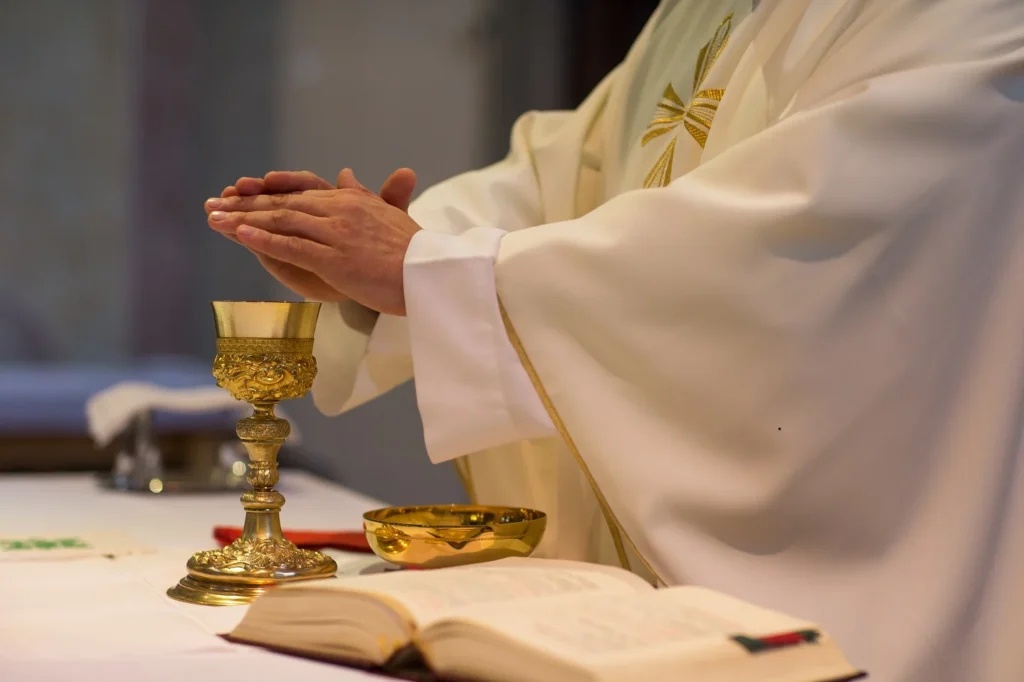
The priest lays his hands over the bread and wine and then makes a sign of the cross over them. He does this as he calls down the Holy Spirit, the One who brings about transubstantiation: the change in the substances of the bread and wine. Then Jesus becomes present in the consecrated bread and wine. Really, truly. It’s said that 70% of Catholics do not believe this! However, Jesus declared,
“Those who eat my flesh and drink my blood have eternal life, and I will raise them up on the last day; for my flesh is true food and my blood is true drink. Those who eat my flesh and drink my blood abide in me and I in them” (John 6: 54-56).
Hearing those words, some disciples walked away. Jews did not consume blood. To them this sounded horrific. Yet, Jesus did not call them back, saying, “I’m only using a figure of speech” or “I’m just kidding.”
At the end of the Eucharistic prayer there is the Doxology:
Through him, and with him, and in him,
O God, almighty Father,
in the unity of the Holy Spirit,
all glory and honor is yours,
for ever and ever.
The “Amen” that follows is the most important one of the Mass. We are saying yes to the great glory due to our Triune God. St. Jerome reported that in Rome when Amen was proclaimed, all the pagan temples trembled. The Amen should be like a thunderclap.

The priest breaks the sacred host, the Fraction Rite, because this is what Jesus did at the Last Supper. In fact, at first the Mass was called the Breaking of Bread.” The two disciples on the way to Emmaus recognized Jesus when he broke bread.

Then the priest breaks off a piece of the sacred host and drops it into the sacred wine. This co-mingling stands for the resurrection when the blood of Christ will return to his body.
Communion
When we are presented with the body and blood of Christ, we respond, “Amen.” This is an act of faith. We mean we believe this miracle.
The fact that we are all partaking of the same meal indicates that we are all one in Christ.
When we are dismissed, we are sent to take Christ into the world. The word Mass is derived from the Latin word missa, which means “sent.”
• What was the most memorable Mass you ever participated in?
• What do you pray after receiving Communion?
• What is your favorite part of the Mass? Second favorite?
Crucifixes and Crosses

I’m rediscovering things about the Mass, in particular the role of the crucifix and the Sign of the Cross. This is because currently I’m writing a book about the sacraments. Here are some facts that might interest you.
A crucifix is there at each celebration of the Eucharist. This is because at Mass the sacrifice of Jesus on Calvary is re-presented for us. We remember what he did for us and offer him to the Father along with ourselves. By the way, technically a crucifix is a cross with the body of Jesus while a cross is bare.
The Coesfeld Cross

The crucifix in our Provincial House chapel is called the Coesfeld Cross. The original one is in Coesfeld, Germany, in St. Lambert’s church where the first Sisters of Notre Dame taught. It is huge and has a unique forked shape. It was carved in the 14th century. Relics have been inserted, including one of the true cross. Pilgrimages are made to it. Today replicas of this cross are carried in procession. Our convents and Sisters were given miniature Coesfeld crosses.

At Mass the crucifix leads the entrance procession and the recessional. I’m one of a handful of Sisters who can carry our crucifix and place it in its stand. It is large, so care is needed to avoid hitting the ceiling. It is also top heavy, so balancing it is a feat. Other challenges occur at the end of Mass. First, you have to remember to retrieve it for the recessional. Then you must turn it to face outward. And finally you need to carry it to the front of the altar before the priest gets there.
The Sign of the Cross
The Sign of the Cross is one of the first prayers Catholics learn. It is a sacramental. We begin and end prayers with it. To teach my first graders to touch the left shoulder first, I had to make the Sign in reverse because they mimic you. Or I had to turn my back to them and make it the correct way. (Eastern Catholics touch the right shoulder first, then the left.) At the conclusion some people make a cross with their thumb and forefinger and kiss their thumb.
On entering the church or chapel for Mass, we bless ourselves by making the Sign of the Cross with holy water, a reminder of our baptism. Blessings are also given to others by making the Sign of the Cross on their foreheads.
Mass begins with everyone making the Sign of the Cross, the sign of our salvation. If the Mass includes a blessing with holy water, we make the Sign of the Cross when the water is sprinkled our way. Before the Gospel is read, we sign crosses on our forehead, lips, and chest. I was taught to say at that time, “Jesus, be in my mind. Jesus be on my lips. Jesus be in my heart.” Were you?
Mass concludes with the priest blessing the congregation with the Sign of the Cross. A bishop will make the Sign three times. And we make it over ourselves.

The Sign of the Cross appears in all the other sacraments too. For example, in confession we being with the Sign of the Cross and the priest makes it over us when giving absolution.
Because we are so used to this sign, it’s easy to get in the habit of making it quickly and thoughtlessly…like I told my students, as though we were swatting flies. When you think about it, this Sign deserves to be made reverently and intentionally. It is an admission of the foundation of our faith: the Holy Trinity. It also makes holy whatever we do after it.
Crosses
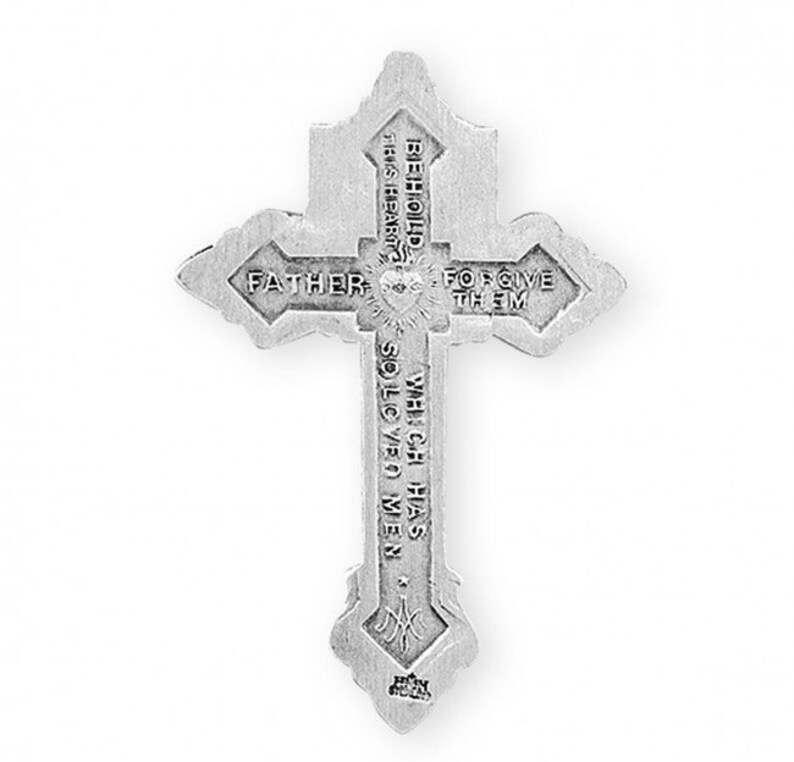
Christians wear crosses as a sign of their faith in Jesus, the Savior. This past year I came across an unusual one. It is called the Pardon Cross. One the back are the words “Father, forgive them” and Jesus’s words to St. Margaret Mary: “Behold this heart which has so loved me.” At the bottom is a fancy M for Mary who stood at the foot of the cross.

The song “The Power of the Cross” is new to me. Here it is sung here by a virtual choir of young people:
• Who taught you to make the Sign of the Cross?
• Do you have a cross that has special meaning for you?
St. Cabrini: An Amazing American Citizen
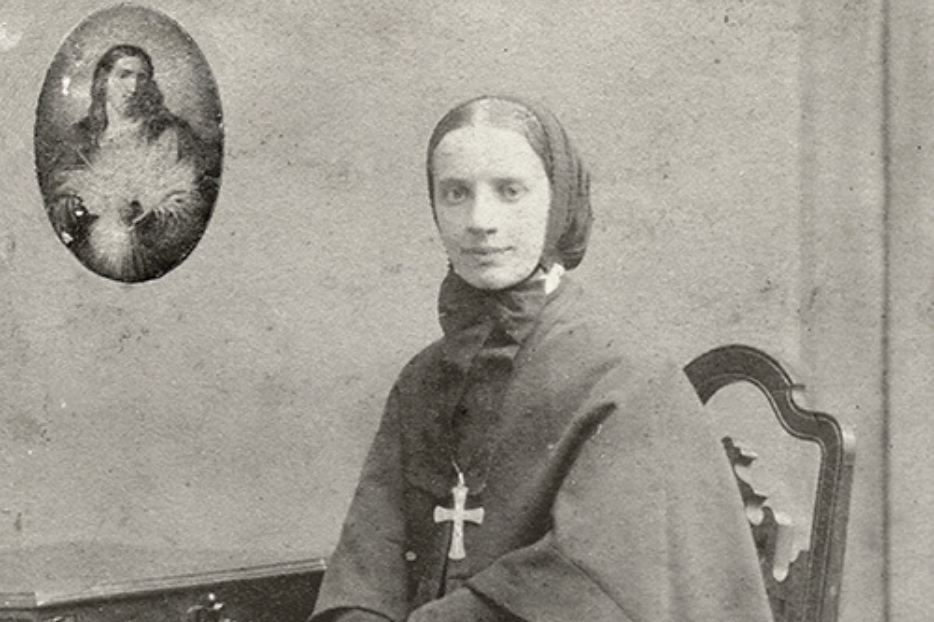
Recently I saw the movie Cabrini. I hope you get a chance to see it if you haven’t already. Mother Cabrini is the first American saint. A woman, not a man, had this honor! The movie is inspiring especially because it shows what one weak woman can accomplish when she lets God direct her life. Because she was a woman of faith and blessed with business acumen, over the course of thirty-four years, she established no less than 67 schools, hospitals, and orphanages. In 2020, Colorado renamed Columbus Day Saint Cabrini Day. In that state she had founded an orphanage, a summer camp, and a small farm.
St. Cabrini’s life was incredible. She was born to farmers in Italy in 1850, two months premature, the youngest of thirteen children. She was diminutive, barely five feet tall and frail, and had piercing blue eyes. Almost her entire life, she was sickly, and once succumbed to smallpox. She also encountered numerous other crosses. But nothing stopped her.
As a child, Frances dreamed of being a missionary. She filled paper boats with violets (missionaries) and sent them down the river. Nearly drowning one day left her with a great fear of water. Despite that, she would cross the ocean 27 times to do God’s work.
Frances was called to be a Sister. When she applied to the religious community who had taught her, because of her poor health, she was rejected. She went on to receive a teaching certificate and taught at a village school. A priest told the bishop what an outstanding teacher she was, and he asked her to be in charge of an orphanage. She joined the Sisters who ran it and took the name Xavier, after St. Francis Xavier, S.J. who was a missionary in the Far East.
Under Sister Cabrini’s leadership, the convent’s ministries increased. The superior of the community, however, was jealous of young Sister Cabrini and bullied and harassed her for six years. When the diocese dissolved the community, Sister was asked to found a new one, which she did when she was thirty years old: The Missionary Sisters of the Sacred Heart of Jesus.
A Missionary
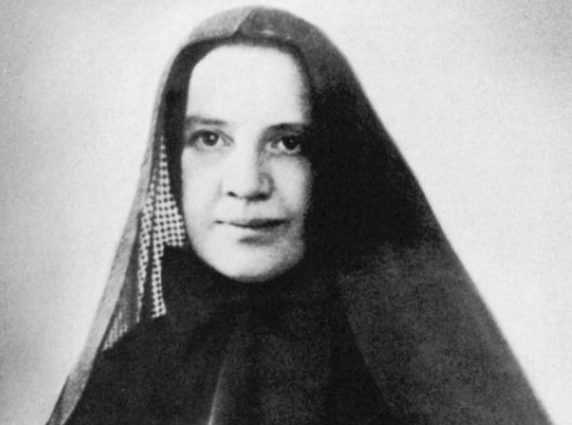
Although Mother Cabrini wished to go to China, at an audience with Pope Leo XIII, he told her “not to the East but to the West” to the United States. Italian immigrants there were living under terrible conditions, including prejudice.
Mother Cabrini and six Sisters came to New York City in 1889. The Monsignor there did not give them a warm welcome, but he did find them a house. Mother Cabrini got to work immediately and organized education for the children. An orphanage housed children from the notorious Five Points neighborhood. She and the Sisters raised money by going door-to-door. An admirable businesswoman, she was ingenious and shrewd in persuading people to donate money, time, labor, and support.
When contractors tried to swindle the Sisters in remodeling a hotel into a hospital, she fired them, and spent weeks directing the workers herself.
Mother Cabrini led her Sisters to minister in the United States in Chicago, New Orleans, Philadelphia, Los Angeles, Seatlle, Denver, and other cities. She also went to Europe, and Central and South America.
At the age of 59, in 1909, Mother Cabrini became a U.S. citizen. In 1917, when she was 67, she died in Chicago from endocarditis (inflammation of the inner lining of the heart caused by bacteria). Nine years after he death, her Sisters did go to China.
Canonization
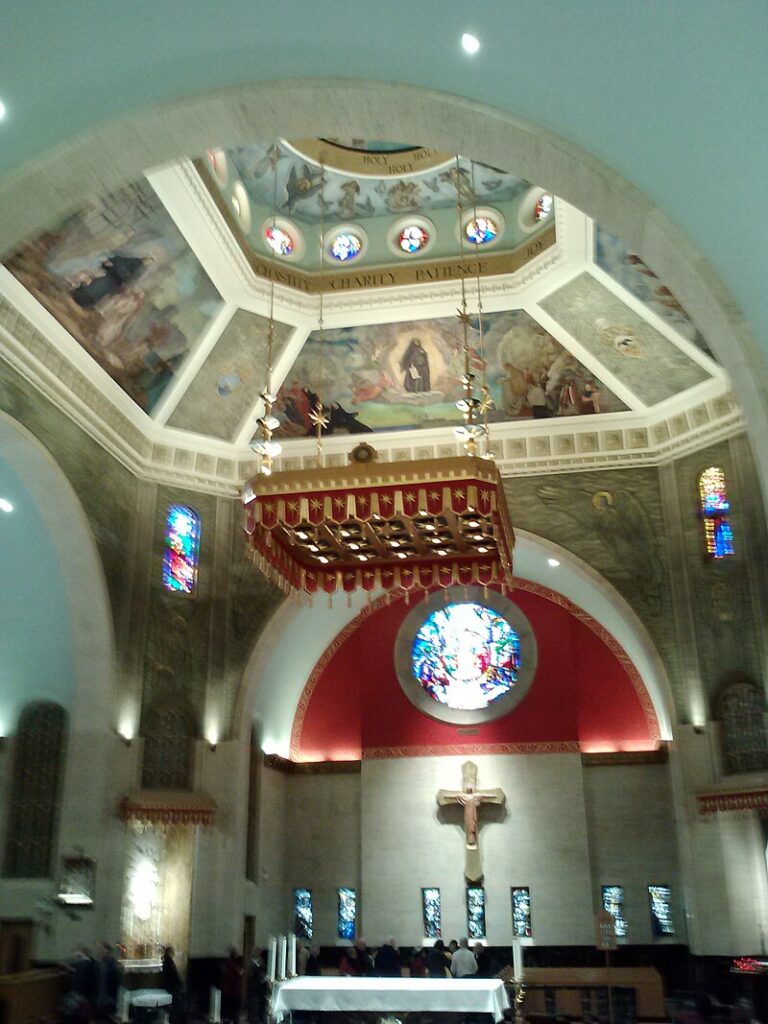
Although 50 years are usually required to elapse after a person is canonized, she was canonized already in 1946. One of her miracles required for canonization was restoring sight to a day-old baby who had been blinded by a great overdose of silver nitrate solution in its eyes. The second miracle was of a terminally ill member of her congregation, who lived twenty more years. At a Mass of thanksgiving for Cabrini’s canonization, about 120,000 people filled Chicago’s Soldier Field.
As would be expected, St. Frances Xavier Cabrini was named the Patroness of Immigrants. Her feast day is November 13. It’s said that she also helps in finding a parking space because she was used to New York City traffic.
Mother Cabrini took these words of Jesus to heart …
• Are you a descendant of immigrants? What is your story?
• What other woman has done prodigious things?
The Greatest Love: The Sacred Heart
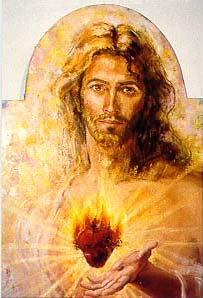
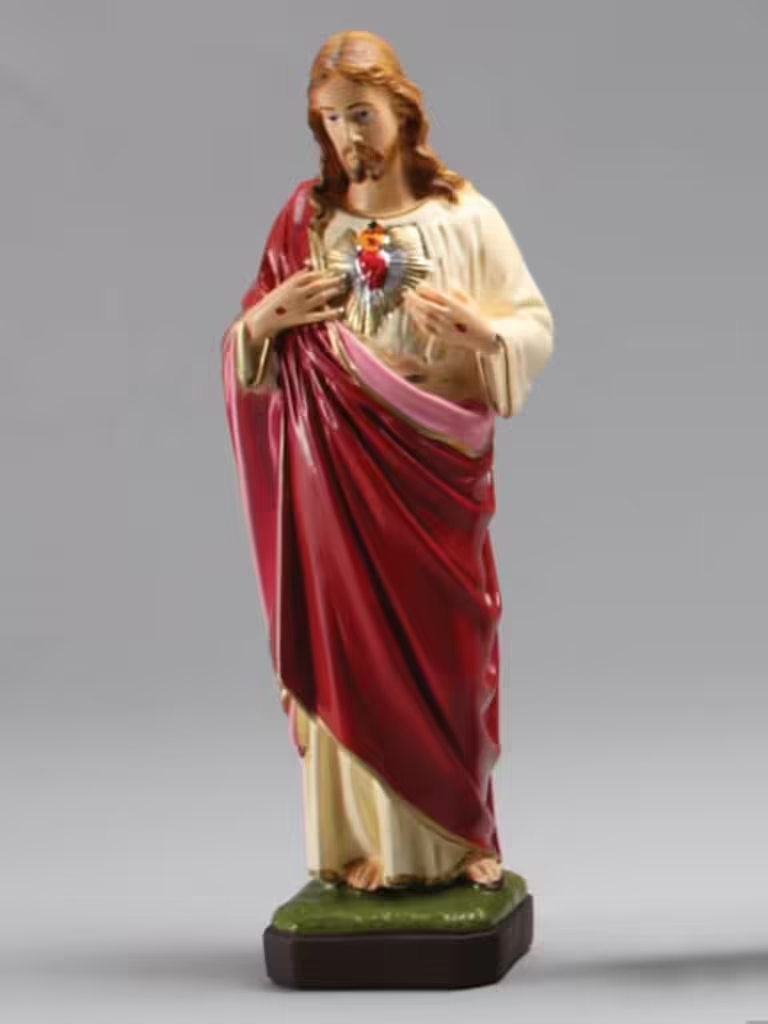
This week I aim to finish writing a book for a publisher by Friday. Therefore to save time and since it’s June again, I’m reprising (mostly)a previous post about the Sacred Heart.
Last week I spoke to catechetical leaders in our diocese about the love of Christ. I wanted a statue of the Sacred Heart for the prayer table that day. One of our kind Sisters found a beige one and added red paint for me so it resembled the one pictured here.
The month of June is dedicated to the Sacred Heart. Not so long ago I was in line in the library. When the man in front of me opened his wallet, I glimpsed a Sacred Heart badge. Today some people consider this devotion passé or sentimental, and children may think the art is morbid. Still, the heart of Jesus is a powerful symbol. What does the heart mean in our culture? Life, love, our whole being. (Hebrews thought kidneys had this role!) The heart of Jesus stands for his total, tremendous love for us. And that is the heart of the matter!
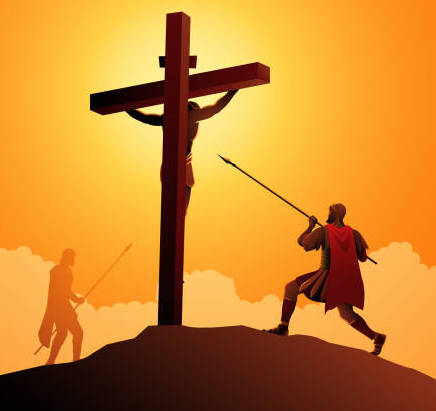
When we say, “I love you with my whole heart,” we mean “with all that I am.” God’s love for us compelled him to hide his divinity and become human. Almighty God became one of his creatures. He showed with all his being that he cared for us. His life on earth culminated in the greatest act of love: dying for the sake of the beloved. What’s more, after Jesus died on the cross to save us, a soldier thrust a lance into his heart to make sure he was dead. Yes, a heart is a very fitting symbol for the love of Jesus.
A Young Saint-to-Be
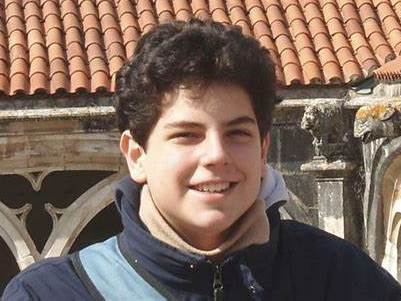
Does technology give you headaches? Does your computer act up? Luckily we have a new expert to call on for help. As of May 24, Blessed Carlo Acutis is closer to being canonized. A second miracle through his intercession has occurred, so Pope Francis approved his canonization. Because Carlo died when he was just fifteen years old, he will be the first millennial saint. He is the patron of youth and computer programmers.
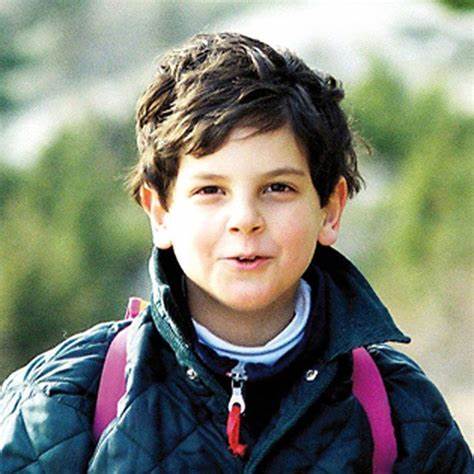
So how did Carlo attain holiness in such a short time and when neither of his parents were religious? After he was born in London in 1991, the family moved to Italy. He was in the care of nannies, one of whom shared the Catholic faith with him. At a daycare children bullied him and took his toys. When a nanny tried to teach him to defend himself, he said, “Jesus would not be happy if I lost my temper.”
In the summer he lived with his grandparents. After each spending each day at the beach, he prayed the Rosary with older women at the church. He started school in 1997. On his walk there each morning as he passed home caretakers, he greeted them by name. At age twelve, he became a catechist. Graduating from the Catholic grade school, he went on to a Jesuit high school.
An average student, Carlo had a tutor who began going to church with him. He studied computer science on his own and taught himself to play the saxophone. A typical teenager, he enjoyed movies and video games. But uniquely, he sacrificed sweets and films, tried to practice poverty, and volunteered to help the homeless and poor. In the evening he brought a beggar in the park food from his grandmother and gave him pocket money for coffee. He donated games he received on his birthday to children who had none.
Carlo cared for the world. He picked up litter on his hikes and removed rubbish from the ocean. He had pets —cats, dogs, and fish—but also asked his parents to take in stray animals.
At school he defended classmates who were bullied, especially those with disabilities, and girls that boys harassed. He supported friends whose parents were divorcing or separating and invited them to his home. When two classmates were fighting he helped them reconcile.
Carlo’s faith brought both his parents back to the Church and led them and others to go to daily Mass. By speaking about the faith, he influenced a servant from India, as well as the servant’s friend and mother to be baptized. He was nicknamed “God’s influencer.”
Websites
Carlo was skillful in using the computer and Internet and helped others who had problems with them. He created a website for his parish and another to promote volunteering. His most outstanding work was cataloguing Eucharistic miracles. Carlo saw this as a way to use media to evangelize.
Death
On October 1, 2006, Carlo had a sore throat and was diagnosed with leukemia. He offered his sufferings for the pope and the Church. Eleven days later he had a cerebral hemorrhage and died. Because of his love for St. Francis, he asked to be buried in Assisi. His body lies in a glass tomb there, clothed in jeans and Nike sneakers.

His work inspired a traveling photo exhibition of 158 Eucharistic miracle sites. This has appeared all over the world.
Wise Words from Carlo
• “We are all born originals, but many of us die as photocopies.”
• “Let us prepare ourselves to experience something extraordinary in the eternal life.”
• “By standing before the Eucharistic Christ, we become holy.”
• “Continuously ask your guardian angel for help. Your guardian angel has to become your best friend.”
• “The Eucharist is the highway to heaven.”
• “Our soul is like a hot air balloon. If by chance there is a mortal sin, the soul falls to the ground. Confession is like the fire underneath the balloon enabling the soul to rise again. . . It is important to go to confession often.”
• “There are queues in front of a concert, in front of a football match, but I don’t see these queues in front of the Blessed Sacrament.”
Dominic
Dominic is on the other end of the age spectrum and probably won’t be canonized; he’s one of those ordinary saints. This precious member of our Notre Dame Village family went home to God last week. He was a proud marine, one of the older marines who led the young guys into Vietnam. He earned purple hearts. If you met him sitting in his wheelchair, he would tip his cap to you and greet you with a smile. If the weather was nice, you would see him outside basking in the sun.
The VA nurse who cared for Dominic told me that they wished all their patients were like Dominic. As I played the piano, he came and talked to me, sharing his wisdom. I was the recipient of Dominic’s kindness after I told him that as a kid I had the piano music for Gershwin’s “Rhapsody in Blue.” A few days later, a Sister handed me a 26-page book of that music, compliments of Dominic, who had ordered it from the Internet.
This is from Dominic’s obituary:
“Dominic was a proud Marine until the day he died. He drew strength from his service and from his upbringing, which allowed him to maintain incredible strength and stoicism until the very end.
Dominic was also an avid reader and historian, and was remarkably intelligent, often captivating his loved ones with facts and anecdotes on subjects ranging from World War II to the Guardians of Traffic. But Dominic’s favorite stories to tell were those about his family, especially those regarding his parents and Italian heritage, how he met and fell in love with his beloved wife, Eunice, and cherished experiences he had with his children and grandchildren.”
We will miss Dominic at our patriotic sing-along this year. I’ll be thinking of him as we sing the last stanza of the “U.S. Marine Corps Hymn”: “If the Army and the Navy ever look on Heaven’s scenes, / They will find the streets are guarded by United States Marines.”
For your enjoyment, here is a rousing rendition of “When the Saints Go Marching In” from a Billy Graham revival.
• Who is your favorite saint? What do you like about him or her?
• Who do you know that is an ordinary saint like Dominic?