Pros and Cons of Criticism
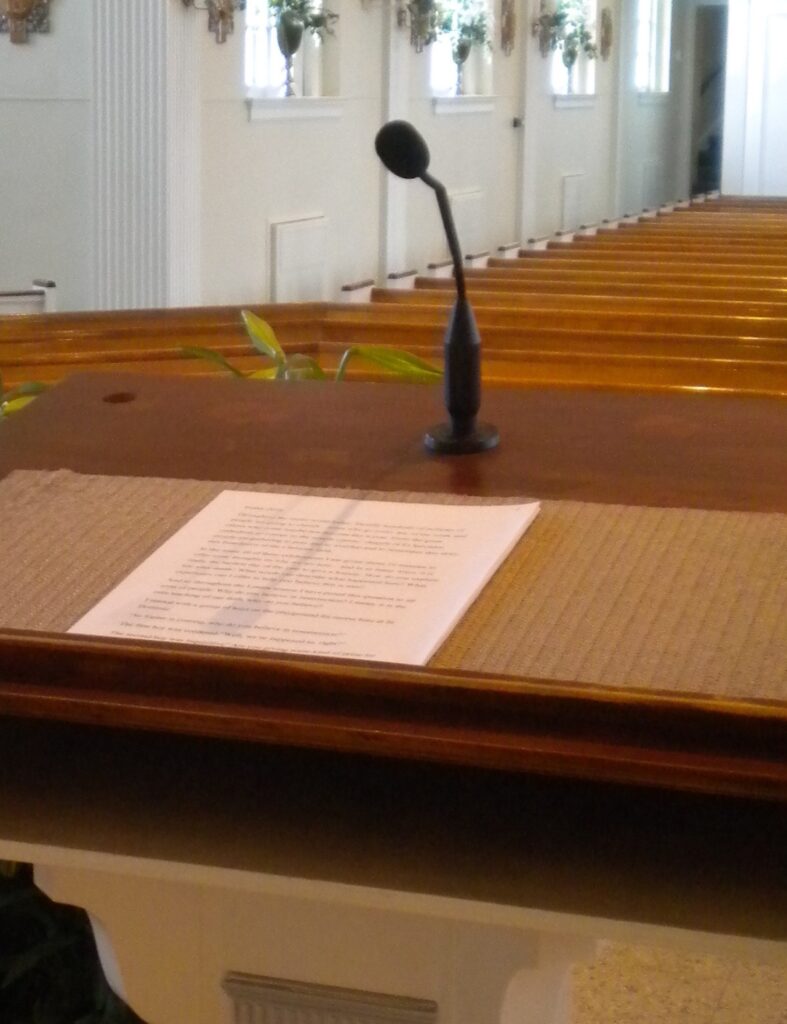
A friend was deciding whether to volunteer to be a reader at Mass. I warned her that if she did read, she had to be ready for feedback, not from the mike but from people! She might hear things like “You were too soft.” “You were too loud.” “You were too fast.” “You were too slow.” “You looked up too much.” “You didn’t look up enough.” “I couldn’t understand you.” “You didn’t speak into the mike.” Performing before a group takes courage. Criticism can be painful because it bruises our egos. We like to think we’re perfect.
Criticism can be devastating. An older sister never sang. Why? A teacher had ordered her not to sing but just move her mouth during a class performance.
Criticism can be helpful when it leads to improvement. Teachers, trainers, and coaches are expected to level criticism as a form of giving advice. Wise people welcome this kind of criticism. I appreciated it when my first editor told me my article lacked anecdotes. Now I’m careful to sprinkle them through my writing and talks. And what woman isn’t thankful when someone points out that her slip is showing or that the label of her top is sticking up on her neck?
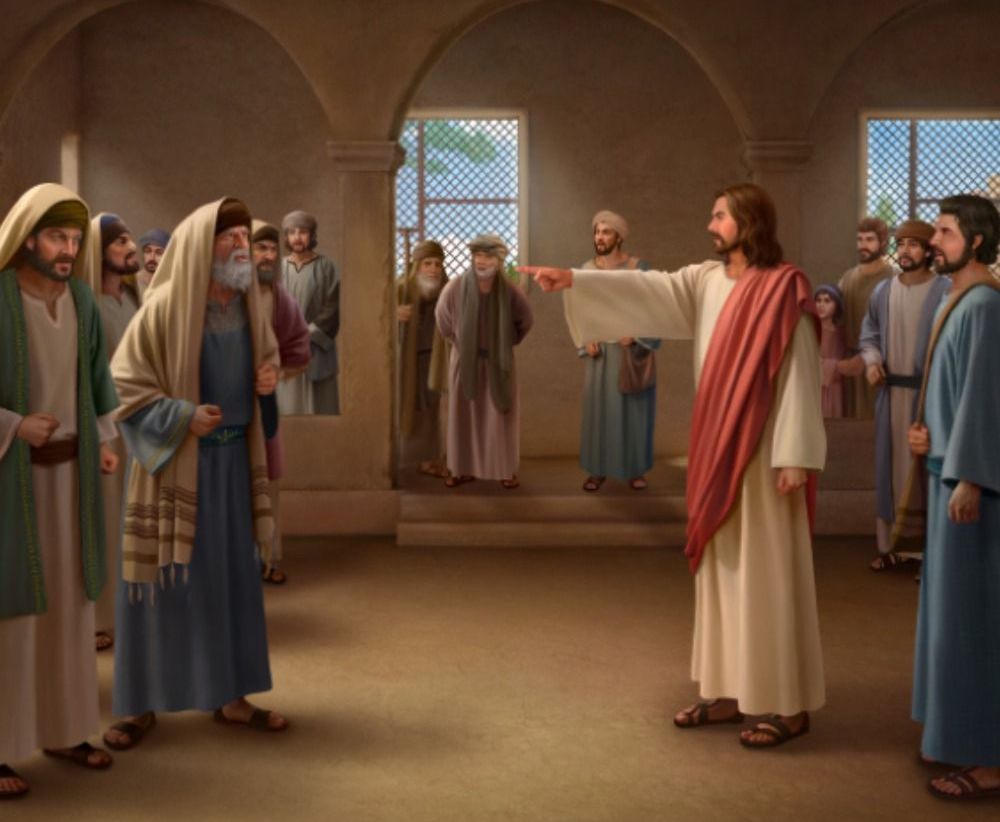
Lately we’ve been listening to Jesus justly criticize the hypocritical religious leaders of his day. They were not appreciative, and it did not lead to their improvement. On the other hand, these leaders were highly critical of Jesus, and their criticism was baseless and ridiculous.
Sometimes we need to accept criticism with a grain of salt. We should consider the source. Is the critic knowledgeable? reliable? What is their motive for the criticism: Are they trying to be kind or are they just being mean? Once someone remarked to me, “Your dress is too short for someone as tall as you.” (Although it covered my knees!) When I told my smart sister this happened, she replied sarcastically, “Yeah, you’re really tall!” (I’m 5’3″.) “They’re just jealous!” Well, that put things in a different perspective.
Now the other side of the coin. When should we criticize someone? Of course, we’re obligated to gently, not sharply, inform people when they are endangering themselves or others. But sometimes we are quick to judge people and find it hard to resist pointing out their flaws. Yesterday Bishop Amos was giving examples in his homily of how to serve people with love. He concluded with “not voicing a criticism.” In other words, sometimes we need to “let it go.”
Before criticizing a person, we ought to honestly consider our motive. It also helps to ask ourselves the three questions, “Is it true? Is it kind? Is it necessary?” Would my comment be constructive criticism, or merely giving in to the temptation to hurt someone’s feelings and make myself feel better? What would Jesus do? Or Mary?
• When have you appreciated constructive criticism?
The Rosary Musn’t Be a Mystery

This post is mostly a repetition of a former one, but it is still appropriate. October is the month of the rosary, no doubt because October 7 is the feast of Our Lady of the Holy Rosary. This feast originated with the Battle of Lepanto when, against all odds, Christians overcame the Muslim forces attacking Europe—accredited to Christians praying the rosary. (Hmm. What would happen if all Catholics prayed the rosary to vanquish ISIS?)
The rosary is associated with Catholics as much as the Mass is. It hangs in our cars, and our hands hold it in the coffin. Martin Luther, a former Catholic, did away with many Catholic things, but not the rosary. He prayed it every day until he died. The composer Hadyn prayed it whenever he got composer’s block! It was Pope St. John Paul II’s favorite prayer. After 9/11, he encouraged praying it for peace. At Fatima, Portugal, the Blessed Virgin Mary, too, advised us to pray the rosary for peace. To those who think that after the reforms of Vatican II the rosary is something to be tossed out the window, think again!
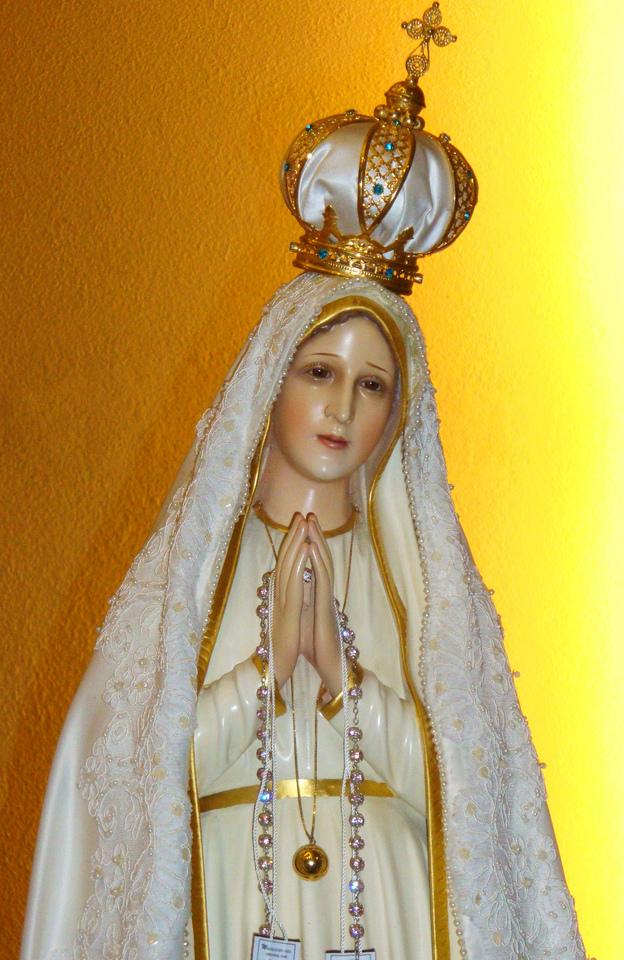
By the way, an assassin attacked Pope St. John Paul II on May 13, the day Mary first appeared at Fatima. He attributed his survival to Our Lady and had one of the bullets encased in the crown of her statue in Fatima, Portugal.
The rosary is a highly scriptural prayer, “the Gospel on Beads.” We pray two ways during the rosary: We say the traditional formula prayers (Our Father, Hail Mary, Glory Be), but at the same time we ponder the mysteries of Jesus, one mystery per decade (set of ten beads). I tell children that this takes practice, like mastering patting your head while rubbing your stomach. The repetitions of the Hail Marys is like soothing background music to our thoughts. (So soothing that the rosary can be a remedy for sleepless nights.)
The rosary is known as a Marian prayer because we primarily honor our Blessed Mother by praying fifty-three Hail Marys. The rosary has been compared to a garland of roses we present to her. I also ask the children how they feel when someone says something nice about their mother. Then I comment that likewise Jesus is pleased when we praise his mother. We Sisters of Notre Dame (Our Lady) pray the rosary every day.
Rosaries can be beautiful crystal ones or homemade. There are also single decade rosaries. I have one made from crushed rose petals. Some people pray on ten-beaded bracelets or rings. Lacking any of these, we can always pray on our hands, which conveniently have ten fingers! The largest rosary is at a shrine in Windsor, Ohio. It is made of foot-high lamps near the tallest statue of Our Lady of Guadalupe, which is 50-feet high.
On the Internet are sites that explain how to pray the rosary, list the four sets of mysteries, and even allow us to pray along. The site at www.Comepraytherosary.org enables us to pray the rosary individually or with others.
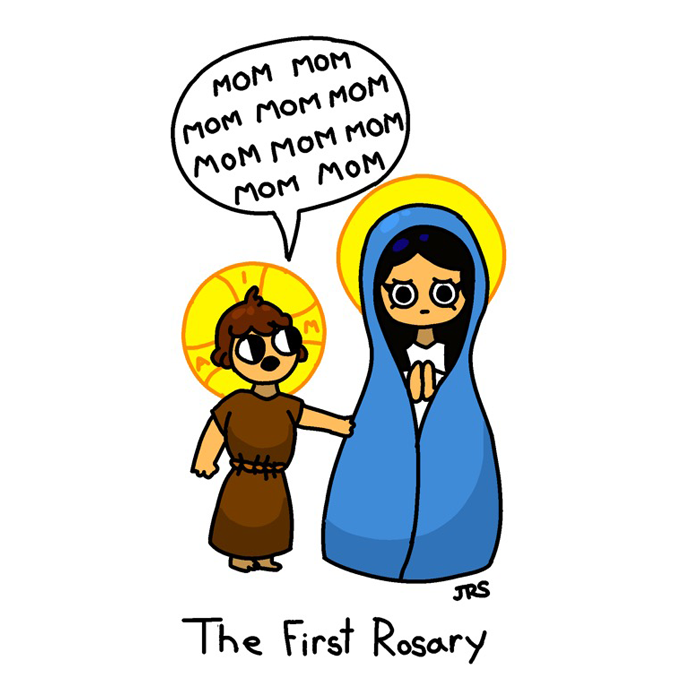
Thought you would enjoy this cartoon:
Variations: You can make up your own mysteries, such as the miracle mysteries or the parable mysteries. You can also stay mindful of the mystery by inserting in the Hail Marys words that refer to it. For example, for the Annunciation you might pray, “Hail Mary, full of grace, to whom the Angel Gabriel came, the Lord . . .”
Contrary to popular belief, the rosary developed over the years. The legend that Mary personally handed one to St. Dominic began because the Dominicans were chief promoters of the rosary.
Here is a lovely Mary Song that I never heard before:
• What rosary has special meaning for you? When has praying the rosary been a comfort or joy for you?
Season of Creation
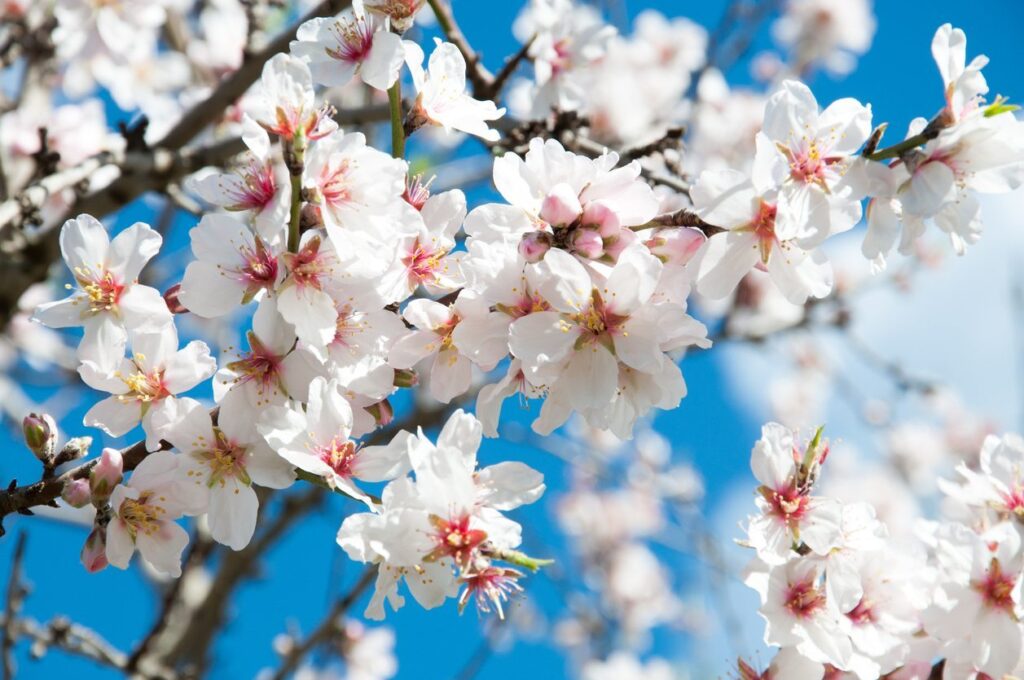
The Season of Creation runs from September 1 to October 4 (Feast of St. Francis of Assisi). In honor of this season, I present (again) the Introduction to my book Voices: God Speaking in Creation . . .
I said to the almond tree, “Sister, speak to me of God.”
And the almond tree blossomed.
~ Nikos Kazantzakis
Creations mirror their creators. A song reflects the composer; a painting, the artist; a book, the author. In the same way, the universe, the masterpiece of the supreme Creator, reveals God. Its variety, its intricacy, and its magnitude attest to God’s wisdom and power. Pope Francis notes in his encyclical Laudato Si’ that St. Francis “invites us to see nature as a magnificent book in which God speaks to us and grants us a glimpse of his infinite beauty and goodness” (par. 12). Every created thing is an epiphany, echoing some aspect of the divine Being.
To behold a snow-topped mountain, its massive rocky slopes jutting boldly into the sky, is to know God’s majesty. To sit at the foot of a waterfall and watch its refreshing rush of water cascade into a deep, limpid pool is to see God’s purity. To stroll through woods of lovely ferns, mosses, and lofty trees is to be enveloped with the peace and serenity of God. The fragile daisy with its velvety white petals and bright yellow center tells of the Creator’s gentleness, while the shimmering, iridescent rainbow arched across purple-gray clouds bespeaks his beauty. A newborn baby is evidence of God’s tenderness. Fire is a reminder of the energy of God’s love. A monkey shows God’s sense of humor, and a giraffe, his unpredictability.
The psalmist, who is thought to be King David, an ancestor of Jesus, is attuned to the speechless voices of the universe. He sings of the sun, moon, and stars in this manner:
The heavens are telling the glory of God;
and the firmament proclaims his handiwork.
Day to day pours forth speech,
and night to night declares knowledge.
There is no speech nor are there words;
their voice is not heard;
yet their voice goes out through all the earth,
and their words to the end of the world.
Psalm 19:1–4
St. Gregory Nazianzen, a fourth-century Archbishop of Constantinople and a Doctor of the Church, echoes this concept in a hymn:
All things proclaim you—
things that can speak, and those that can not . . . .
All things breathe you a prayer,
a silent hymn of your own composing.
In the same tradition, St. Francis of Assisi, that lover of nature, expresses the following prayer in his joyous paean “Canticle of the Sun”:
Praise be to Thee, my Lord, with all Thy creatures
especially to my Brother Sun,
Who brings us the day and through him Thou dost
brightness give.
And beautiful is he and radiant with splendor great.
Of Thee Most High, he speaks.
More recently, in the writings of French theologian and philosopher Teilhard de Chardin, S.J., the notion that all creation manifests the Creator appears like a mighty refrain, especially in his beautiful book The Divine Milieu: “[T]he great mystery of Christianity is not exactly the appearance, but the transparence, of God in the universe.”

Physical things are important to us. Partly spiritual, partly material beings, we live and work out our destiny in the realm of matter. How we use it and how we abuse it determine our eternity. We are free to expend and ravage the material universe for our own power and pleasure, or we can share it. We can let it go to ruin, or we can show concern for it. We can regard the world as just the lucky result of a coincidental combination of chemicals eons ago, or we can cherish it as the love-gift of a personal God who cares about us. The latter point of view opens for us the possibility of finding material objects a source of prayer.
The Word took on flesh and lived with us among color, hardness, roughness, scent, wetness, and warmth. The Son of God reveled in the things of Earth, the handiwork of his Father. Jesus saw that they were good—so good that he redeemed them along with us at the price of his life. Furthermore, he assigned them prominent roles in the act of redemption. During his public life, Jesus often incorporated concrete objects in his teaching. His audiovisuals were the birds of the air, the bread women baked, the Temple in Jerusalem, a Roman coin, and the roadside fig tree. Today, from the dimension where he dwells, Jesus reaches out in the sacraments and touches us with things: water, bread, wine, and oil. Matter has been christened by his presence.
In particular, objects associated with Christ in the Gospels hold much potential for stimulating meditation. Each chapter of this book is a patchwork quilt of reflections on one of these things. Some topics, like the manger and the crown of thorns, are familiar. Others, like the turtledoves and the water jar of the Samaritan woman, are obscure, not notable. All become meaningful when considered with faith and love; all convey messages about relevant themes today, such as hospitality, co-creation, peace and justice, reconciliation, and respect for life.
May these pages and the inspiration of the Holy Spirit draw the reader to Scripture, to prayer, and to Jesus so that he or she too may proclaim the greatness of the Lord.
The universe unfolds in God, who fills it completely. Hence, there is a mystical meaning to be found in a leaf, in a mountain trail, in a dewdrop, in a poor person’s face. The ideal is not only to pass from the exterior to the interior to discover the action of God in the soul, but also to discover God in all things. Saint Bonaventure teaches us that “contemplation deepens the more we feel the workings of God’s grace within our hearts, and the better we learn to encounter God in creatures outside ourselves.”
Pope Francis, Laudato Si’ (par. 233)
• At what special place on our planet does God speak to you?
Here is a gorgeous video celebrating creation:
Announcement
Here is a link about a free app that you might find helpful. Its creator, Ryan Bilodeau, explains: “At a time when we as a society are facing unprecedented moral challenges, the app collects, categorizes, and stores the Church’s official moral teachings in one place. Searching through the Catechism of the Catholic Church can be a timely process, and the app can save people countless times doing research on their own.”
Humility, Humus, and Humiliations
When I was in the novitiate, each Monday we were assigned an act of humility. Of the four possible practices, the easiest was to pray Cardinal Merry del Val’s “Litany of Humility.” Some lines from this prayer are “From the desire of being honored, deliver me, Jesus. From the fear of suffering rebukes, deliver me, Jesus. That others may be esteemed more than I, Jesus, grant me the grace to desire it.” You get the idea.
Years later, one day during a celebration, Sister Frederick entertained us Sisters with a humorous personal story. When she entered the convent and became a postulant, she was assigned a “guardian angel” (a novice appointed to help introduce one to religious life). Her guardian angel gave her a task. She said, “I want to be a nurse. Each day pray the Litany of Humility so that this will happen.” The postulant did as she was told, and her guardian angel did become a nurse. Then Sister Frederick said, “And as for me, others have been esteemed more than I, others have increased and I have decreased, others have been chosen and I set aside, others have been praised and I unnoticed….”
I’ve found that self-imposed acts of humility aren’t really necessary. Life itself provides plenty of humiliations to keep my ego in check!
A recent Gospel reading told of the disciples arguing about who was the greatest. Their words afforded Jesus the opportunity to teach: “Whoever wants to be first must be last of all and servant of all” (Mark 9:33–35). Apparently they didn’t learn their lesson, for at the Last Supper right after the institution of the Eucharist, the argument continued.
Previously James and John had the audacity to ask for the highest places in heaven. (Matthew’s Gospel protects their reputation by having their mother request this!) Jesus also taught, “All who exalt themselves will be humbled, and all who humble themselves will be exalted” (Matthew 23:12).
These stories show a lack of humility, a main virtue prized in all religions. Essentially, this virtue is simply seeing yourself accurately, as God sees you. The word humility is derived from humus, which means “earth.” This etymology is a reminder that we are but dust. A humble person does not have an inflated ego, a big head. One of Aesop’s fables illustrates the folly of such conceit:

Roaming by the mountainside at sundown, a wolf saw his shadow greatly magnified. He said to himself, “Why should I, being of such an immense size and extending nearly an acre in length, be afraid of the lion? Ought I not to be acknowledged as king of all the collected beasts?” While absorbed in these thoughts, he didn’t notice a lion approaching. The lion fell upon the wolf and killed him. Too late the wolf realized that his overestimation of himself caused his destruction.
True humility is also honest. Remember Uriah Heep in Dickens’s novel David Copperfield? He is the epitome of false humility as he protests, “I am well aware that I am the ‘umblest person.”
Being humble does not mean denying our good points. Henry Augustus Rowland, professor of physics at Johns Hopkins University long ago, was once a witness at a trial. During cross-examination a lawyer asked him, “What are your qualifications as an expert witness?” The usually modest professor replied, “I am the greatest living expert on the subject under discussion.” Later a friend expressed surprise at the professor’s uncharacteristic answer. Rowland said, “Well, what did you expect me to do? I was under oath.”
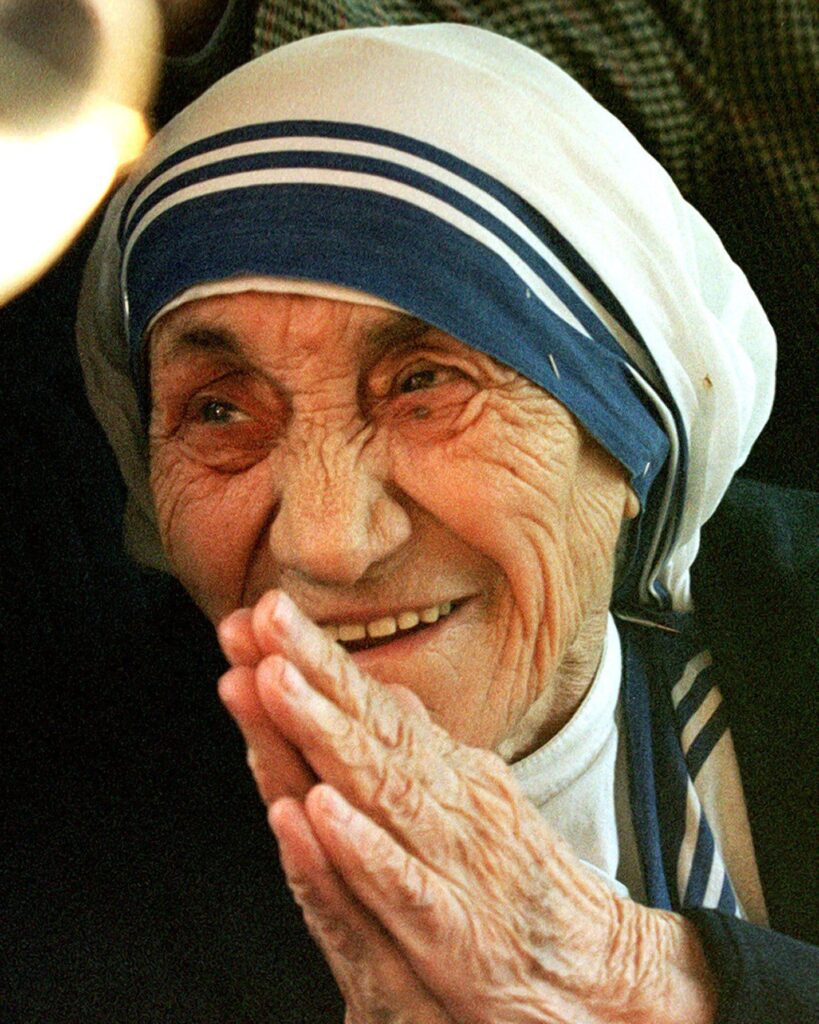
Saint Teresa of Calcutta offered a succinct description of humility:
“Humility is the mother of all virtues; purity, charity and obedience. It is in being humble that our love becomes real, devoted and ardent. If you are humble nothing will touch you, neither praise nor disgrace, because you know what you are. If you are blamed you will not be discouraged. If they call you a saint you will not put yourself on a pedestal.”
We are repulsed by people who are arrogant, vain, proud, and self-important. To the Greeks, hubris (pride) was the worst sin against the gods. In the Catholic tradition it was pride that led to the fall of the angels and the fall of human beings.
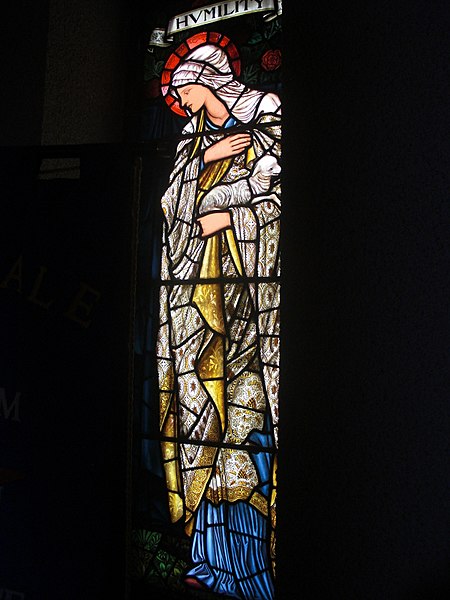
At the top of this post is a stained-glass window depicting “humility” designed by Sir Edward Burne-Jones. Not surprisingly, it shows the Blessed Virgin Mary, the “handmaid of the Lord.” It was her humility, among other virtues, that drew God to her.
Of course, the humblest person who ever walked this Earth was Jesus. Although he was almighty God, he stooped to become a man and as a man he stooped to wash the apostles’ feet.
• What other humble persons do you know of? Who can you stoop and serve today?