A Painting Parable: Beauty Out of a Mess
 Years ago when taking a course at our seminary, I met a priest who was an artist. He loaned out his paintings to the priests and seminarians who lived with him there. At the time, Sister Megan, an artist, was my suite mate. I suggested that she loan me one of her paintings. She graciously invited me to her studio and let me choose one. You can see my choice here. It has an unusual origin. Sister explained that one day while she was painting a picture, whenever the brush got a glob of paint on the end, she wiped it off on an empty canvas beside her. After she finished the picture she was working on, she looked at the globs and began swishing them around to create the piece that I favored. Not only do I like my painting, which I take with me from home to home, but I find that like a parable it holds hidden meaning. For me it says that rejects, leftovers, things that seem to be worthless can become beautiful. They can become treasures.
This is comparable to the mystery we celebrate during Holy Week. Jesus took the pitiful human race, polished it, and promised it a glorious life in the next world.
I was going to give other examples, but because I’m furiously trying to finish writing a book this week, I will leave that to you. Can you think of some?
What other meaning do you find in this artwork?
Swimming in God, the Omnipresent One
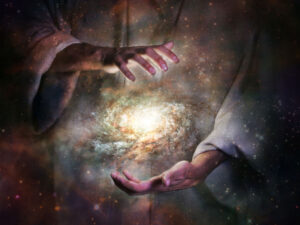 A little boy was afraid to get the broom out of the dark closet for his mom. She assured him, “Don’t be afraid. God is everywhere.” So the little boy cracked open the closet door and called in, “Hey, God, would you hand me the broom?” God is omnipresent. We are never alone because God is constantly with us, and so we needn’t feel lonely or be afraid. God says in Isaiah 41:10, “Do not fear, for I am with you. . . I will strengthen you and help you; I will uphold you with my righteous right hand.”
The Catechism of the Catholic Church calls God “Most Near.” How can God be everywhere? He is the eternal, infinite spirit. He is not restricted by space or time. God is in everything he created simply by the fact that he is the cause, the source of all being. (But everything is not God or even a part of God.) God keeps everything in existence. If God stopped thinking about you, the chair you are sitting in would be empty.
St. Paul said, “In him we live and move and have our being.” God is like the air we breathe: invisible, life-giving, all around us. There is a story about a little fish who is looking for the ocean. He asks a big fish, “Where is the ocean?” The big fish replies, “It’s what you’re swimming in.” “But this is just water,” the little fish replies, and he swims on in search of the ocean. This is what we’re often like. Although we are swimming in God, we don’t realize it. Sometimes at prayer we become acutely aware of God’s presence. Beholding a fantastic piece of God’s creation also might bring us to stand before God in awe. Most of the time we are oblivious of our Creator. 
In the beautiful Psalm 139:5–11 we sing about God’s omnipresence: “Behind and before you encircle me and rest your hand upon me. . . .Where can I go from your spirit? From your presence, where can I flee?/ If I ascend to the heavens, you are there; if I lie down in Sheol, there you are. /If I take the wings of dawn and dwell beyond the sea, /Even there your hand guides me, your right hand holds me fast./ If I say, ‘Surely darkness shall hid me’. . .Darkness is not dark for you.”
Jesus promised, “I will be with you always.” The apocryphal Gospel of Thomas, a collection of sayings of Jesus, includes this one: “Split wood; I am there. Lift up a rock, you will find me there.” That’s why St. Patrick—and we—can say, “Christ with me, Christ before me, Christ behind me; Christ in me, Christ beneath me, Christ above me; Christ on my right, Christ on my left; Christ in breadth, Christ in length, Christ in height.”
God is with us the way he was with the Hebrews when they fled Egypt. God’s loving kindness (hesed) surrounds us. When Pharoah’s army was in pursuit, the Israelites called out to Moses in fright. He replied, “the Lord himself will fight for you; you have only to keep still.” God’s hesed surrounds us too.
We call Israel the holy land. But because God is everywhere, our land is holy too. And yes, God’s got the whole world in his hands.
Right now God is with you, watching you. Why? You are the apple of God’s eye!
What makes you aware of God’s presence?
The Cross: A Sign of Love
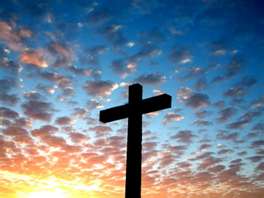
When my niece Lisa was baptized, I gave her a cross necklace. It was a lovely cloisonné cross with a pink rose in the center, but it was still a cross. How curious that an instrument of execution is now a worn as jewelry! (Can you imagine wearing a guillotine or an electric chair?) Moreover, many Christian houses have a cross displayed somewhere, with the body of a nearly naked man nailed to it. The cross is so common around necks, atop church steeples, and in cemeteries that we have become immune to the shocking horror of it as well as the glory associated with it. That is why Lent is so important. During Lent we have six weeks to ponder and pray over the mystery and the message of the cross. As we eat our hot cross buns, pray the stations of the cross, and venerate the cross on Good Friday, we realize once more what it symbolizes.
From Death to Life
On Calvary Christ transformed the cross into a sign of life. Ash Wednesday’s ashes confront us with the hard truth that we will die. However, these ashes are placed on our foreheads in the form of a cross. Because of the cross, we can laugh at death and recognize, like St. Paul, that is has no sting for us. Yes, we know we will die, but we also know that we will live forever because Jesus redeemed us on the cross. Since Christ’s death, dying and rising are inseparable. At the Easter Vigil the priest carves a cross into the paschal candle. The cross has become a symbol of victory.
The cross is also a sign of love. Some pictures show a crucifix (a cross with the body of Christ) with the words, “I asked Jesus, ‘How much do you love me?” ‘This much,’ he answered, and he stretched out his arms and died.” Jesus loved us so much that he died for us. Read that sentence again, substituting “me” for “us.” Isn’t that incredible? Only the unfathomable depths of God’s goodness and love make the statement believable. Every cross reminds us of God’s love revealed in Christ. This includes our physical crosses as well as the sign of the cross made over us in blessings. We are wrapped in God’s love from the time we are sealed with the cross at baptism the day we are sent into eternity sealed with a cross.
We ourselves are to be living crosses: signs of life and love. The very structure of our bodies is cruciform. Lent and the cross call us to conversion: to become better signs than we are.
You can use the image of the cross during Lent to spur your children toward a conversion of heart. Invite them to reflect on it by discussing:
- Where cross shapes are seen (including the northern sky)
- Its shape (encompassing all directions, north, south, east, and west), its resemblance to a plus sign
- Its significance
- Its use in the liturgy and in art.
Your children might like to make simple crosses out of wire, wood, clay, or foil. Older children can make a more complicated cross by gluing  burnt wooden matches to a cardboard or wood base and varnishing them. (Search “matchstick cross” in the Internet.) Have children become familiar with the various kinds of crosses by cutting them out of black paper and backing them on colored paper.
Is there a cross or crucifix that has special meaning for you?
Thank God You’re You! Loving Yourself
 Last year after Mass, someone said, “Come with me. You have to meet Father’s sister. She looks just like you.” Did anyone ever tell you, “You look just like my ________________”? (Fill in the blank.) Maybe we do have a doppelganger or two. But no one will ever be exactly like us, even if we are cloned. Each one of us is unique, a nonrepeatable combination of physical characteristics, talents, and memories. Each is to be cherished and loved. No wonder Jesus tells us to love others as we love ourselves. He takes it for granted that we love ourselves. And what’s not to love? You may dislike certain aspects of your looks or personality. You may wish you had a voice like Lady Gaga or Andrea Bocelli or could play basketball like LeBron James. But there are many reasons to love yourself. Let’s count the ways—at least some of them.
- You are God’s masterpiece, the culmination of creation. Made in God’s image, you are God’s beloved.
- You are a temple of God; God dwells within you. Therefore you are sacred.
- You are capable of thinking: solving crossword puzzles and Sudokus, planning the next meal, carrying on a conversation, enjoying a book or a movie, laughing.
- You have an amazing body that can walk, swim, sing, behold Niagara Falls and the Grand Canyon, hear Beethoven’s Fifth Symphony, smell and taste fresh-baked bread, and even reproduce. You have eyelashes that protect your eyes; a big toe to give you leverage and balance; and, as I found out, a trapezius muscle that contracts to cause pain and protect your spinal cord when you have a herniated disc in your neck.
- You have power to determine the course of your life. You make decisions regarding lifestyle, partner, career, housing, vacations, and so on.
- You aren’t perfect, but you certainly can take credit for a number of good deeds.
- You have the precious ability to love other people and be loved by them.
- Jesus gave his life for you and deigns to come to you in the Eucharist.

The gift of your life, the gift of being, is entrusted to you. You can care for it, both body and soul, or not. You can make the most of the time that is allotted to you on earth by developing your talents and taking opportunities, or you can squander it. No one knows you better than you, except for God. Hope you, like God, know how valuable you are. After all, God thinks you are the apple of his eye.
Loving ourselves to the extreme, being narcissistic, egotistical, self-centered, of course, is wrong. But a healthy love of self is a virtue. How is it manifested? We pay attention to ourselves: We eat properly, exercise, get enough sleep, go to the doctor, make time for leisure, socialize. We also maintain a good relationship with our Creator through prayer and the sacraments. We accept ourselves for who we are—someone in this country, in this century, with certain characteristics, ideals, aspirations, and flaws. Just as we are gentle and understanding with other people we love, we forgive ourselves. We extend mercy and compassion to ourselves.
What can you do to be kind and loving to yourself today? What do you do to “pamper” yourself?
You might pray (or sing?) Psalm 139 slowly and thoughtfully. That’s the one about God knitting us in our mother’s womb.
The Heart of Jesus, An Immortal Devotion
 The heart of Jesus was formed and began beating in the body of a young Jewish girl. It stopped beating about thirty-three years later and was pierced by a soldier’s lance. Ever since, it has been a symbol of the God-Man’s love for the human race, for us. Three recent experiences have renewed my interest in devotion to the Sacred Heart. First, was a story Sister Mary John Albert told. Her family had always had devotion to Jesus under this title, and they displayed the image in their home. As a girl, Sister was drawn to the Sisters of Notre Dame, her teachers, who had special devotion to the Sacred Heart. She joined the community, leaving her parents with an empty nest, for she was an only child. When she was a novice, her parents informed her that they wished to adopt a baby. For months they applied to various agencies but were rejected because of their age. (The father was 40, the mother, 36!) Sister prayed furiously to the Sacred Heart. As time drew near for her to make her vows and become a professed sister, she dared to give Jesus an ultimatum: “You don’t get me if my parents don’t get a baby.”
Sister Mary Agera, SND, attended a conference in Montreal where she met some sisters who ran an orphanage. She explained how Sister Mary John Albert’s parents desperately wanted another child. In June (the month of the Sacred Heart) on the very feast of the Sacred Heart, the parents received a letter from the bishop of Montreal inviting them to come and choose from children at the orphanage. They adopted a six-week-old baby boy. Sister got a brother and made her vows.
My second encounter with the Sacred Heart came as I read a new book about Pope Francis’s reactions to wise advice from the elderly. He told how a brave single mother from Sicily had helped his mom weekly in their home in Argentina. After he was ordained, she came to see him, but he had no time to talk and, to his deep regret, let her know he wasn’t available. He lost track of her. Then one day a visitor’s cabdriver turned out to be the woman’s son, and Pope Francis reconnected with her. When she visited him, she gave him a medal of the Sacred Heart. To this day he wears it under his white cassock on his heart. He said, “Her medal of the Sacred Heart of Jesus helps me through struggles to this day.”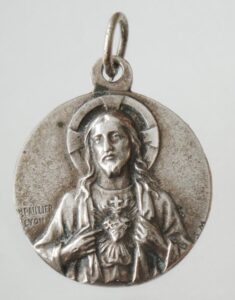
Third, in the process of writing a book about St. Julie Billiart, I realized how much she was enamored with the Sacred Heart. At the age of ten she was enrolled in the Confraternity of the Sacred Heart, signing up to spend from two o’clock to three on Good Friday in prayer before the Blessed Sacrament. On the day of her first vows, she consecrated herself anew to the Sacred Heart. She had her community, the Sisters of Notre Dame, pray an Act of Reparation to the Sacred Heart of Jesus every day together. On the Thursdays before First Fridays (observing First Fridays is a Sacred Heart devotion) the Sisters made a holy hour before the Blessed Sacrament. For twenty-three years Julie was paralyzed and usually bedridden. Then one day a priest asked her to make a novena to the Sacred Heart for someone he knew. On the fifth day of the novena, he told Julie to stand and walk. And she did. She was the “someone.” At the age of fifty-two, St. Julie began making one hundred and twenty journeys, often on foot!
In a previous blog post you can find more information about the Sacred Heart, such as how this devotion began: “Why the Sacred Heart?” at https://bit.ly/2hKcFpz
What have been your experiences with the Sacred Heart of Jesus?