Are There Miracles Today?
 Each year a team of medical professionals from my parish, St. Dominic, spend a week in a poor village in El Salvador screening and treating more than 1,000 patients. On their visit last month, to their dismay there was only enough lidocaine for local anesthesia for five or six patients. However, each time the doctors needed the lidocaine to prepare another patient for a procedure, there inexplicably was some left in the vial! This went on day after day until the last patient was treated. The pastoral associate who led the group views this was an honest-to-goodness miracle.
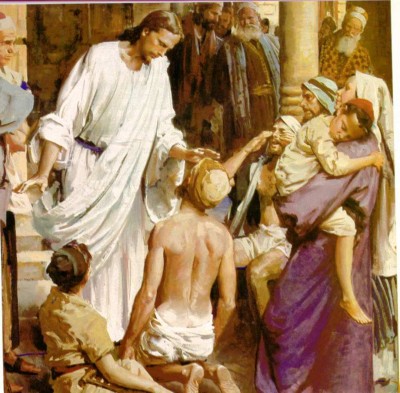
We say things like “It’s a miracle I didn’t have a heart attack watching the last World Series game.” A real miracle, however, is something impossible that occurs when there is no natural or scientific explanation and it can only be attributed to divine intervention. The Old Testament is rife with miracles, such as a burning bush, a Red Sea that parts, and a boy brought back to life by the prophet Elijah. Jesus, the divine physician, performed miracles. At his word, a leper was healed, a paralytic stood and walked, a blind man regained his sight, a bent over woman straightened up, and a dead little girl came back to life. Jesus didn’t multiply medicine, but he multiplied bread and fish and changed water into excellent wine.
The saints, too, are known as miracle workers. The apostles healed many sick people, for example, when Saint Peter told a lame beggar to get up and walk, the man jumped up and began walking and leaping! Saint Andre Bessette of Montreal and Venerable Solanus Casey of Detroit healed people. Saint Pio of Pietrelcina could bilocate. Saint John Vianney could read minds. When bread ran out, Saint Julie Billiart miraculously provided it. Saints continue to work wonders after they die. Before a person is canonized, the Church requires two miracles as a sign that he or she is really in heaven.
At Fatima thousands of people witnessed the sun dancing in the sky. Every year on the feast of Saint Januarius his blood kept in a0 vial liquifies. Our Lady of Prompt Succor in New Orleans has provided miraculous protection, most notably against a fire and a British attack. When the atomic bomb fell on Hiroshima, eight Jesuits living only a half mile from ground zero were unharmed and not even affected by radiation later, unlike the 80,000 who died instantly. Often when towns or buildings are destroyed a religious image is unharmed. And every so often something happens in our life that we can’t explain. A man’s epilepsy disappears after his parish prays for him. After having surgery a woman experiences no pain.
Yes, God obviously is alive and well and breaks into our lives periodically. I remember once when I dialed the wrong number, a man I didn’t know answered. He said, “I was just sitting here asking God to give me a sign that he exists and then out of the blue you, a Sister, calls me.” One time a community treasurer didn’t know how she could pay a certain bill until a donation came in—for the exact amount due. A friend claims that when she has an impossible number of things to do and prays for help, time stretches for her!
Did you ever start searching for something in a book, and it opened to exactly the right page? Did you ever “coincidentally” encounter a person who impacted your life? Were you ever in a situation where you should have been hurt but escaped unharmed? If so, you might say you were lucky. Better to say you were blessed!
Jesus promised, “If you have faith the size of a mustard see, you will say to this mountain, ‘Move from here to there, and it will move” (Matthew 17:20). Since nothing is impossible for God, we shouldn’t be surprised when he works miracles for us. After all, God loves us.
Have you experienced or witnessed an honest-to-goodness miracle?
 BOOK REVIEW: Praying with Scripture: The Bible: You’ve Got Mail!
The Bible is Sacred Scripture for Christians who regard God as its author. It is a gift by which God reveals himself to us and communicates with us. Sadly, for too many people, it is a hidden treasure. If they own a Bible, it may lie gathering dust instead of becoming dog-eared. Praying with Scripture introduces the reader to the Bible as God’s letter meant to be taken personally—a love letter. For the uninitiated, the book briefly explains the history and composition of the Bible and how to find your way around in it. But the large majority of chapters are devoted to how to use the Bible for prayer. Topics found in the book include ways to read the Bible, methods for meditating on Scripture passages, how to personalize passages, various ways to pray psalms, lectio divina, and lacing the Rosary and Way of the Cross with Scripture. A new chapter not found in the original version of this book is “Teaching Children to Pray with Scripture.”
At the end of each chapter are questions for personal reflection that may also be used for group sharing in book club or retreat settings. These questions are followed by a number of suggestions for Bible-based prayer related to the subject of the chapter.
In Praying with Scripture Sister Kathleen shares simply and clearly the knowledge she’s acquired from years of teaching and writing about God’s Word as well as from using it for prayer herself. People who are looking to nurture their personal relationship with God (and helping others to do so) are bound to profit from reading this book.
What’s Heaven Like?
 My Aunt Arline was born with cerebral palsy. A good Lutheran couple adopted her. Operations to straighten her arms left long scars on her. Her speech was slurred, and she walked with difficulty. Sometimes her slight body was marked with ugly bruises from falls. Nevertheless she was a delightful person, married to my father’s brother, who had polio. In the seventh grade I wrote an essay about Aunt Arline called “The Abused Handicap.” During the summer my sister and I each took a turn spending a week with Aunt Arline, working jigsaw puzzles and going shopping with her, as she held unto our arm. When my mother called one day to tell me that Aunt Arline had died, instantly I had a vision. In my mind’s eye I saw Aunt Arline in a large green field. She was doing cartwheels!
The Sadducees did not believe in the afterlife like the Pharisees did. One day they set out to ridicule the idea of resurrection and to trick Jesus into looking like a fool. According to Jewish law, if a man died childless, his brother was obliged to marry the widow and have a child in his brother’s name. The Sadducees concocted an absurd situation. Suppose a man dies and one by one his six brothers marry his wife and also die. The Sadducees asked Jesus which of the seven men would be the woman’s husband in heaven. Jesus replies no one because in heaven we will be like angels. The Sadducees are deflated and don’t dare ask him any more questions. There is no marriage in heaven. It isn’t needed. But no doubt married couples who shared their life on earth will enjoy a special bond in heaven.
Unlike the Sadducees, we do believe in heaven. For us, death is just a door that leads to a whole new wonderful world. In the Old Testament, Job says, “I know that my Redeemer lives, . . . and after my skin has been destroyed, in my flesh I shall see God.” The first Maccabee brother to be martyred declared, “The King of the world will raise us up to live again forever.”
Jesus taught that heaven existed. Peter Marshall, a former chaplain of the United States Senate, stated, “Jesus told us that what we had hoped for, was true.” At the Last Supper, Jesus assured the apostles—and us—that he was going to heaven to prepare a place in his Father’s house, which has many rooms. After Jesus died, he rose with new, glorified life. And because he rose from the dead we can believe his promise that we too will rise again and live forever.
What is heaven like? No one knows. Jesus compared heaven to a wedding feast, a joyful celebration. St. Paul had a vision of heaven but couldn’t describe it. It was beyond words. Paul could only say, “Eye has not seen, ear has not heard, nor has the heart ever imagined what God has prepared for those who love him.” John in the book of Revelation tries to put into words the city of God he saw in a vision. He says it is adorned with every jewel and pearls. The street is pure gold. The water of life flows there and trees of life grow there. There is no need for lamps or the sun because the glory of God is its light.”
A common notion of heaven is that we will all be angels sitting on clouds and playing harps. That seems pretty boring to me. Luckily it isn’t true. For one thing, we will not turn into angels. Angels are pure spirits who have no body. In heaven we human beings will still have our bodies but they will be glorified, like the body of the risen Lord that could pass through matter. Our bodies will be perfect. I look forward to not needing my glasses and hearing aids. And, yes, my Aunt Arline will be able to do cartwheels.
Also, we will be perfectly happy. At times we have a little taste of heaven while we are on earth. We experience something that fills us with joy. That wonderful feeling will never end in heaven. In the Bible’s Book of Revelation we read, “God will wipe every tear from his people’s eyes. Death will be no more; mourning and crying and pain will be no more.” Just think: We will no longer need pills and shots and therapy.
Our earth is so beautiful: the Grand Canyon, Niagara Falls, night skies full of stars, our sunrises and sunsets. If earth is this splendid, surely then heaven will be overwhelmingly gorgeous. Of course, the best thing about heaven is that we will be with God forever. This is the destiny we were created for. All of us long for something more. Someone said it’s as though a piece of our heart is missing and we won’t be complete until we hear the words “Welcome home!” and are united with God. St. Augustine prayed, “Our hearts are restless until they rest in you.” The yearning we have for God will finally be completely satisfied in heaven. We will see God face to face, clearly, in what is called the Beatific Vision. We will be enveloped by his love.
In heaven we will meet Jesus, our Lord and Savior, face to face. We will meet Mary, his mother and ours. The angels will be our companions, those magnificent creatures. We’ll be able to thank our Guardian Angel. We will live with our patron saints, St. Francis, St. Patrick, St. Teresa of Calcutta, and all other holy people. We will be reunited with our loved ones, spouses, children, parents, and grandparents, who have preceded us into heaven. And from heaven, we will be able to pray for our loved ones that we have left behind on earth.
November 2 is All Souls Day when we remember all the faithful departed. It’s comforting to know that whenever we celebrate Mass, these people, our deceased family member and friends, are praying with us and for us. We are all one in the liturgy.
Steve Jobs was the cofounder and CEO of Apple. As he was dying, he looked past the people gathered around his deathbed and uttered his last words: “Oh, wow!” “Oh, wow!” “Oh, wow!” I like to think he was having a vision of heaven. Someday it will be our turn to leave this world and enter the next. May we too be able to declare, “Oh wow!” Although we don’t know what the next life will be like, we do know that it will be fantastic. We can expect nothing less from the good God who created the universe and loved us to death. Thanks to Jesus, our Redeemer, we will enter heaven and live as we’ve never lived before.
What do you think heaven will be like?
Mary, a Model of Mercy
 We learn from and are inspired by other people. Olympians, movie stars, and sports figures often credit an older person who was a model for them. An African proverb is “No one sits by the fire without getting warmed.” Mary, the Mother of Jesus, serves as an excellent model of mercy for us. No doubt, she taught Jesus ways to be a merciful little boy, a merciful neighbor, and a merciful cousin. One wonders how she could ever forgive Herod, who tried to murder her Son; the neighbors and relatives who tried to throw him off a cliff; and the people who called him crazy and possessed. How could she forgive the apostles who deserted Jesus on Calvary? Yet, we find her among the them on Pentecost, praying. We call the Blessed Virgin the Mother of Mercy; she had a heart large enough to forgive and loving enough to help those in need. Let’s reflect on a few events in her life that demonstrate this.
First and foremost, was Mary’s willingness to undertake God’s daunting plan for her. By saying yes to being the mother of God, Mary agreed to be the channel through which God’s mercy would flow to the human race. She sacrificed a normal life for this, risked being stoned to death as an unwed pregnant woman, and endured the execution of her Son.
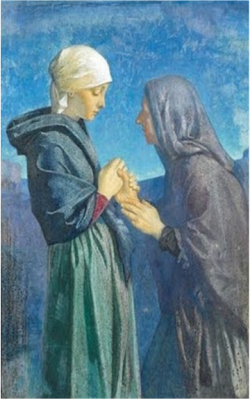
The day of the annunciation, Mary learned that her elderly relative Elizabeth was also miraculously pregnant. Mary had mercy on her and went in haste to help her out. This act of mercy entailed a 90-some-mile journey, a dangerous undertaking for a teenage girl who was carrying the Messiah. Apparently Mary stayed with Elizabeth about three months, cooking, cleaning and keeping house for Elizabeth and her elderly husband.
Then there was the trip to Bethlehem for the census. Mary was not obliged to go. Perhaps she went as an act of mercy performed for Joseph: keeping him company on the way there.
Remember how Jesus as a preteen wandered off and was missing for three days? Considering the agony he put Mary and Joseph through, he surely deserved a memorable punishment. But Mary has mercy and simply asks, “Why have you treated us like this? We have been worried sick.”
Of course, there was the wedding at Cana where the wine ran out. Mary has mercy on the newlyweds and their parents and spares them embarrassment. She prompts Jesus to work a miracle before he was planning to. The result is an abundance of excellent wine.
Today Mary has mercy on us. In every Hail Mary we ask her to pray for us sinners. There is a fictitious story that one day Jesus meets Peter in heaven and asks, “Why are there so many sinners in here? I told you to keep the gates shut for them.” Peter replied, “I did close the gates, but your mother opened the window.” Two devotions to Mary, Mother of Perpetual Help and the more recent Mary, Untier of Knots arose from our confidence in he r love for us that impels her to respond to our requests. We believe that on Calvary, Jesus gave Mary to us as our spiritual mother. She takes her role as our mother very seriously.
Some people prefer going straight to God with requests for help and don’t pray to Mary. What would you say to them?
Year of Mercy, part 4: Jesus Teaches Forgiveness
 We have been the recipients of God’s incredible abundant mercy. Now we are to let mercy flow from us onto others. We are to be the face of God’s compassionate love for others: our family members, friends, and colleagues. Jesus taught us this. When he was criticized for eating with tax collectors and sinners, he said, “Go and learn what this means, ‘I desire mercy, not sacrifice.’ ” Mercy doesn’t judge; it loves.
Jesus also taught, “If you are offering your gift at the altar, and there remember that your brother has something against you, leave your gift there before the altar and go; first be reconciled to your brother, and then come and offer your gift” (Matt. 5:23-24). When Jesus gave us the Our Father as a model for our prayer, he gave us something dangerous: We tell God to forgive us to the extent that we forgive others. That should be motivation enough to be a very forgiving person!
Jesus underscores his teaching on mercy with a parable. In it a master forgives a servant a great deal of money, but that same day the servant beats up and casts into prison a fellow-servant who owes him a pittance. That doesn’t make sense. The servant who experienced mercy should show mercy himself. Likewise, we ought to be merciful since almighty God has forgiven us our offenses against him.
One day Peter asked Jesus how many times we ought to forgive. He thought he was being magnanimous by suggesting seven times. But Jesus countered, “No, seventy times seven.” In other words, endlessly. Another time Jesus said, “If the same person sins against you seven times a day, and turns back to you seven times and says, ‘I repent,’ you must forgive” (Luke 17:4).
Shakespeare understood the beauty of mercy. In the “Merchant of Venice” he has Portia say these words to Shylock:
The quality of mercy is not strain’d, (that is, not forced but freely given)
It droppeth as the gentle rain from heaven
Upon the place beneath: it is twice blest;
It blesseth him that gives and him that takes:
‘Tis mightiest in the mightiest: it becomes
The throned monarch better than his crown.
Mercy means forgiving those who hurt us. Jesus would have us love our enemies and do good to those who persecute us. When someone offends us, our first instinct, our gut reaction, is to retaliate. We find the Old Testament code eye for an eye, tooth for a tooth satisfying. That is why in movies we like to see the bad guys punished or killed in the end. That is also why we were amazed to learn that these people forgave:
• Saint Pope John Paul II forgave his would-be assassin.
• Cardinal Joseph Bernardin forgave the man who falsely accused him of sexual misconduct.
• After a man shot 10 Amish schoolgirls, killing 5, and then shot himself, the Amish community visited his widow, went to his funeral, and raised money for his family.
It’s not enough to say the words “I forgive you.” Forgiveness has to come from the heart. This means bearing no grudge, harboring no anger, and not being obsessed with the offense. As the movie “Frozen” advises, “Let it go!” Someone observed, “Holding a grudge is like drinking poison and expecting the other person to die from it.” Resentment festers and destroys our peace and happiness.
There is a saying “Forgive and forget.” We probably can’t forget, but we don’t have to bring up the hurt later (maybe over and over) or punish the perpetrator. Let bygones be bygones. After all, isn’t that how we hope others would treat us after we’ve harmed them? I’ll always remember with gratitude the neighbor whose car I crashed into. He merely said, “Accidents happen,” and later invited me to lunch.
If true forgiveness seems impossible, especially for those who don’t ask for forgiveness, we can always pray for the grace to forgive.
Can you think of other occasions when someone truly forgave?
Jesus and Women
 I’m interrupting my series on mercy by this blog that is relevant in light of current events. God would certainly support women’s rights. According to Genesis, our God, who is neither male nor female, created women in his own image and likeness. Therefore, they are God’s children who share in God’s divinity. Women are men’s partners and have equal dignity. However, God apparently favors women! When God decided to come to earth as a human being, there were many options. God could have appeared as a grown man, a baby washed up on the shore, or the wealthy son of a king. Instead, the Son of God was conceived by a young village girl by the power of the Holy Spirit. As abolitionist Sojourner Truth pointed out in a speech, “Where did your Christ come from? From God and a woman! Man had nothing to do with him.” God’s mother, the Blessed Virgin Mary, was the first person to hear the news that the Messiah was on his way.
Again, after Jesus rose from the dead with new life, in John’s Gospel it was a woman who first learned of the stupendous miracle. Jesus appeared to Mary Magdalene and told her to relay the good news to his brothers, the apostles. Other Gospels report that not one, but two or more women were the first to encounter the risen Lord.
Jesus ignored the mores that prevailed in first-century Israel regarding women. At that time women along with children were considered property of men, as they still are in some countries. Women were illiterate and not obliged to pray or observe feasts as men did. In the Temple they were confined to the Court of Women. For a man to address a woman in public was unthinkable. Women could not testify in court or ordinarily inherit property. A man could easily divorce his wife for a crime as minor as a badly cooked meal. But the woman was not accorded the same recourse. An unmarried, pregnant woman would be stoned to death, but the man who impregnated her would go scot free.
The way Jesus treated wome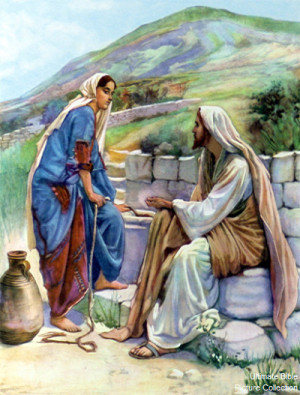 n was unusual, actually radical, for a Jewish man. He spoke to them in public, as he did to the Samaritan woman of ill-repute. He taught women as disciples, as he did for Mary seated at his feet in Martha’s house. He healed them, including the woman with an issue of blood who dared to touch his robe. He brought a twelve-year-old girl back to life. Jesus told a parable about a woman who lost a coin, someone who was a God-figure,
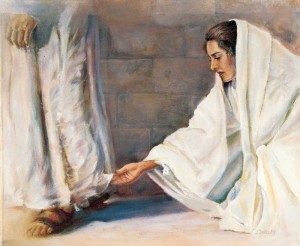 and he praised a widow who donated her few coins in the Temple. Jesus forgave sinful women and even had his mind changed by one desperate Canaanite woman who pleaded for her sick daughter. He showed women respect and love, and the women disciples reciprocated with love. They supported Jesus and the apostles financially and probably cooked their meals as they traveled with them. Women accompanied Jesus to his death on the hill of Calvary, while all but one of the male apostles fled.
May reading and pondering the Gospels, draw women to Jesus and make them modern disciples who, like St. Mary Magdalene, are on fire to spread the good news. And may it persuade men to follow Christ more closely by regarding and treating women as he did.
What woman has played an important role in your life? How?