God Loves You…Unconditionally
Here is a very abridged chapter from my book, A Love Affair with God: Twelve Traits. It’s entitled “Presence.”
When we love a person we long to be with them. Meister Eckhart asserted, “No human being has ever desired anything as much as God desires to be with him or her.” At the Last Supper Jesus said, “I will come again and take you to myself, so that where I am you may be also” (John 14:3). God promised, “Listen! I am standing at the door, knocking; if you hear my voice and open the door, I will come in to you and eat with you.” (Revelation 3:20).
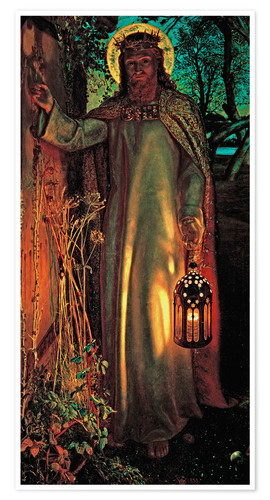
Dining with God is a delightful image of the intimacy you are privileged to experience with your divine Lover. Such intimacy is dependent on being attuned to God’s voice and opening the door of your heart. William Holman Hunt’s painting The Light of the World illustrates this: Jesus knocks at a door that lacks a doorknob and so can only be opened from inside.
It is impossible to avoid God’s presence, albeit a veiled presence. God is present everywhere and at all times. Nicholas of Cusa expressed this attribute geometrically: “God is he whose center is everywhere and whose circumference is nowhere.” The Catechism refers to God as Most High (transcendent) but also Most Near (immanent). (#2581) St. Paul, preached, “In him we live and move and have our being” (Acts 17:28). You are engulfed by God. This means God is there for you 24/7. Here’s a metaphor for God’s ubiquity:
Little fish asks old fish, “Where is the thing called ocean?” Old fish replies, “It is the thing you are in right now.” “But this is just water,” protests the little fish, disappointed; and he swims away.
Scripture limns God’s presence in Psalm 139: “Where can I go from your spirit? Or where can I flee from your presence?/ If I ascend to heaven, you are there; if I make me bed in Sheol (land of the dead), you are there….” You could add: “If I have to work with so-and-so who drives me crazy, you are there.” “If I am being interviewed for a new position, you are there.” “If I am diagnosed with a chronic disease, you are there.” “If my mother dies, you are there.”
God in Creation
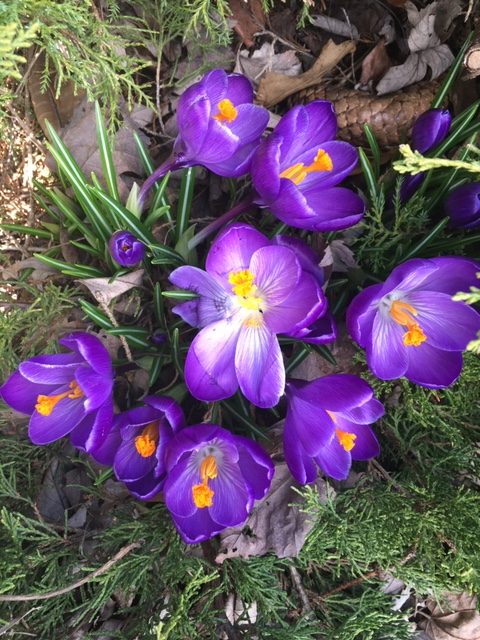
God surrounds you in creation: “Do I not fill heaven and earth?” (Jeremiah 23:24). God has always animated everything from an infinitesimal microbe to a fifteen-ton Tyrannosaurus rex. According to the Gospel of Thomas, Jesus declared, “Split a piece of wood; I am there. Lift up the stone, and you will find me there.” Pope Francis in Laudato Si’ affirmed God’s presence within every created thing:
The creatures of this world no longer appear to us under merely natural guise because the risen One is mysteriously holding them to himself and directing them towards fullness as their end. The very flowers of the field and the birds which his human eyes contemplated and admired are now imbued with his radiant presence. (100)
One poem of Gerald Manley Hopkins begins, “The world is charged with the grandeur of God.” In a letter he elaborated: “All things therefore are charged with love, are charged with God and, if we knew how to touch them, give off sparks and take fire, yield drops and flow, ring and tell of him.”
Teilhard de Chardin agreed: “By means of all created things, without exception, the divine assails us, penetrates us, and molds us. We imagine it as distant and inaccessible, whereas in fact we live steeped in its burning layers.”
St. Catherine of Siena wrote, “What then is not a sanctuary? Where then can I not kneel and pray at a shrine made holy by God’s presence?” And one time when St. Angela of Foligno was overwhelmed by the presence and power of God in everything she saw, she cried out, “The world is pregnant with God!”
Elizabeth Barrett Browning conveys this idea in “Aurora Leigh”:
Earth’s crammed with heaven,
And every common bush afire with God;
And only he who sees takes off his shoes;
The rest sit round it and pluck blackberries.
God’s words to Joshua, he also speaks to you: “Be strong and courageous; do not be frightened or dismayed, for the LORD your God is with you wherever you go” (Joshua 1:9). There is not one second when God is not close, delighting in you and loving you. In fact, God dwells in the depths of your being.
God Alive in You
A teacher asked, “Does God ever take a vacation?” Hilary answered, “Of course. God went with me on my vacation.” She knew that God is within us. A Carmelite website reminds us: “A God is the Divine Guest of my soul, dwelling there day and night, desirous of receiving the unceasing homage of my intimate friendship and of my love!” Blessed John of Ruysbroeck noted, “God is the one who approaches us from the inside out.”
St. Catherine of Siena experienced the truth of the Divine Indwelling. After she was plagued by temptations, somewhat miffed with Jesus, she demanded, “Where were you when I was in such a frightful situation?” He assured, “Daughter, I was in your heart, fortifying you with grace.”
Jesus promised, “Those who love me will keep my word, and my Father will love them, and we will come to them and make our home with them” (John 14:23). He also proposed an image for your vital union with him: a vine and branches. A vine is the source of life for the branches. As long as you are attached to Jesus, the true vine, divine life courses through you. St. Paul wrote, “It is no longer I who live, but Christ who lives in me” (Galatians 2:20). Christ likewise lives in you. You are a walking tabernacle!
You could be acutely aware of God’s abiding presence during exceptional moments as when you are celebrating a an anniversary or when you accomplish something you thought you were incapable of without supernatural help—like driving safely through a blizzard or mastering a computer. Although a woman I know was an introvert, she agreed to deliver the eulogy for a friend’s mother named Louise. Driving to the church, she was filled with dread . . . until she noticed the license plate on the car in front of her: 4LOUISE: a message that God would empower her.
You might be overwhelmed with the knowledge of God’s presence while engaged in a mundane task like folding laundry or doing dishes. Experiences of your divine Lover might bring tears to your eyes.
Divine Constancy
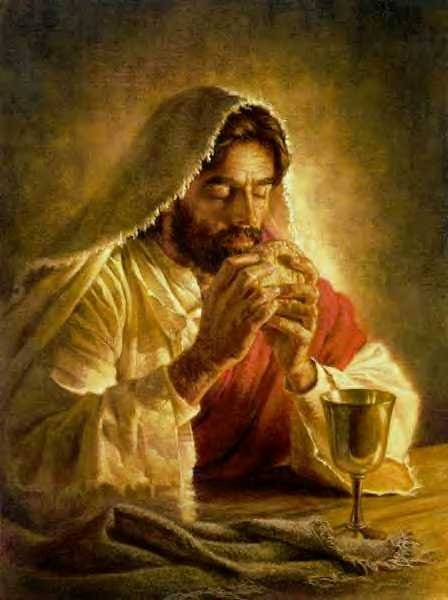
God proves his love by outrageous acts of self-surrender. God became a man so he could love you with a human heart, reveal himself to you, and die to keep you near him for all eternity. The God-Man surrendered to a humiliating, agonizing death. The omnipotent God condescends to assume the forms of bread and wine—small, vulnerable, inanimate things! He is placed on altars, locked in tabernacles, and within our bodies. Such is the folly of God’s love. The the Eucharist is known as the Real Presence.
God aches for you to be with him forever. When you ignore, forget about, or are angry at God—even if you doubt God exists—this steadfast Lover does not jilt you. No, God patiently waits like a parent with unflagging love waits for an obstreperous teenager to grow up. God loves you unconditionally. In God’s eyes, you are never unworthy of his love.
• When have you felt God’s presence in a strong way?
I like this video of the hymn “Yahweh [Lord], You Are Near,” which is based on Psalm 139. It begins with a scene related to the little fish story above. Gorgeous nature scenes follow.
Modern Penance: Lemons into Lemonade

Saints of old practiced what we would consider bizarre penances. St. Thomas More wore a hair shirt under his clothing. In pictures St. Rose of Lima has a crown of roses. She actually wore a thick silver circlet with spikes on the inside (like a crown of thorns). When I entered the convent, we were gradually introduced to a variety of penitential customs the Sisters practiced, which were done away with after Vatican II. The Catholic Church known for centuries for fasting from meat on Friday, lifted this mandate, though some form of penance is still required in remembrance of Christ’s sacrifice for us on that day.
Strangely, when I looked up penance in the comprehensive index of the Catechism of the Catholic Church, it wasn’t there! But ascesis, a synonym, was. However, it has only three brief mentions. Under the section on chastity, it is in a list of means to remain faithful to baptismal promises and resist temptations. (2340) Another place states that “ascesis enhances the mastery of the will over its acts.” (1734) The lengthiest mention is this: “There is no holiness without renunciation and spiritual battle. Spiritual progress entails the ascesis and mortification that gradually lead to living in the peace and joy of the Beatitudes” (2015).
So, since hair shirts have gone out of fashion along with chains and self-flagellation, how do we practice mortification (dying to self) today? As an older Sister, I live a rather comfortable life. I’m not even bound any longer by the strict Lenten fasts. Examining my life, I drew up a list of a few “penances” that are worthy substitutes for the physically harmful ones of the past. You will probably be able to identify with them.
I practice penance when I . . .
• don’t procrastinate
• get out of bed as soon as I wake up (unless it’s 3:30 a.m.!)
• patiently listen to someone tell a story they’ve told umpteenth times before
• am still kind to someone who hurt my feelings

• donate blood
• go outside for a walk every day
• refrain from snacks at night
• unclutter my wardrobe
• make that doctor’s appointment I’ve been putting off
• volunteer for something especially when no one else does
• call a person I’ve been out of touch with for a time
• let someone else tell a story or anecdote when I could have
• smile when I don’t feel like it
The Catechism does have a section on penance. In my opinion, its most valuable sentence is this: “Taking up one’s cross each day and following Jesus is the surest way of penance.” (1435)
It occurred to me that saints who lived centuries ago did not have to deal with the ready-made penances we face today. They didn’t need to learn how to use a computer, post on facebook, or join a zoom meeting. They didn’t have to take a driver’s test or deal with rush-hour traffic. They were even spared getting a vaccination and a colonoscopy!
Recently I edited the book Lucia of Fatima and was reminded that the Angel and Mary exhorted us to do “penance, penance, penance.” So why practice penance or accept “involuntary penances”? Penance gains grace. We grow closer to God, which is the chief benefit of penance. Practicing penances makes us stronger, better able to deal with trials. When penances are offered to God and united with Christ’s suffering on the cross, they make up for sins, ours and others’. When we pray the Morning Offering, this is taken care of: we already give God every moment of the day.
Here’s something to reflect on: What penances did Jesus practice?
• What could you add to my list?
What Did Jesus Look Like?
The other day a few of us were discussing how Jesus looked. Not surprisingly, our opinions differed. He lived 2,000 years ago before cameras were invented. And he was Jewish, which meant that images were forbidden. (The first commandment forbade idols.) Therefore we have no accurate picture of him. This has not stopped people from depicting him. I did some research on Jesus’s appearance, and you might find my discoveries interesting.
What color skin, hair, and eyes did Jesus have? People in his country were like Egyptians. They had olive skin, black hair, and brown eyes. No way would Jesus have been a first-century Brad Pitt. From living outdoors, his skin would have been tanned and weathered.
What was his build? Based on skeletons from his country and era, Jesus was about 5’5″. Because of his job as a carpenter and his many journeys, he must have been lean, muscular, and strong. It’s surmised that if he were handsome, the evangelists would have mentioned it since Moses and David were described this way. Also Jesus apparently had no remarkable features that set him apart from others. That is why in the garden Judas had to kiss Jesus to identify him for the Roman soldiers. And also why he so easily vanished in a crowd several times.
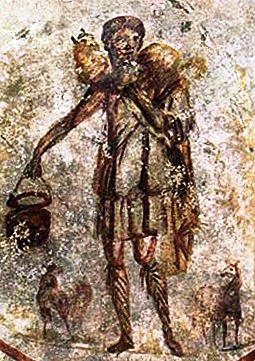
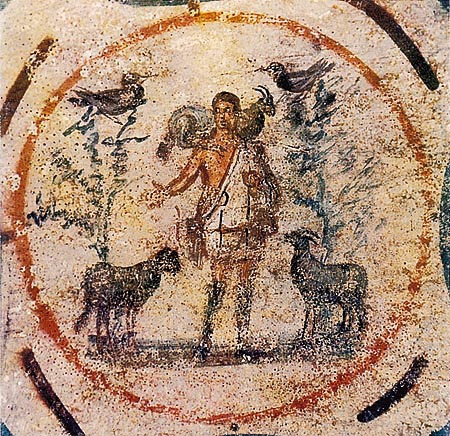
What does Jesus look like in the earliest pictures? Early on Jesus was depicted as a shepherd. One that has come down to us is in the Catacomb of Callistus, dated 3rd century. It shows Jesus with short, curly hair and no beard.
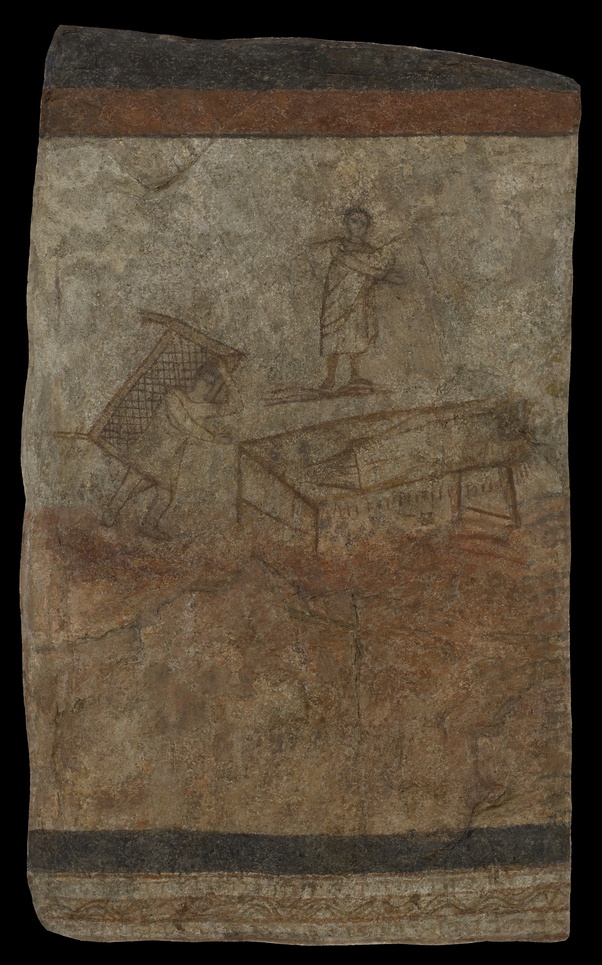
Another early picture from 235 AD is from a church in Syria. It shows the curing of the paralytic. In it Jesus also has short hair and no beard.
People speculate that when Jesus lived, men had short hair and if they had a beard, it was short. They trimmed their hair and beard with a knife. One reason proposed for this shortness was to deter lice. Besides, Paul commented, “Long hair is a dishonor for a man” (1 Corinthians 11:14).
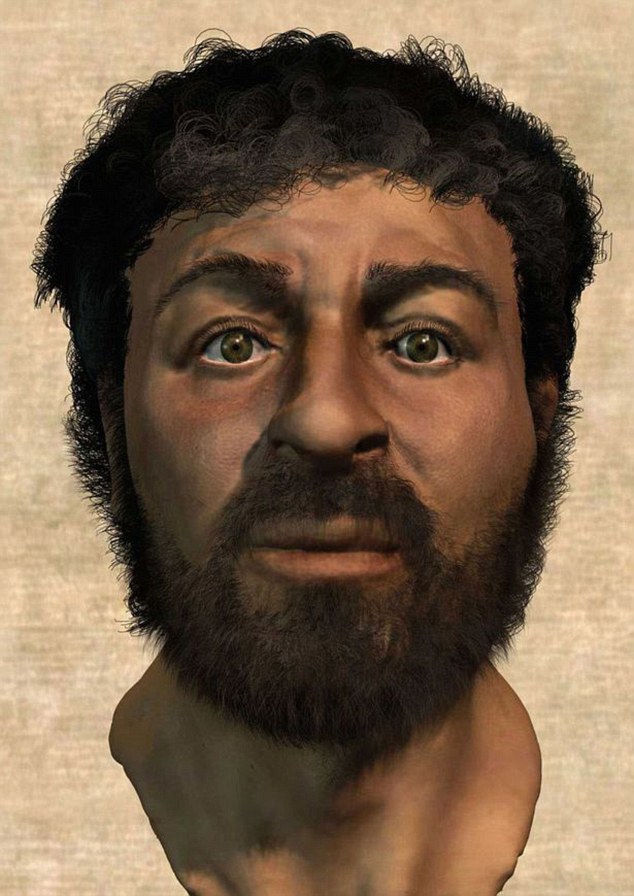
Richard Neave, a forensic anthropologist, used a first-century skull of a Jewish man and in 2001 created an image of Jesus based on it. In it Jesus has black, curly hair, a mustache, and a trim beard as was common for Jewish men at that time.
How did we inherit the concept of a long-haired, bearded Jesus? During the time of the Byzantine Empire, emperors had long hair and full beards (perhaps styled on Zeus). To emphasize the royalty and majesty of Jesus, artists began portraying him this way and enthroned in the late 4th century. This is the “Jesus” that has prevailed since then. The mysterious figure on the Shroud of Turin promotes this image. However there are strong arguments for and against the shroud’s authenticity.
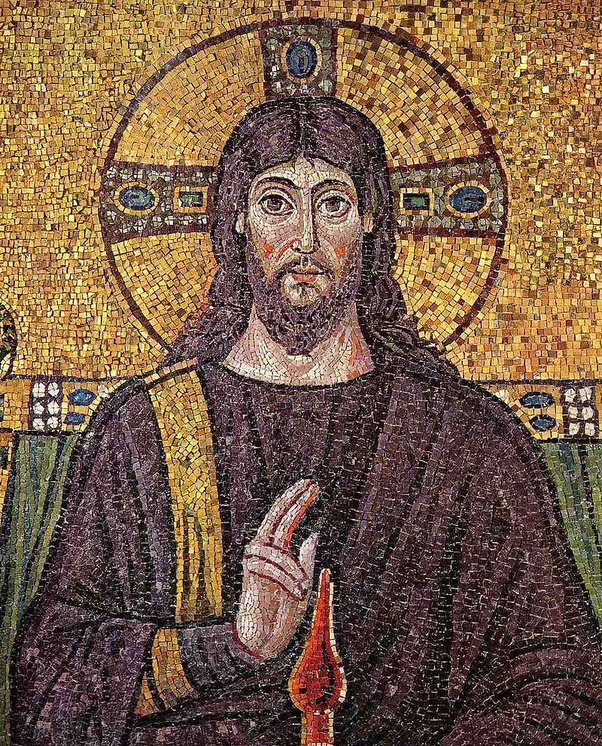
What did Jesus wear? Sandals of course. His tunic was knee-length and he had a long mantle. His clothing was undyed wool, which was cream-colored, not white. He wore the tassels God commanded Jewish men to wear on the four corners of their garmet.
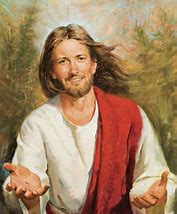
What about his face? The face of Jesus must have been warm and friendly, reflecting his loving, compassionate nature. People flocked to him for cures, and children were not afraid of him.
In a way, not having an exact picture of Jesus is a blessing. Worldwide, people have presented him (and his mother)to reflect their own society, therefore making him easy to identify with. So we have an African Jesus, a Japanese Jesus, and so on.
The important thing is that we recognize Jesus in other people. He looks not only like saints but like our cantankerous neighbor, the black sheep in our family, the homeless person under a bridge, and our personal enemy. We also see Jesus whenever we look in a mirror. Gerard Manley Hopkins acknowledged this in his poem “As Kingfishers Catch Fire” when he said, “Christ plays in ten thousand faces.”
If we treat others and ourselves with loving kindness, someday we will have the privilege of seeing Jesus face-to-face. The mystery will be solved!
- When you pray to Jesus, how do you picture him? What is your favorite depiction of Jesus?
Joy, a Gift from God

One of my most precious memories is pushing my four-year-old nephew in a wheelbarrow on a farm. He was laughing hysterically and this made me laugh. Life is full of joyful moments like that one. Reflecting on them warms the heart. We feel joy when someone does us a favor, when we accomplish a difficult task, when we know we are loved, when we eat a satisfying meal, when we help a person, and when we are in the company of a good friend. Sometimes beholding an awesome feature in nature fills us with joy: a spectacular sunset, a perfect red rose, a fawn asleep on the lawn, ocean waves.
Benedictine Demetrius Dumm defines joy as “a kind of exuberant awareness that all is well; it bubbles up from a deep sense of confidence and peace.” When we are right with God, we know this kind of lasting, deep-down joy. After all, God made us for himself and planned that we have an eternal life of perfect happiness. We get hints of this happiness here below.
Joy is one of the twelve fruits of the Holy Spirit. These spiritual fruits are signs that God is alive in us and working in us. At the last supper Jesus said to his disciples, “I will see you again, and your hearts will rejoice, and no one will take your joy from you” (John 16:22). Some wit explained that when you put nothing O between Jesus (J) and You (Y), you have JOY. In Scripture we pray, “My joy lies in being close to God” (Psalm 73:28). The closer we are to God, the more we will rejoice. Even as we endure the vicissitudes of life that are bound to come, we will still have “confidence and peace.”
One of my favorite Scripture passages is Habakkuk 3:17-18:
Though the fig tree does not bud
and there are no grapes on the vines,
though the olive crop fails
and the fields produce no food,
though there are no sheep in the pen
and no cattle in the stalls,
yet I will rejoice in the Lord,
I will be joyful in God my Savior.
The joy I’m writing about here is not the ephemeral happiness that comes with winning the lottery or owning a hundred pairs of shoes. It is a lasting joy.
Radiating this kind of spiritual joy is one of the best strategies to drawing other people to God. They might wonder what your secret is for being so calm and happy.
Proverbs 17:22 gives this advice: “A joyful heart is good medicine, but a downcast spirit dries up the bones.”
May you always have a joyful heart!
• What experiences have brought you joy?
In case you haven’t heard the song “Don’t Worry, Be Happy” for awhile, here is a foot-tapping, finger-snapping version:
The Sacred Heart Is Not Passe
This Friday is the Feast of the Sacred Heart of Jesus. It fittingly occurs during June, the month dedicated to the Sacred Heart. To some people this title for Jesus smacks of times gone by. On the contrary, the concept of the Sacred Heart is relevant and meaningful.
Take the idea of heart. To us, a heart means the entire person, one’s whole being, the core of oneself, the most important part. We say, “I love you with all my heart,” a “heart-to-heart conversation,” “put your heart into it,” “heartfelt praise,” “the heart of the matter,” and so on. When we refer to the heart of Jesus, we mean his whole person, human and divine. When we say Jesus loves us with his whole heart, we mean with all his being.
The heart is a symbol of love. That’s why we are swamped with hearts on Valentine’s Day and why lovers carve their initials inside a heart. Jesus loves us more than anyone else loves us. My goodness, he sacrificed his life for us! As he said, there’s “no greater love.” It’s no coincidence that as he hung on the cross, it’s his heart that was pierced with a lance.
Such extreme love calls for love in return. When Jesus appeared to St. Margaret Mary and asked her to spread devotion to the Sacred Heart, he said some of the saddest words ever spoken: “Behold this heart that has so loved and is so little loved in return.” Unrequited love is a shame; unrequited divine love is tragic.
Besides being dedicated to the Sacred Heart, I believe June is the most popular month for weddings. This month then is the ideal time to rekindle our love for Jesus. How? We can read the Gospels, accounts of his life, with fresh eyes. We can open our ears to hear him speak personally to our hearts through them. We can spend extra time aware of his ever-present presence and bask in his love. Now that COVID restrictions are lifted, we can participate more fully in the Eucharist, his farewell gift to us where we are nourished by his whole being.

We have an unquenchable thirst for something more. It’s said that our heart is like a puzzle with a piece missing. Only God will complete it. Conversely, the human heart of Jesus can be thought to also be missing a piece: you!
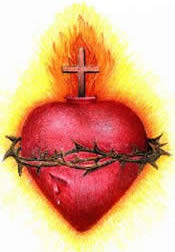
In the artistic rendition of the Sacred Heart, flames fan out from the heart. These symbolize that Jesus is burning with love for us. Would that we were on fire with love for him, a love that impels us to introduce others to him.
• The love someone has for you is a tiny reflection of the immense love Jesus has for you. When have you been blessed with someone’s love? How did it make you feel?