Roses, Mystical Rose, Rosary
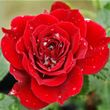 My mother was very proud of her roses. She knew them by name: the American Beauty rose, the John F. Kennedy rose, and so on. When roses were in season, her kitchen table was never without at least one gorgeous rose from her garden gracing it. Roses are the most popular flower. We present them to loved ones as a sign of our love, to the sick, to graduates, and to others who have achieved success. Roses are not only beautiful, but they have a lovely fragrance. For good reason they are known as the queen of flowers. We associate roses with the Blessed Virgin Mary, who is queen of heaven and earth. One of her titles is “Mystical Rose.” In 1947, during appearances at Montichiari, Italy, to Pierina Gilli, Mary asked that we celebrate July 13 in honor of her as mystical rose. St. Bernard wrote, “Eve was a thorn, wounding, bringing death to all. In Mary we see a rose, soothing everybody’s hurts, giving the destiny of salvation back to all.” A rose’s thorns could also stand for her sacrifice in accepting the role of Mother of God.
Clearly our Blessed Mother favors roses too. She appeared to St. Bernadette at Lourdes with a golden rose on each foot. As Our Lady of Guadalupe, the sign she gave St. Juan Diego was a bouquet of roses gathered from a barren hill in winter. (more…)
What Is a Missionary Disciple?
 At the National Catholic Teachers Association convention next year, I will be speaking on prayer. The organizers asked me to rework my talk’s title and description to reflect the theme “missionary disciples.” In doing research, I discovered that Pope Francis used this term in his encyclical “The Joy of the Gospel,” and this year our United States Bishops Conference issued a document called “Living as Missionary Disciples.”
The Gospel for the Twenty-Eighth Sunday of Ordinary Time, October 8, ties in with this theme. It recounts the parable of Jesus about the landowner who expects his workers to produce fruit. Jesus expects us to bear fruit in the form of new members of his Church. Before returning to heaven, he gave his disciples what is known as the Great Commission: “Go therefore and make disciples of all nations, . . . baptizing them . . . and teaching them to obey everything that I have commanded you.” We are the disciples of Jesus. He sends us on this mission to bring other people to know him and love him as we do. A disciple is a learner, an apprentice. We practice living according to the teachings of Jesus.
How do we act as missionary disciples? We needn’t travel and found churches like St. Paul or preach on street corners. However, when we have a chance to talk about or explain our faith, we can grab it in our zeal to share what we have. By our very example of Christian living, we can attract others to Jesus. Our vibrant worship at the Eucharist; our concern for the needy; our respect for people of all nations, races, and religions; our protection of life and creation; and our integrity in the workplace speak volumes. My goal in writing books and giving talks about the Catholic faith is to ignite in others a passion for Jesus Christ. Most likely we won’t know until we reach heaven the far-reaching influence we have had.
Invitation is another strategy of missionary disciples. Why not invite a relative or neighbor to the RCIA sessions, to Mass with you, or to another parish event? My mother returned to the church after her best friend encouraged her to go to confession to Father Garrity—because he wouldn’t yell at her! Let’s hope that at the end of time, when Christ asks us, his people, for the fruit we produced, we can show him a rich harvest.
Do you know a good story about how a person was brought into the Church?
Blessed Virgin Mary, the Color Blue, Tabby Cats, and Tears
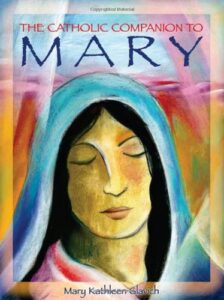 The centennial year of Our Lady of Fatima is coming to a close. Therefore, for today’s blog, I offer a few frivolous facts about Mary. For meatier explanations, see my previous blogs about our Blessed Mother or read one of my bestselling books The Catholic Companion to Mary, which has theology as well as “tidbits” of information. For starters: A candidate for a religious men’s community showed up one morning with blue hair. The novice director inwardly groaned, but then the lad explained, “I dyed it blue in honor of Mary. Today is her feast day.” (more…)
The Dying Words of Saints
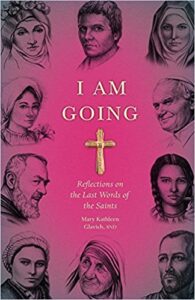 My newest book is out: “I Am Going . . . : Reflections on the Last Words of the Saints” (89 of them!) published by ACTA Publications. It has lovely full-page portraits of 14 of these saints. I thought you might enjoy reading the introduction . . . and be interested enough to purchase the book, which is $12.95! By the way, the intriguing title “I Am Going” is taken from the last words of St. Elizabeth of the Trinity: “I am going to Light, Love, and Life.”
Introduction:
Dying words, especially those of heroes and other famous people, fascinate us. Some last words are common knowledge; we recall them as easily as our home address. Everyone knows (at least from Shakespeare) that as Julius Caesar passed from life in 44 B.C., he asked, “Et tu, Brute?” History students learn that, before his execution, American Revolution hero Nathan Hale valiantly proclaimed, “I wish I had more than one life to give for my country.” More recently, as Steve Jobs, cofounder and CEO of Apple, Inc., left this world, he looked past those gathered around his deathbed, and mysteriously uttered, “Oh, wow! Oh, wow! Oh, wow!”
To us mortals, last words possess a kind of mystical significance. We deem them so important that we even allow condemned prisoners an opportunity to make a final statement. They may express remorse, anger, or gratitude to their families or wardens. They may apologize or steadfastly maintain innocence.
If you type “dying words” on an Internet search engine you will get pages of hits, including these gems:
- Just moments before receiving a fatal gunshot would, during the American Civil War, General John Sedgwick is reported to have remarked, “Why, they couldn’t hit an elephant at this distance.”
- President Grover Cleveland wistfully said, “I have tried so hard to do the right.”
- Some say that comedian Lou Costello’s capped his fun-filled life by commenting, “That was the best ice-cream soda I ever tasted.”
- According to his wife, Beatle George Harrison said, “Love one another.”
- Leonardo da Vinci suppossedly ended life regretfully, saying, “I have offended God and mankind because my work did not reach the quality it should have.”
More meaningful for us than the last words of VIPs are those of our loved ones as they depart for the next world. They might assure us of their love, make a request, or impart some final advice. We tuck their dying words tenderly into our hearts.
Saints are our Church’s heroes and our family, our brothers and sisters in Christ. Because canonized men and women completed their earthly journey successfully, they serve as models. It follows then that their final words are a legacy and a challenge. The greatest saint is Mary, the Mother of God, but unfortunately we do not know her final words. However, the last thing she says in John’s Gospel is good advice: “Do what ever he [Jesus] tells you.” Neither do we have a record of the dying words of Mary’s husband and second greatest saint, Joseph, who doesn’t speak at all in the Gospels.
We are deprived of the last thoughts of other popular saints. St. Madeline Sophie Barat, R.S.C.J., founder of the Society of the Sacred Heart who died in France in 1865, is one of these. Years before her death, she declared, “If God hears my prayers, there will be no last words of mine to repeat, for I shall say nothing at all.” Her words were prophetic because for the last days of her life, paralysis prevented her from speaking. Another French saint, the beloved St. John Vianney (1786–1859), otherwise known as the Curé of Ars, also died peacefully and silently. Perhaps humility kept his tongue in check. Ironically, although the great St. Thomas Aquinas generated an avalanche of written words, apparently no one was able to record his final words. You won’t find St. Benedict’s last words in this book either, although we know he died of a sudden fever. His final gesture though is a powerful statement. Standing in an oratory with arms uplifted after receiving Communion.
On the other hand, the dying words of a number of saints have been preserved, offering us a treasure trove for reflection. As would be expected, the majority of  them died with a prayer on their lips. Some humble saints, as holy as they were, still begged God for mercy. Many martyrs, in imitation of Jesus, forgave their enemies with their dying breath. Some saints delivered a final instruction to those at their deathbed. And a few saints gifted with an irrepressible sense of humor couldn’t resist expiring with a joke, notably the Roman deacon St. Lawrence and the English chancellor St. Thomas More.
I was tempted to include in this book the Jesuit Blessed Miguel Pro’s triumphant “Long live Christ the king!” as he faced the Mexican firing squad with his arms outstretched as on a cross. In the end I decided to focus solely on officially declared saints.
Each entry opens with a brief biography intended to entice readers to become better acquainted with the saint by researching other sources. Then the saint’s last words are quoted, followed by a reflection that zeroes in on some aspect of them. Finally there is a suggestion for taking the words to heart.
For those who would like to follow the liturgical calendar for the saints in this book, an index is provided.
We are unlikely to remember an event the same way as others. This is especially true in the case of a traumatic and emotional death. Our memories are colored by our relationship to the dying person and other factors. The same holds true for the memories of some saints. While most of the dying words quoted in this book have been authenticated, some might be the result of altered or embellished memories. And a few might be the product of what someone thought the saint ought to have said! In any case, I hope you find these pages enlightening and inspiring.
It’s doubtful that the saints planned their dying words. Rather, their final utterances were most likely spontaneous epitomes of their entire lives. We usually don’t think about our own death, much less determine our last words. What would you want your words to be as you exit this world and enter the next?
Do you know other people’s pertinent words on their deathbed?
In Honor of Labor Day and Laborers
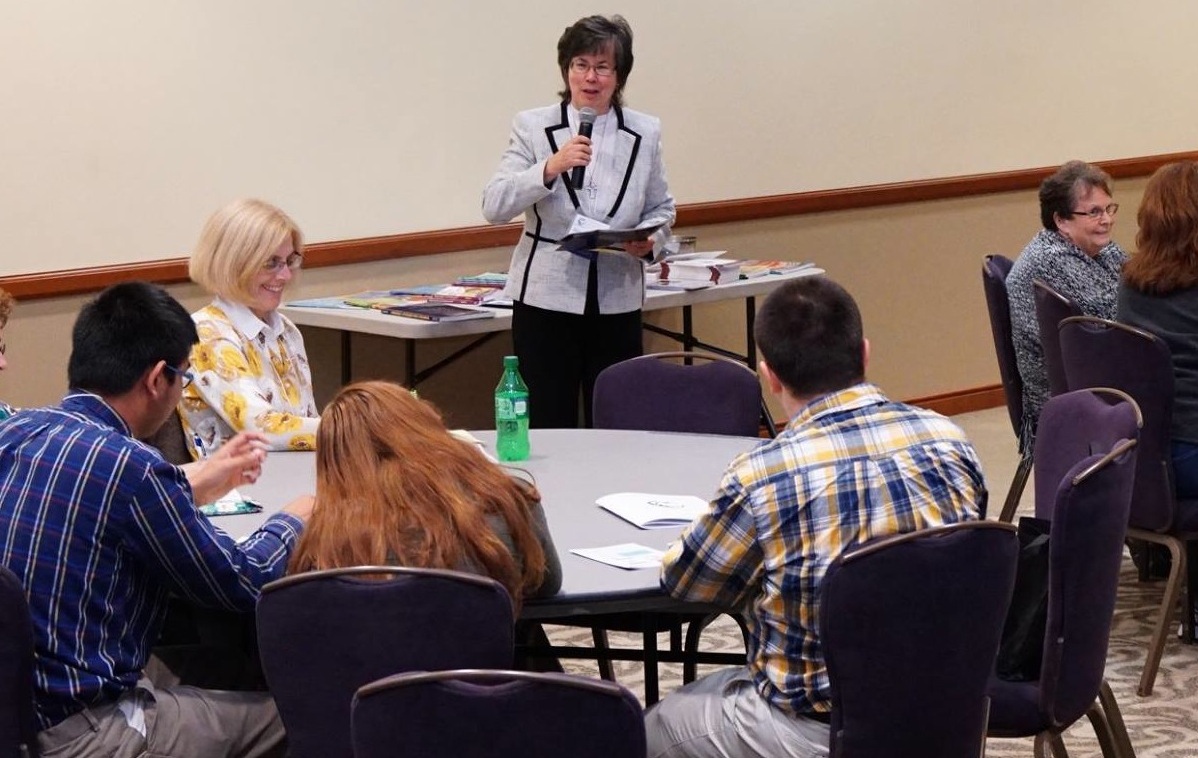
Because I am quite overwhelmed with work these days, I’m resurrecting a previous post. Hope it is new to you or that you have forgotten it! It’s called “Work: Grace in the Daily Grind.” Click on the link here:
https://kathleenglavich.org/2015/02/11/work-grace-in-the-daily-grind/