What Kind of Pearls Do You Search For?
 As a child, I wore necklaces made of pop beads, which resembled pearls but were plastic. Jesus compared the kingdom of God to a real pearl—so valuable that a man trades everything he owns to possess it. This is an apt comparison. Pearls were expensive. Most of them came from the Persian Gulf, where men risked their lives to collect them from oyster beds. A diver, nose clipped closed with turtle shell and ears plugged with wax, sank to the bottom, weighted with a stone. Using fingers protected by leather caps, he filled a basket and then tugged on a rope to signal he was ready to be pulled up. Pearling was the chief industry of the United Arab Emirates until the Japanese invented cultured pearls.
In the time of Jesus, pearls were lovely and mysterious. Pliny, a first-century writer, claimed that pearls rose to the surface and swallowed dew to make them lustrous. It was proposed that lightning striking an oyster produced a pearl. (more…)
How to Find Lost Things and St. Anthony’s Help
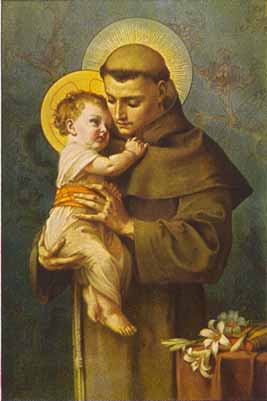 A picture appeared on Facebook showing St. Anthony of Padua saying “Seriously? You lost them again?” As the patron of lost things, this saint is possibly the one most prayed to other than our Blessed Mother. How did he acquire this reputation? According to a legend, St. Anthony, as the novice director for the Franciscans, taught the novices about the psalms. His book of psalms was marked with his class notes. One day a novice decided to leave the community and took with him St. Anthony’s psalter. Naturally, St. Anthony was distressed and prayed for the return of the novice and his valuable book. The novice came back, repentant, and returned the psalter.
To retrieve lost items, people resort to various customs. A friend (Sister Jeanne Mary Nieminen) always prays the Creed. Others turn to a deceased parent. Our Muslim brothers and sisters go directly to God as in this lovely prayer:
O Allah, the One who returns the lost, by Your power and awe return what I have lost, for surely I have received it as Your gift and favor (boon). (Hisnul Hasin)
Prayers are in order for “lost” things other than keys, books, and important papers: a person who is lost physically or spiritually (a lost sheep), a lost job, a lost pet, a lost sense of God’s presence, and so forth.
A time-honored practice is to appeal to St. Anthony, known as the Wonderworker, with this jingle:
St. Anthony, St. Anthony,
Please come down.
Something is lost
And can’t be found.
Those who are on a more familiar basis with the saint might pray this:
Tony, Tony, look around.
Something’s lost that now must be found.
Here is a longer prayer to St. Anthony:
Saint Anthony, perfect imitator of Jesus, who received from God the special power of restoring lost things, grant that I may find (mention your petition) which has been lost. As least restore to me peace and tranquility of mind, the loss of which has afflicted me even more than my material loss. To this favor I ask another of you: that I may always remain in possession of the true good that is God. Let me rather lose all things than lose God, my supreme good. Let me never suffer the loss of my greatest treasure, eternal life with God. Amen.
Furthermore, it’s only good etiquette to thank the saint for his help. One practice for showing your gratitude is to donate food to the poor. This custom is known as giving St. Anthony’s Bread. Otherwise, or in addition, we can pray this prayer:
Most loving protector, St. Anthony, what gift can I give you in exchange to show my heartfelt gratitude? With your continued help I will show appreciation to you by being more faithful to God, more constant in prayer, and readier to do good to those nearest me. I praise you for the esteem in which your name is held throughout the world, for the miracles and wonders with which you have filled the Church, and for the many benefits mankind continues to receive through your gracious help. May these intentions convey my great thanks to the triune God, Father, Son, and Holy Ghost, and to our Blessed Lady, Queen of heaven and earth.
Our Father, Hail Mary, Glory Be…
Of course, one of the best strategies to find a lost item is to get up and look for it. I used to advise my students, “Look under your bed.”
St. Anthony is also the patron saint of travelers, so if you are waiting for a loved one to return home—for example, from military service, or a business trip, or college—you might keep an image of St. Anthony in your house and pray to him daily that your loved one returns home safely. You could give that person a blessed medal or statue of St. Anthony to take with them.
Images of St. Anthony are full of symbolism. A lily stands for his purity and innocence. A child is usually with him whose presence is explained by a legend. Purportedly, a Count Tiso had provided a hermitage for the friar where Anthony often prayed. One night, Jesus appeared to Anthony in the form of a child there, and the cell filled with light. Passing by the hermitage, the count saw the light and discovered St. Anthony holding and communicating with the infant. Sometimes a book is included, indicating that St. Anthony, known for his preaching, was declared a Doctor of the Church, an expert in theology.
When have you found a lost article? What strategy did you use to get it back?
P.S. Tomorrow I leave for Chicago, and I couldn’t find my little camera. After searching the house for two days, as I opened a drawer I had already looked in, I said,”St. Anthony, I just wrote a blog about you. Please help.” Just like that, there was my camera in the back of the drawer!
Jumpstarting Your Prayer Life
 This chapter (abridged) called “Priming the Pump” from my book “Praying on Empty” was reprinted in a daily devotional . . .
Grant, O our God, that we may know you, love you, and rejoice in you; and if in this life we cannot do these things fully, grant that we may at the least progress in them from day to day, for Christ’s sake. Amen. ~ St. Anselm
My family used to spend weekends on land my father purchased in the country. Next to the house, Dad had dug a well that operated with a hand pump. Each week when we arrived, one of the first things he did was to pour a little water down the well. This “priming the pump” caused water to flow when we needed it. Similarly, there are “priming” acts you can try in order to fill your parched, empty soul and slake your thirst for God. (Remember, however, that your dryness might be a gift from God and out of your control.)
Start right.
In the convent our morning meditation together in the chapel began with the exhortation “Recall the presence of God.” This was wise advice. Before praying be conscious of the fact that you are coming before almighty God. He is there with you, gazing on you and loving you. Make the deliberate intention to pray. Some people find that taking a few deep breaths before praying settles them and helps them to focus on God. Visualization is a powerful tool. If you will be praying to Jesus or Mary, picture them standing or sitting before you.
Go to Scripture.
“Dust on the Bible, draught in the heart.” Scripture puts us in touch with God. We believe that Scripture is God’s Word. Hebrews 4:12 describes it as “living and active.” And Wilfrid Stinissen noted, “As a rocket fires off a spaceship into space, so the Word can propel us into God’s endlessness.” Through the Bible, God speaks to us personally. Several times when I was upset, I opened the Bible to a random page, hoping for comfort from God. He didn’t disappoint. One day through Isaiah 43:2, God told me that when I passed through water he would be with me and I would not drown and when I walked through fire I would not be burned. Scripture proved to be what St. Gregory called it—“a melody in the night.” Someone quipped, “A Bible that is falling apart usually belongs to someone who isn’t.”
Reach God through his creation.
Beholding the moon and stars at night made the composer of Psalm 8 aware of God’s majesty and burst forth in praise. A gorgeous nature scene that moves us deeply and causes joy to bubble up within us can lift our hearts to God. Research shows that just looking at a nature scene through a window or in a picture promotes healing and is good for the brain!
So walk through a park in autumn when fire-colored leaves crunch underfoot and fall all around you, and the air is crisp and bracing. Go for a ride in the country in the springtime, when flowers in myriad colors carpet the ground anew. Watch snow gently drift down or be mesmerized by the waves breaking on the shore. View a magnificent sunrise, sunset, or meteor shower. Visit a zoo! Creation is a reflection of God and an expression of his love.
Light a candle.
The calm, steady flame of a candle creates a peaceful ambience. Lighting a candle, especially a scented one, can gently make us aware of God enveloping us with his loving presence. The flame always points upward, even when the candle is tipped, reminding us to center on God.
The qualities of fire can send your thoughts Godward. Fire resembles God in its power, beauty, and mystery and in its ability to purify, strengthen, and warm. The sun, a ball of fire, is life giving, like God. Fire gives light, dispelling darkness, and light is one of the foremost images for our invisible God. Right after the Jewish Festival of Lights, Jesus called himself the light of the world, offering it the light of life.
As you light one or more candles, you might pray,
God of unapproachable light, break through my darkness.
Let the warmth of your love thaw my cold heart.
Purify me of all sin.
Enlighten my mind to know you and to see the path leading to you.
Enflame me with love for you and fill me with hope and courage. Amen.
~ Mary Kathleen Glavich, S.N.D.
Listen to music.
As a high school teacher, whenever I was blue, I listened to the opening of Richard Strauss’s “Sprach Zarathustra” as in 2001: Space Odyssey. This stirring music never failed to lift my spirits. Music has power to move our hearts. You might listen to your favorite classical pieces, popular songs like “Chariots of Fire,” or Christian songs that might inspire your heart to sing again. Sing along with such songs or sing solo. You might imitate one of our older Sisters. When she was alone in chapel, she sang popular love songs to Jesus!
Look at a picture.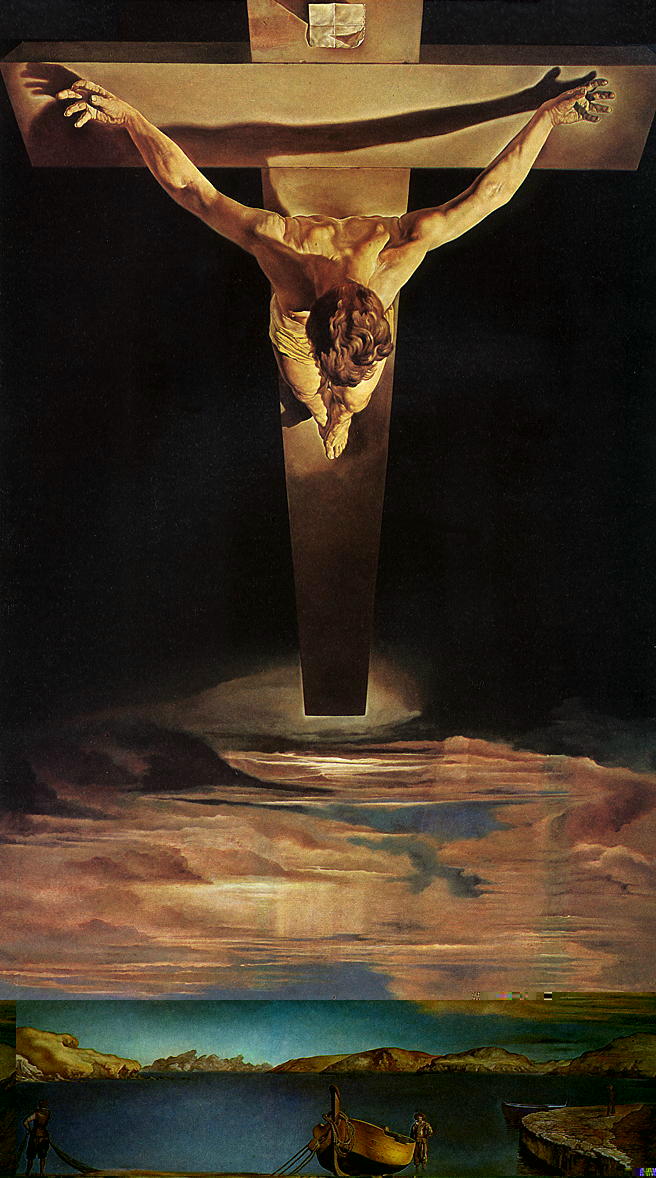
Gazing at a religious picture or photos might elicit fervent prayer. One of my favorites is Salvador Dali’s “Christ of St. John of the Cross.” It depicts Jesus on the cross suspended over a sea and fishing boats. In the Holy Land, one morning I arose early enough to take a picture of sunrise over the Sea of Galilee. A beam of light from the sun appears to glide across the water directly to the person viewing the picture. (See the shot at the top of this website.) This image aids my prayer. Placing before you a picture of the person or intention you are praying for is also a way to keep your mind locked into your prayer.
Pray prayers that formerly touched your heart.
Prayers or devotions that you once loved to pray might jolt you into being aware again of God looking at you, listening to you, and speaking to you.
Draw on past blessings.
God told the Israelites to remember his saving deeds. Scan your memories to find times when God made his presence felt. For instance, one day as I gazed out of the window of a plane, I saw a miniature shadow of it riding over the clouds and encircled by a rainbow, what’s called a pilot’s halo. On another flight, when I wished to spot one again. I did—one with three rainbows around the plane! Surely you’ve experienced things that likely were attributed to God’s action— courtesies of God or “lovebursts” or God winking at you. Keep a record of them. Otherwise you might forget them or dismiss them, thinking, “Oh, I must have imagined or dreamed that.”
Change how you pray.
There is a whole smorgasbord of prayer forms: lectio divina (sacred reading), guided meditation, the rosary, hymns, the labyrinth, centering prayer, not to mention traditional prayers and prayers composed by people. If you are unfamiliar with these, consult a book on prayer, such as my The Catholic Way to Pray (Twenty-Third Publications). Let the principle “Pray as you can, not as you can’t” be your guide.
Change how you pray your usual prayers. For example, for the rosary substitute mysteries you create such as miracle mysteries or parable mysteries. Or for your meditation, use a devotional book.
Join a prayer group. The faith of others might bolster yours. Or pray before the Blessed Sacrament. Pray out loud or while kneeling, prostrating, walking, or dancing! Try praying at a different time or place.
*****
Hopefully one of these tips will enable you to turn the page and begin the next chapter in the story of your spiritual adventure.
Which of these tips have you found useful in refreshing your prayer life?
Trusting in the Lord for Miracles
 Saturday’s first reading at Mass included the angel’s words to Abraham about Sarah becoming pregnant at the age of ninety: “Is anything too marvelous for the Lord to do?” This is echoed by the angel Gabriel when he tells Mary that the elderly Elizabeth will bear a son: “For nothing will be impossible with God.” Relying on the truth of those statements, I’m venturing into a new project: marketing my books—more than eighty of them. One by one they are going out of print before the world has read them, or even know they exist! Nowadays marketing is done via social media, which to me is complicated and overwhelming. Hence the need for a miracle. In addition, ideas I’ve proposed have been blocked, so much so that I commented, “I keep running into a brick wall.” I was on the verge of giving up marketing. But then, last week on the first evening of my annual retreat, I began reading a book (on being happy). Not once but twice it advised that when you run into a brick wall, throw your knapsack over it! I took this as a message from God. So what is happening? (more…)
Who Is Jesus in the Gospel of John?
 I’ve just completed a week-long retreat on the Gospel of St. John packed with insights about this “maverick” account of the life of Jesus. I thought I’d share some of what I gleaned from the conferences. As background, the Gospels of Matthew, Mark, and Luke were composed rather early. John’s Gospel took shape much later after the Church had time to reflect on Jesus (with the help of the Holy Spirit) and when Christians were not regarded as a Jewish sect that still worshiped in the Temple but as a new and highly suspect religion in the eyes of Jewish leaders. That being said, here are ten insights.
- The poetic prologue (which we used to pray after Mass when I was a little girl) immediately identifies Jesus as God. The opening verses, “In the beginning was the Word and the Word was with God, and the Word was God. . . . All things came to be through him” echo Genesis, whose first words are “In the beginning” and which goes on to tell how merely by words (“Let there be …”) God created the universe.
- The prologue introduces the themes that are woven through this Gospel: Jesus brings life. He is light in our darkness. Some reject him, while others accept him and enter into the intimacy that he has with the father: They become “children.”
- God became man. There was no advantage for him in doing this. He did it to reveal himself to us. Jesus proclaimed, “The Father and I are one” (John 10:30) and “Whoever has seen me has seen the Father” (John 14:9).
- At the time this Gospel was written, there was still tension between the disciples of John the Baptist and those of Jesus. The evangelist makes an effort to show Jesus, not John, is the Messiah.
- Jesus brings abundance: about 180 gallons of wine at the wedding of Cana, bread and fish sufficient for more than 5,000 people–and with twelve baskets of leftovers, the promise to the Samaritan woman of living water that quenches thirst forever.
- That people come to the light gradually is shown by the increasingly important titles they give Jesus. The Samaritan woman calls him sir, a prophet, then Messiah. The man born blind calls him the man, a prophet, sir, and then Lord.
- Multiple times Jesus refers to himself as “I am” (in Greek, ego eimi). This is the personal name God revealed to Moses at the burning bush. When Jesus
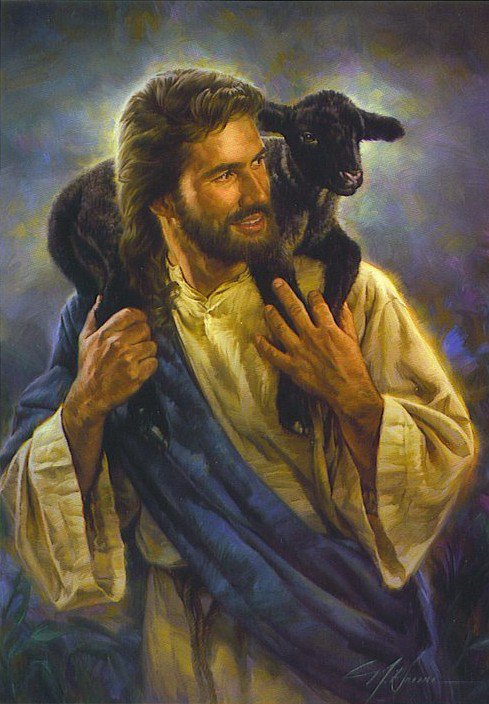
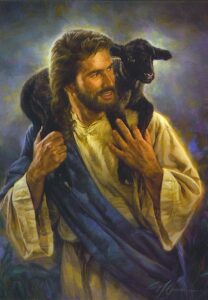 walks on water, he identifies himself: It is I, or I am. He also says, “I am the bread of life. I am the light of the world. I am the resurrection and the life. I am the good shepherd. I am the gate for the sheep. I am the true vine.” He says, “If you do not believe that I AM, you will die in your sins.” He predicts, “When you lift up the Son of Man, then you will realize that I AM.” He exclaims, “Before Abraham came to be, I AM.” Before his betrayal, he explains, “I’m telling you before it happens, so that when it happens, you may believe that I AM.” When soldiers in the garden say they are looking for Jesus of Nazareth, he replies, “I AM.”
 - The first part of the Gospel of John comprises seven signs. These all demonstrate that Jesus brings us eternal life and in abundance.
- John’s Gospel does not include the institution of the Eucharist at the Last Supper. Instead Jesus speaks about it at length immediately after the multiplication of the loaves and fish. The Gospel is unique in presenting Jesus washing the feet of the apostles.
- In the Gospels of Matthew, Mark, and Luke, during the arrest and crucifixion of Jesus, his human nature predominates. He is meek like a lamb, silent, passive, forsaken by all. But in John’s Gospel, Jesus is in command. He is assertive and in charge from the moment in the garden when the soldiers fall to the ground at his voice. It’s Pilate who is on trial. The death of Jesus is a victory.
This is just a taste of the meanings underlying John’s Gospel. You might open your Bible to this Gospel, read it slowly and thoughtfully, and refer to the footnotes. John sates that he wrote so that you may believe that Jesus is the Messiah, the Son of God, and that through this belief you may have life in his name. That is, eternal life, which we already experience.
What event in the Gospel of John speaks most poignantly to you?
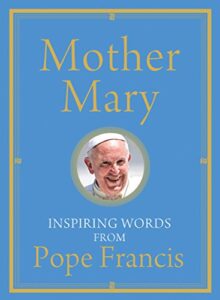 BOOK REVIEW: Mother Mary: Inspiring Words from Pope Francis, edited by Alicia Von Stamwitz, Franciscan Media, $22.99
Anyone who loves Mary and anyone who loves Pope Francis will love this book. It is a collection of this Pope’s reflections about the Blessed Virgin gleaned from his writings, homilies, speeches, and even tweets. His love and admiration for Mary is obvious. The reflections are neatly filed according to six topics: Handmaid of the Lord, Model of Faith, Mother of Mercy, Our Refuge and Our Hope, Star of the New Evangelization, and Queen of Peace. They may, however, be read by dipping into the book at random. Each reflection is labeled with the date and the occasion the Pope gave it.
The selections focus on Mary’s yes to God and yes to her brothers and sisters, Mary as a model for us, and Mary’s tender love and protection of us. Many of the concepts are easily applicable to everyday life, and some of them are quite relevant to today’s world, in particular, the reflections on peace.
In the Holy Father’s inimitable way, he poses unique titles for Mary. In discussing the Annunciation, he refers to her as “this little girl” and “mother and daughter of Jesus.” Later, he calls her our mamma. Other times he names her an icon of faith, the mirror of the Trinity, the virgin of readiness, and the mother of help.
The little book ends with a bonus: nine original prayers to Mary composed by Pope Francis. To me the most powerful prayer is the first one, “Mother of Silence.” In it we pray, “Save us from the idolatry of the present time, to which those who forget are condemned. . . . Help us to burn away the sadness, impatience, and rigidity of those who do not know what it means to belong. “
Reading this book deepens one’s understanding and appreciation of our Blessed Mother and her God-appointed role in salvation. It also encourages and inspires the reader to imitate her. More important, it fosters a love of this extraordinary woman who is God’s mother and ours.