An Eclipse: Raising Eyes to the Heavens
 On August 21, the eyes of the world were on the skies, hoping to catch a glimpse of the solar eclipse. Thousands gathered to witness the stunning event and celebrate. Lucky were those whose view was not blocked by clouds! The sun’s corona, the diamonds, the ring were awesome. The phenomenon made me think of the astronomer’s psalm: “When I look at your heavens, the work of your fingers, the moon and the stars that you have established; what are human beings that you are mindful of them, mortals that you care for them?” (Psalm 8:3–4) The beauty of the eclipse and of the universe captured in photos makes the heart swell and lifts our minds to the mighty God whose wisdom created all this wonder. We’ve seen our planet like a white and blue jewel in pictures shot by astronauts. We’ve seen other planets invisible to the naked eye spinning in all their glory. We’ve even seen galaxies, one looking mysteriously like the eye of God. No wonder the psalmist concludes his psalm by exclaiming, “O Lord, our Sovereign, how majestic is your name in all the earth!” (Psalm 8:9) (more…)
Holy Places and Memories
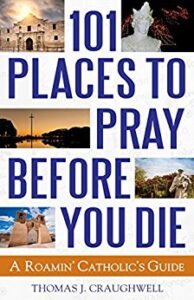 This week I have to agree with the movie title “It’s a Mad, Mad, Mad, Mad World.” How do we cope with the anxiety and the frustration brought on by world events? We might take refuge in one of the lovely Catholic sanctuaries our country boasts, breathe deeply, relax, and pray to the God in whose hands we are. If you need help locating such a place, the following book makes an excellent resource for you . . .
101 Places to Pray Before You Die: A Roamin’ Catholic’s Guide Thomas J. Craughwell
Franciscan Media, $18.99
In more ways than one, this book is a unique, fascinating read. A virtual tour of the United States, it is a handbook of sacred sites for every state: churches, shrines, missions, abbeys, retreat centers, museums, and hallowed grounds. The sites range from famous buildings like St. Patrick’s Cathedral in New York to obscure ones like the Convent of St. Birgitta, which at one time was supported by Anne Morrow Lindbergh.
There are surprising entries, like the East Room of the White House where John Kennedy was laid out, the farm in Georgia where Flannery O’Connor lived, and the John and Mabel Ringling Museum of Art in Florida, where four Ruben paintings in honor of the Blessed Sacrament hang.
All of the places are described in detail: their architecture, furnishings, statues, stained glass windows, paintings, grounds, and treasures, such as the skeletons of two Roman martyrs St. Martin of Tours Church houses and the rare medieval manuscripts found in the library of Mount Angel Abbey in Oregon.
A fair bit of American history is gleaned from the pages of this book. Readers will discover historical tidbits: the first shrine to Our Lady in the United States (Our Lady of La Leche in St. Augustine, Florida); the Great Elm monument in Boston in memory of Ann Glover, hanged for being a Catholic when Philadelphia was the only state where Catholicism was allowed; St. Augustine Seminary in St. Louis, Mississippi, the first to train African Americans for the priesthood; and Our Lady’s appearance to Adele Brise in Wisconsin, the only apparition in the United States declared authentic.
The descriptions of the sites often entail a short biography of notable Catholics, such as St. Damien, St. Kateri, Fr. Emil Kapaun, Venerable Henriette Delille, Michigan’s valiant priests Fr. Gabriel Richard and Venerable Fredric Baraga, Anton Dvořák, and Danny Thomas.
Anecdotes hold the reader’s attention. For example, after John Adams visited Old Saint Mary’s Church in Philadelphia, he wrote his wife Abigail: “Here is everything that can lay hold of eye, ear and imagination. . . . I wonder how Luther ever broke the spell.”
The book also introduces several Catholic devotions, such as the Virgin of the Poor, Our Lady of La Vang, and the Holy Child of Atocha.
A practical travel guide, the book begins each entry with the site’s address, phone number, and website address and concludes with practical information, such as the times and seasons the site is open and even the price of retreats; the sacraments and devotions found there, and whether guided tours are available.
The reader will probably first look up the entries for his or her own state and then either dip into this book at random or read it straight through. No doubt, the book will awaken a desire to visit many, if not all, of the sites described.
Where is your favorite holy spot to soothe your soul and connect with God?
In Honor of the Assumption of Mary
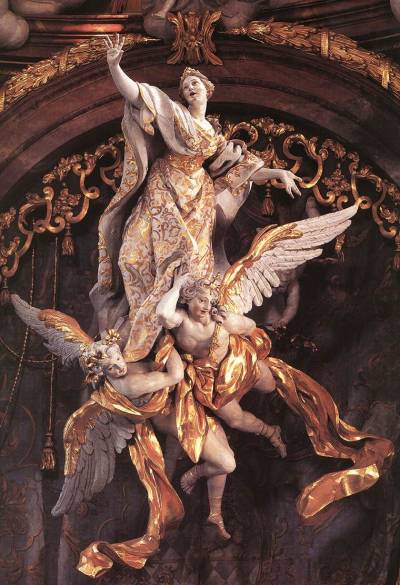 Because this week we celebrate Mary’s Assumption into heaven, I thought it fitting that this blog be the introduction from my book The Catholic Companion to Mary. Hope you enjoy it! . . . In Amy Tan’s novel The Joy Luck Club, four young women, who are estranged from their mothers to varying degrees, come to understand them after hearing the stories of their lives back in China. This new knowledge lets the girls really see their mothers for the first time and leads to deeper relationships with them. Mary, the mother of Jesus, the Mother of God, was given to us by him as a gift when he was hanging on the cross, looking down on her and St. John the apostle. He told John (who stood for all of us), “Behold your Mother.”
This heavenly mother of ours is even more of a mystery to us than Tan’s Chinese mothers were to their daughters. Twenty centuries stretch between her life on earth and ours. Because Mary’s culture didn’t approve of making images, we have no contemporary paintings or statues of her. She didn’t leave anything in writing, and what was written about her in her century is sparse—a few passages in the Gospels. (more…)
What’s a Sister or Nun Today?
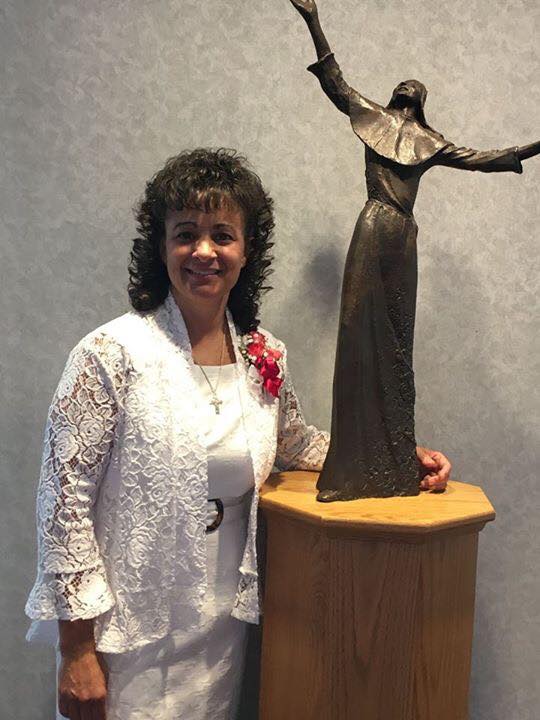
Yesterday about four hundred people gathered in our provincial house chapel to witness the final, perpetual vows of Sister Mary Kelley Rush. It was a glorious (and long) celebration of Mass. Today when religious Sisters are few and far between some people, even Catholics, don’t know one. Neither do they know about Sisters. Several times I’ve heard the comment, “When the church allows women to be priests, you sisters will be able to be priests.” Wrong! A consecrated religious woman and an ordained priest are two different species. (I have no desire to be a priest.) A Sister is called by God to offer her whole life to him. She follows Jesus and imitates him usually by making the three vows of poverty, chastity, and obedience. She belongs to a particular congregation founded for a certain purpose and marked by a charism, that is, a special gift for the benefit of the whole Church. Congregations can be devoted to social action, promoting life, giving retreats, missionary work, or publishing. Others focus on the traditional ministries of teaching and nursing. We Sisters of Notre Dame, who trace our roots back to the French revolution when the Church was being snuffed out, were founded to catechize, especially poor children.
The life of a Sister is rather unique, because she belongs to a large family of like-minded women, who support one another financially, emotionally, and spiritually. Usually a Sister lives in a community of two or more, although she may live alone for the sake of her ministry or health. In the latter case, she still is in contact with her Sisters by belonging to a group of them who pray and celebrate feasts together regularly.
A Sister prays a lot— for the world, her family and friends, and the Church. As a Sister of Notre Dame, every day I go to Mass; pray the Rosary; meditate; pray Morning, Midday, Evening, and Night Prayer from the Prayer of Christians; make an examination of conscience, and read from a spiritual book.
Mary, the Mother of God, is the patroness of our congregation, and inside the silver band of our “wedding” ring are the words “All for Jesus through Mary” engraved in French.
An advantage of working for the Church and the world as a member of a congregation is that you have much more power. Synergy is at work (when 2 + 2 is greater than 5). For one thing, we SNDs have taken corporate stands for pure, accessible water and against human trafficking.
We Sisters are sometimes referred to as nuns. Strictly speaking, we are not. Nuns are consecrated women who live in a cloister apart from “the world.” Sisters, on the other hand, are activity engaged with the outside world. In our case, we strive to proclaim to others God’s goodness and provident care.
Sisters wear something distinctive to indicate they are a member of their community. SNDs all over the world wear the same crucifix. As for the habit, there are good reasons to wear it or not. We are free to decide what we will do.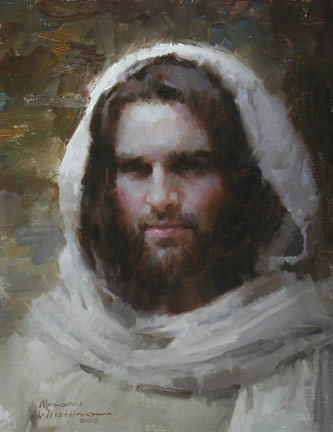
Before a Sister makes final vows, she goes through a formation process that is much longer than the typical engagement period of a married couple. After entering the convent, she may be a candidate and spend time discerning her vocation. She may become a postulant (someone who “asks” to join). Then usually two years as a novice follows, culminating in the profession of temporary vows. The period living under temporary vows lasts at least five years. Then the Sister makes perpetual vows.
The male counterpart of a Sister is a Brother. He too makes vows and belongs to a congregation but is not an ordained priest. Some communities comprise both priests and brothers.
Sisters are not saints, but saints in the making. We have our faults and fight temptations like anyone else. We try to be true to the vocation God has called us to, aware that it is not a better lifestyle than others, but different. All of us children of God are on our journey back to him and depend on grace to see us safely home. We are just in separate lanes.
What Sister has had a positive impact on your life?
Charity by Accepting Charity
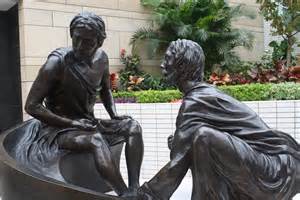 Did you ever offer to help someone who firmly rejected your offer to help? If so, how did you feel? Conversely, how did you feel when you were able to be of assistance to someone? Maybe you helped a person carry a load or cook a meal or drive somewhere. No doubt this act of charity warmed your heart, made you happy, and perhaps let you feel a bit proud! When we accept someone’s offer to help us, we cause these same positive feelings in them. This is an act of charity. However, being strong, independent Americans, we tend to reject other people’s offers of help. We say, “No, thank you,” or “I can manage, thank you.” By doing this, we deprive them of their chance to do a good deed. We are like Peter who protested to Jesus at the Last Supper, “You will never wash my feet!” (more…)